Show summary Hide summary
- How a grain-sized rock rewrites ancient oceans
- The surprising richness before a mass extinction
- X‑ray vision: the technological leap in paleontology
- Hidden diversity and underestimated ancient oceans
- What this means for evolution and future research
- Next steps: scanning the overlooked rock archive
- What makes these radiolarian fossils so special?
- How do these fossils change our view of the Ordovician mass extinction?
- Why is synchrotron scanning a breakthrough for paleontology?
- What does this tell us about hidden fossil diversity?
- How is this research relevant to modern oceans?
- FAQ
- What can ordovician radiolarian fossils tell us about ancient ocean ecosystems?
- Why are discoveries of new species in ordovician radiolarian fossils significant?
- How do scientists identify different species in such tiny fossil samples?
- What role did radiolarians play in the Ordovician oceans?
- How do ordovician radiolarian fossils help us understand mass extinctions?
You hold a rock chip half the size of rice. Inside, entire worlds of life appear: 20 micro-creatures from ancient oceans, thriving just before a catastrophic mass extinction. What else has Earth been hiding in plain sight? sea monsters that took over after Earth’s greatest extinction
How a grain-sized rock rewrites ancient oceans
In the Sichuan basin of China, researchers sliced a tiny pellet from a 445‑million‑year‑old rock, dating to the Late Ordovician. This interval sits immediately preceding the second-biggest extinction in the last 500 million years.
Inside that miniature fragment, they uncovered 20 exquisitely preserved fossils of radiolarians, single‑celled plankton that build silica skeletons. These tiny architects still drift through today’s seas, linking modern evolution to deep time.
A supervolcano almost erased humans 74,000 years ago—what we did to survive shocked scientists
Pirouetting and gaping: What scientists just saw as humpback migration begins—and why it’s causing serious debate
Twenty lives, eight species, one new to science
The team, led by Jonathan Aitchison at the University of Queensland, identified eight distinct radiolarian species from that single pellet. The sample spans five genera, four families and three higher orders, all captured in a volume smaller than a pinhead.
Among them, they recognised a completely unknown species, christened Haplotaeniatum wufengensis. Naming a new organism from such a modest pebble underlines how much paleontology still has to reveal about pre‑extinction seas.
These observations echo other discoveries where tiny archives reshaped big stories, such as a minuscule fossil claw that transformed ideas about spider origins. Small clues, big consequences.
The surprising richness before a mass extinction
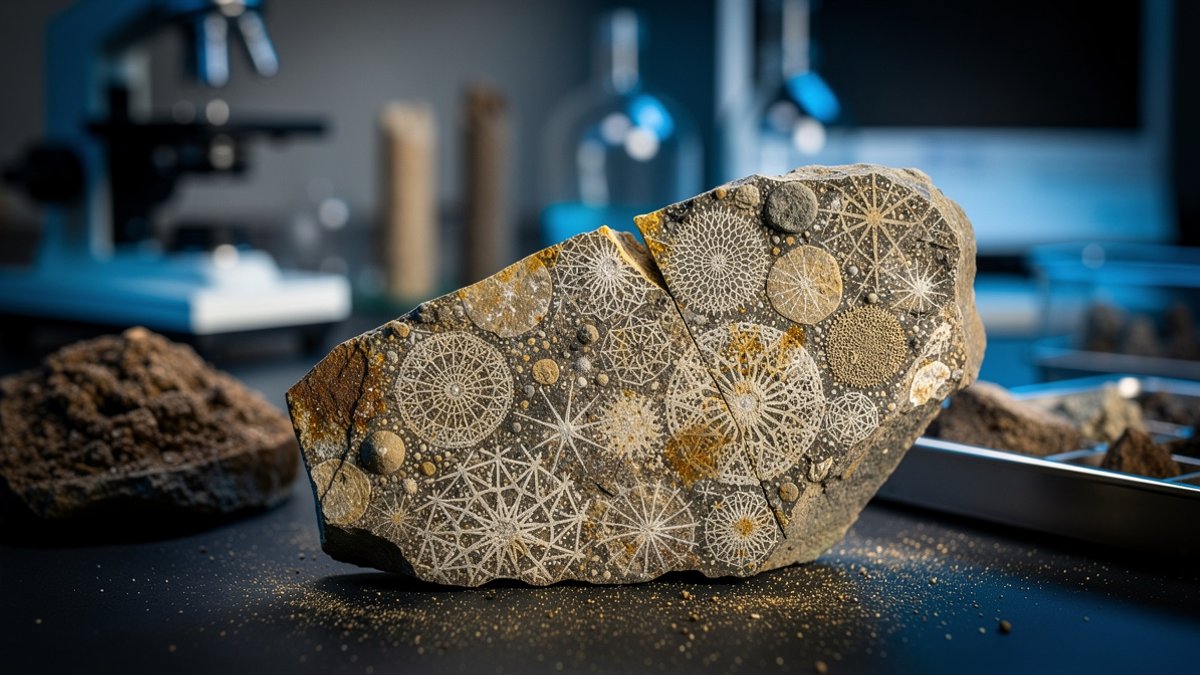
Geologist Patrick Smith, not involved in the project, emphasises that these radiolarians lived before the extinction fully unfolded. The pellet captures a moment when Earth’s oceans were still packed with activity at the microscopic scale.
The density and variety in such a confined volume show that Ordovician marine ecosystems were far richer than previously suspected. Plankton communities formed complex food webs, feeding larger organisms long before conditions turned hostile. bees nesting in fossils
What the pellet reveals about ocean health
Before, many reconstructions suggested a gradual ecological decline leading into the Late Ordovician crisis. This new window tells another story: micro‑ecosystems remained teeming with life almost until the environmental tipping point.
Comparable insights appear in other time slices, like the richly preserved marine predators revealed in the Arctic and described by the Natural History Museum in its work on unearthed fossils of ancient marine hunters. Healthy seas can pivot abruptly toward disaster.
X‑ray vision: the technological leap in paleontology
Traditionally, scientists studied microfossils by dissolving the surrounding rock with acid. That method often destroys delicate structures and can wash away rare species before anyone notices them.
For this study, the team used a high‑energy synchrotron X‑ray beam in Melbourne. In seconds, they generated detailed 3D images of the radiolarians still entombed, without cracking or grinding the sample. fossil ecosystem that helped kick‑start life after global catastrophe
Seeing through stone without touching it
Aitchison compares the experience to finally owning real X‑ray glasses: the machine peers straight through the rock and isolates every tiny shell. Both outer surfaces and internal architecture appear clearly in the digital models.
Bitumen inside the pellet had seeped around and into each cell, moulding perfect replicas of their shapes. That combination of natural casting and advanced scanning turns a nondescript chip into a high‑resolution archive.
Hidden diversity and underestimated ancient oceans
The richness inside one miniature pellet hints that previous diversity counts for Ordovician seas were likely “grossly underestimated”. If one grain hides 20 individuals, what might an entire outcrop contain when scanned non‑destructively?
Smith points out that the fossil record is not empty; our methods have simply overlooked much of it. Rocks long dismissed as barren might host elaborate micro‑faunas waiting for modern imaging.
Connecting radiolarians to other extinction stories
These results resonate with research on post‑extinction recoveries, like the 30,000 Arctic marine fossils that tracked how oceans rebounded after the “Great Dying”, reported in outlets such as large Arctic fossil surveys of post‑Permian seas. Before and after an event, plankton patterns set the stage for larger life.
Parallel projects also demonstrate how unusual preservation and new tools can shake assumptions, for instance studies on unexpected fossil finds that rewrite the timing of complex animal evolution. Each fresh technique in geology and imaging multiplies what researchers can read from every rock slice. shrinking antarctic ice
What this means for evolution and future research
Radiolarians sit near the base of marine food webs. Their diversity before the Ordovician die‑off refines models of how evolution built early plankton ecosystems and how rapidly they respond to environmental shifts.
Understanding these micro‑communities helps trace how climate swings, sea‑level changes and ocean chemistry can destabilise even thriving systems. That perspective matters when today’s oceans face rapid warming and acidification.
Next steps: scanning the overlooked rock archive
For a fictional researcher like Dr. Lee, planning a survey of “barren” shale cores, this study is a roadmap. Instead of dissolving kilograms of rock, Lee could screen tiny pellets with synchrotron scans and then target the richest zones.
Projects inspired by this approach might follow a clear roadmap:
- Sample smarter: select small pellets from key time intervals, especially around known extinction boundaries.
- Scan first: use non‑destructive X‑ray or similar imaging to map internal fossils in 3D.
- Model ecosystems: quantify diversity, abundance and morphology to reconstruct food webs.
- Compare crises: align Ordovician data with later events, like the Permian or Cretaceous extinctions.
- Apply to today: use those patterns to refine predictions for modern ocean responses to rapid change.
This blend of technology and classic fieldwork is pushing paleontology into an era where even a speck of rock can rewrite extinction narratives.
What makes these radiolarian fossils so special?
They come from a tiny rock pellet yet show high diversity—20 individuals from eight species, including a brand‑new one. Their pristine 3D preservation, thanks to bitumen infilling and synchrotron scanning, reveals details that older, acid‑based methods would likely destroy or miss entirely.
How do these fossils change our view of the Ordovician mass extinction?
They show that microscopic plankton communities remained rich and active immediately before the Late Ordovician crisis. Instead of a slow, uniform decline, ocean ecosystems appear to have been thriving right up to a rapid environmental tipping point, sharpening how we model the onset of the event.
Why is synchrotron scanning a breakthrough for paleontology?
It lets researchers see inside rocks without cutting or dissolving them. High‑energy X‑rays generate quick, detailed 3D images of hidden fossils, preserving fragile structures and revealing organisms that traditional methods overlook, especially at microscopic scales.
What does this tell us about hidden fossil diversity?
If a grain‑sized pellet holds such variety, many rock units previously labelled poor in fossils may actually be packed with micro‑life. The issue has been detection, not absence, meaning ancient ocean biodiversity has likely been underestimated for decades.
How is this research relevant to modern oceans?
Radiolarians occupy key positions at the base of marine food webs. By understanding how their communities behaved before and during past crises, scientists can better anticipate how present‑day plankton and broader ocean ecosystems might react to rapid climate and chemistry shifts.
FAQ
What can ordovician radiolarian fossils tell us about ancient ocean ecosystems?
Ordovician radiolarian fossils provide a window into the diversity of microscopic life just before a major extinction. By studying their variety and abundance, scientists can reconstruct food webs and environmental conditions from that era.
Why are discoveries of new species in ordovician radiolarian fossils significant?
Finding new species highlights how little we know about early marine life. Each new species adds detail to our understanding of how ecosystems evolved before mass extinction events.
How do scientists identify different species in such tiny fossil samples?
Researchers use powerful microscopes to examine the unique shapes and structures of radiolarian skeletons. Distinct features allow them to classify and sometimes name entirely new species.
What role did radiolarians play in the Ordovician oceans?
Labour’s Clean Air Act Is Facing a Major Hurdle—Charities Warn Hidden Delays Could Leave UK Air Unsafe
Stunning fossil discovery just shattered scientists’ beliefs about when animal life began—here’s why they’re reeling
Radiolarians were important plankton that formed the foundation of the Ordovician marine food chain. Their silica skeletons also contributed to ancient seafloor sediments.
How do ordovician radiolarian fossils help us understand mass extinctions?
By tracking changes in radiolarian diversity and abundance before and after extinction events, scientists can detect shifts in ocean health and climate. These fossils act as markers for environmental change on a global scale.