

Show summary Hide summary
- Asteroid impact risk assessment: what the numbers say
- How complete is our map of the space threat?
- From cosmic hazard to planetary defense strategy
- What you should actually be concerned about
- Simple ways to stay informed without panicking
- How likely is a major asteroid impact in my lifetime?
- Would scientists see a dangerous asteroid coming in time?
- What is the difference between a near miss and a real threat?
- Could an asteroid wipe out all life on Earth again?
- What should I actually do about asteroid risk?
Your night sky scroll is full of dramatic asteroid images and doomsday headlines. But how much of that reflects assessing real risk and real impact probability, and how much is pure entertainment? The gap between Hollywood and hard data is wide – and that gap matters for your peace of mind.
Asteroid impact risk assessment: what the numbers say
Start with scale. The rock that ended the dinosaurs was at least 10 kilometres wide. That single asteroid impact launched megatsunamis, global firestorms, and a long, cold “impact winter” that reshaped life on Earth. Analyzing craters, researchers estimate events of that magnitude occur roughly every 60 million years.
Move one notch down and you reach 1-kilometre objects. Those can trigger a global climate shock and continent-scale damage. Current estimates suggest one such cosmic hazard hits about every million years, with the last occurring around 900,000 years ago. At that timescale, the impact probability during a single human lifetime is tiny, yet not zero over civilization’s full history.
Subsurface Oceans on Icy Moons Could Be Boiling Beneath Their Frozen Crusts
NASA Revamps Its Artemis Program for an Ambitious New Era of Moon Exploration
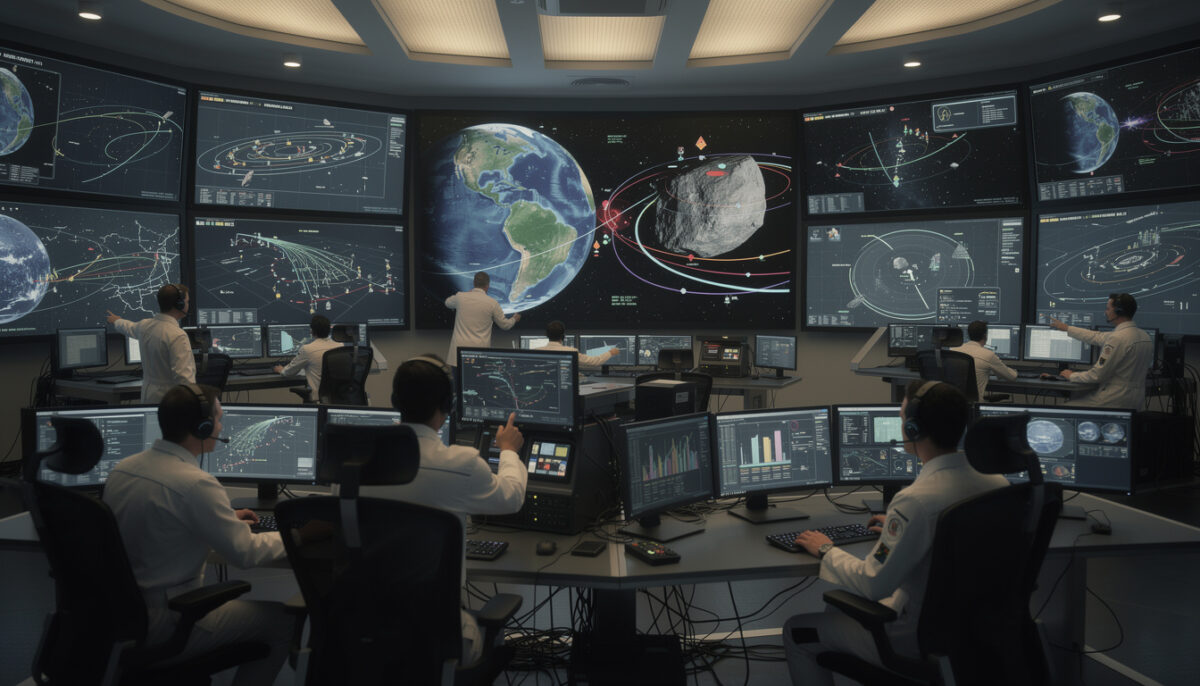
Near-Earth asteroids we already know about
Humanity’s advantage over dinosaurs is straightforward: telescopes and math. A global network constantly searches for near-Earth objects and feeds orbits into risk assessment models. According to recent catalogues, only about 35 tracked objects have even a higher-than-one-in-a-million chance of collision with Earth over the next century.
Almost all of those are under 100 metres across. That matters. A 30 to 50 metre rock, like the 2013 Chelyabinsk meteor, can shatter windows and injure thousands, but it will not collapse global agriculture. Larger events remain the outliers, and they are monitored obsessively by planetary defense teams.
How complete is our map of the space threat?
Astronomer “Maya,” a composite of several real survey scientists, likes to explain her job with three numbers: how much sky we have scanned, how sensitive our instruments are, and how many asteroids we have logged. Combine those, and you can estimate what remains unseen. For dinosaur-killer scale, the answer is reassuring.
Surveys suggest humanity has already found essentially all objects 10 kilometres or larger that could threaten Earth. For 1‑kilometre bodies, coverage is around 80 percent. That means a surprise global catastrophe from that size class is very unlikely, although teams keep refining orbits and searching for the remainder with both ground-based and upcoming space telescopes.
The real worry: 100-metre “city killers”
Below 100 metres, atmospheric breakup limits damage most of the time. Above that threshold, things change. A 100 to 300 metre impactor could flatten a region the size of a large metropolitan area. Current surveys have identified less than half of this population, leaving a genuine monitoring challenge in this middle range.
This is where new missions step in. NASA’s planned NEO Surveyor, for example, aims its infrared eyes specifically at discovering these mid-size threats that are faint in visible light. Analyses like those discussed in recent planetary defense studies focus heavily on that band, because better early detection translates directly into more options for gentle deflection.
From cosmic hazard to planetary defense strategy
Knowing an asteroid exists is one step; knowing how worried to be is another. Tools such as the Torino Scale translate orbital data and impact probability into color-coded categories, making communication clearer for non-specialists. A rating of 0 means no realistic danger, while 10 would signal a certain global-scale event.
Most newly found objects briefly sit at low but non-zero categories until additional observations shrink the uncertainty. Articles like detailed Torino scale explainers help decode these updates for the public, avoiding unnecessary panic when a rock temporarily receives a “concerning” label before being downgraded.
Deflect, don’t destroy: practical response options
The 2022 DART mission proved a key point for planetary defense: a spacecraft can slightly nudge a small asteroid off course. That single demonstration showed that, given several years of warning, engineers can alter an orbit enough to turn a hit into a harmless miss. For larger objects, combinations of kinetic impactors and gravity tractors remain under active study.
If a smaller object were discovered too late for deflection, disaster preparedness becomes the tool of choice. Because most of Earth’s surface is ocean or sparsely inhabited land, many impacts would hit remote zones. When a landfall near population is expected, authorities can treat it like a forecast hurricane or volcanic eruption: evacuate, shelter, protect infrastructure.
What you should actually be concerned about
Compare time scales. A 1‑kilometre impact roughly every million years versus severe weather every season, or earthquakes and floods on much shorter cycles. Researchers repeatedly stress in reviews, including pieces like long-form asteroid risk explorations, that day-to-day safety gains more from strengthening general emergency systems than from fixating on rare cosmic events.
Maya uses the “dual benefit” argument with policymakers. Budgets that enhance evacuation plans, resilient grids, and public risk communication help both against a direct space threat and against the far more frequent terrestrial disasters. Planetary defense and civil protection are not rivals; they are two sides of the same resilience strategy.
Simple ways to stay informed without panicking
Raw headlines about an “asteroid headed for Earth” often omit key context: size, probability, and time frame. A calmer approach relies on a few habits that any informed citizen can adopt without spiraling into anxiety about every cosmic rock that makes the news.
To keep perspective, you can follow these guidelines:
- Check whether the asteroid is listed on official monitoring sites before sharing alarming posts.
- Look for its size; under 50 metres usually means local effects at worst.
- Note the time horizon: many “threats” are centuries away and likely to be ruled out.
- Read updates from scientific outlets, not only social media threads.
- Treat preparedness advice that also helps for storms, fires and quakes as a practical priority.
How likely is a major asteroid impact in my lifetime?
Current risk assessment models show that a civilisation-ending asteroid impact during one human lifetime is extremely unlikely. Large impacts occur on time scales of hundreds of thousands to millions of years. Smaller events are more frequent, but they tend to cause regional, not global, damage and are increasingly monitored by dedicated surveys.
Would scientists see a dangerous asteroid coming in time?
For the largest objects, astronomers have already found nearly all candidates that could hit Earth, and their orbits are well mapped. For mid-sized city-killer asteroids, surveys are improving rapidly with new telescopes. In many realistic scenarios, detection would come years in advance, giving room either for planetary defense actions or organised evacuation.
What is the difference between a near miss and a real threat?
A near miss simply means an asteroid passes relatively close to Earth in space terms, often millions of kilometres away, with no chance of collision. A real threat combines a non-negligible impact probability with a size capable of serious damage. Scales like the Torino system help distinguish harmless fly-bys from objects that deserve closer tracking.
Could an asteroid wipe out all life on Earth again?
A Subtle Cosmic Whisper May Unlock the Secrets Behind the Universe’s Expansion
Understanding Legalities Owning Apollo Moon Rocks and Lunar Samples
Science cannot rule out any theoretical scenario forever, but data show that impacts large enough to sterilise the entire planet are extraordinarily rare, far beyond the scales of human history. The dinosaur extinction was massive yet still left many species alive. With modern observation networks and technology, humanity now has tools the dinosaurs never had.
What should I actually do about asteroid risk?
For most people, the most productive response is staying informed through reliable sources and supporting strong disaster preparedness in their communities. Measures that strengthen emergency response, infrastructure resilience, and communication will help manage an unlikely asteroid impact and the far more likely floods, storms, or fires that you may face.