

Show summary Hide summary
- Proton size mystery that shook nuclear physics
- Laser experiments that pinned down the proton
- Quantum mechanics, QED and what comes next
- What this means for your picture of matter
- Key takeaways from the proton size breakthrough
- What is the newly agreed size of the proton?
- How did physicists measure the proton’s size so precisely?
- Why was there a proton radius puzzle in the first place?
- Does the new proton radius reveal new particles or forces?
- Why does such a tiny difference in proton size matter?
- FAQ
- What methods are used in proton radius measurement today?
- Why was the proton radius measurement controversial for so long?
- How does the updated proton radius measurement impact physics?
- Does the proton radius measurement affect everyday technology?
- What challenges still exist in measuring the proton radius?
A proton you never see decides how stars burn, how atoms hold together, even how your GPS stays accurate. Now physicists finally agree on its true size, ending a decades-long mystery that pushed nuclear physics and quantum mechanics to their limits. For a deeper dive into how scientists finally settled the long-standing puzzle over the size of a proton, check recent reports.
Proton size mystery that shook nuclear physics
For most of the 20th century, textbooks gave a comfortable answer: the proton measured about 0.88 femtometres across. Every hydrogen nucleus in your body, every atomic nucleus in the universe, was modeled with that familiar figure. Then, in 2010, a strange hydrogen atom blew that certainty apart.
Researchers had replaced the usual electron with a heavier cousin, the muon. Their ultra-precise measurement of atomic energy levels suggested the proton was roughly 4 per cent smaller than expected. Nuclear physics went on high alert, because such a gap hinted either at hidden experimental errors or at unknown particles and forces. The “proton radius puzzle” quickly became a reference case, mentioned alongside other disruptive results such as the discovery that a seemingly flawless atom challenged standard nuclear physics.
The Story of the First Human Tool Isn’t What You Think—How One Overlooked Container Quietly Changed Everything
Deep-diving fur seals delay their heart surges—why the real recovery starts only after landfall
How hydrogen atoms reveal the proton’s true radius
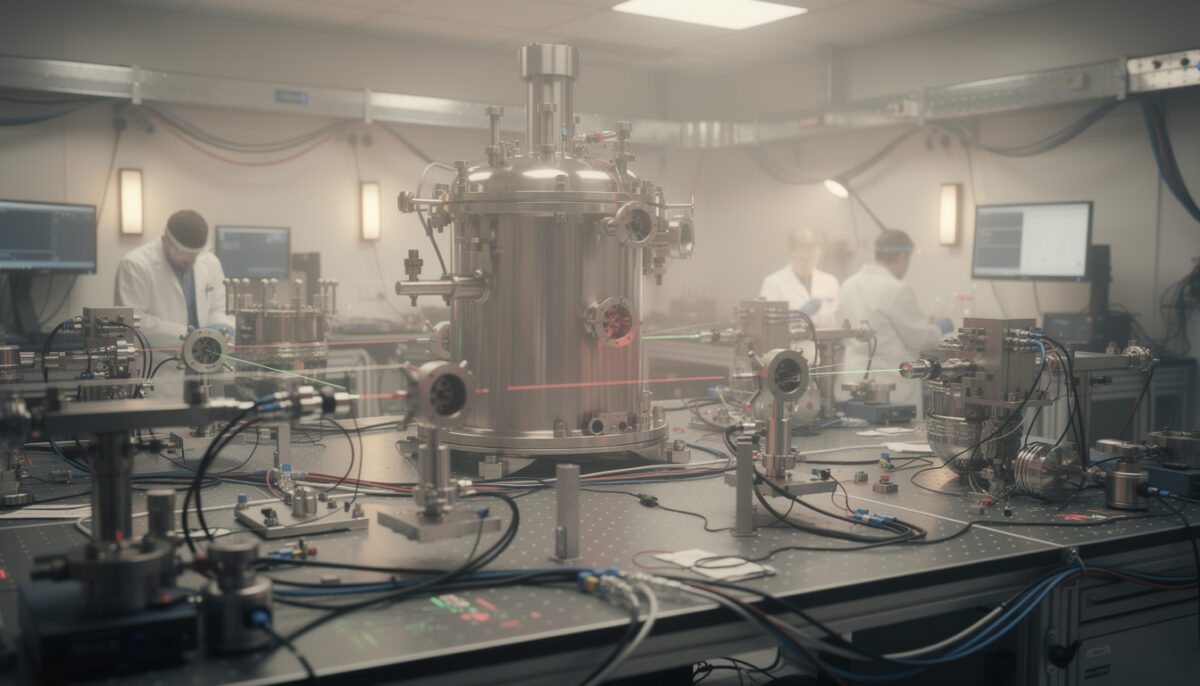
To settle the dispute, teams in Colorado and at the Max Planck Institute of Quantum Optics focused on the simplest system possible: atomic hydrogen, with just one proton and one electron. The electron’s allowed energy levels depend sensitively on how the proton’s positive charge is distributed in space, meaning on its size. Any tiny mismatch in radius shifts the frequencies of light needed to move the electron between levels.
Using ultra-stable lasers, the groups measured three electron transitions that no one had previously observed at high precision. Each transition acts like a different “ruler” applied to the same proton. When every ruler agrees, confidence soars. According to Dylan Yost, who led one of the experiments, the betting odds that the radius is now correctly known have gone “significantly up”.
Laser experiments that pinned down the proton
These measurements read like a manual for extreme patience. Hydrogen atoms were trapped in a near-perfect vacuum to prevent stray collisions. Temperature, magnetic fields, and laser frequencies were monitored over weeks, then analysed over years, to weed out every stray disturbance. The outcome: a proton radius clustered tightly around 0.84 femtometres, less than a million-billionth of a metre.
What makes the result robust is not just precision, but diversity. Each team manipulated hydrogen in a different way, yet their outcomes matched each other and aligned with the 2010 muonic hydrogen result. As theorist Juan Rojo likes to point out, a genuine property of matter must appear identical regardless of the experimental lens, exactly as seen when gravitational wave detection validated Einstein’s theory.
Why different methods now tell the same story
Earlier attempts to resolve the puzzle sometimes disagreed because each setup had its own systematic quirks. One group might cool atoms in a specific way, another might use distinct laser geometries. Pinpointing whose hidden bias skewed the answer turned into detective work that stretched over a decade. The latest campaigns turned this diversity into an advantage.
By deliberately choosing complementary transitions and techniques, physicists made it highly unlikely that a shared mistake could survive. A glitch specific to a single detector, a laser line, or a data model would shift one dataset, not all of them in the same direction. Convergence around 0.84 femtometres now leaves very little room for the old, larger radius.
Quantum mechanics, QED and what comes next
Behind the scenes, these results are also a triumph for quantum mechanics, and more narrowly for quantum electrodynamics (QED), the theory describing how light interacts with charged particles. The Max Planck team pushed QED tests to an accuracy of about 0.5 parts per million using their hydrogen spectra. No deviation surfaced, so no hidden interaction appears to be tugging on the electron.
This level of agreement rivals other precision milestones in modern research, from antimatter transport experiments to campaigns that track exotic nuclear structures, such as those discussed in work on scientists discovering an innovative pathway to accelerate quantum materials development. Each clean confirmation of QED and the Standard Model narrows the hunting ground for new physics, forcing theorists to search in more subtle corners.
From giant colliders to tabletop new-physics hunts
Particle colliders like the LHC chase heavy, short-lived species by smashing protons together at high energies. Precision hydrogen spectroscopy offers a very different window. Tabletop setups, once their systematics are under control, can reveal the feathery imprint of extremely light, weakly coupled particles that colliders would miss. The known proton radius then serves as a calibrated baseline.
Imagine a future experiment where every classical contribution, including the 0.84 femtometre radius, is accounted for. Any tiny leftover discrepancy in the electron’s energy would be a smoking gun for a new force carrier or a dark-sector particle. By turning a once-frustrating puzzle into a fixed reference, the community has effectively built a new compass for exploring beyond-standard physics. For more insights, read about how physicists may be a step closer to solving the mystery of proton size.
What this means for your picture of matter
For a student like Maya, starting a PhD in 2026, the proton radius saga already feels like a case study. Textbooks she used at school quietly switched from 0.88 to 0.84 femtometres without drama. Yet the path between those two numbers reshaped how laboratories collaborate, how uncertainties are tracked and how ambitious measurement campaigns are planned.
The episode also reframes how you might think about “simple” atoms. Hydrogen, long treated as the basic building block in quantum mechanics lectures, turns out to be an incredibly sharp probe of nuclear physics. A single electron and a single proton, interrogated with lasers, can challenge or confirm the deepest equations used to model stars, reactors and cosmic evolution.
Key takeaways from the proton size breakthrough
When you step back, several lessons emerge from this long-running mystery:
- Textbook values can change: even familiar constants can shift when new techniques appear.
- Diverse setups matter: independent routes to the same number build real confidence.
- Precision is a discovery tool: tiny shifts in atomic spectra can signal new forces or confirm existing theories.
- Small scales, big impact: knowing the proton radius refines models across astrophysics, chemistry and metrology.
- Tabletop and collider physics complement each other: both are needed to map the full landscape of matter.
The size of the proton will never look like a headline figure on a sports scoreboard, yet it quietly sets the rules of the physical game you live in. Now that the number is finally pinned down, attention can shift from “How big is it?” to “What else can this tiny ruler reveal?”
What is the newly agreed size of the proton?
Recent high-precision experiments using hydrogen spectroscopy converge on a proton radius of about 0.84 femtometres. This means the proton’s charge is concentrated within a sphere less than a million-billionth of a metre across, smaller than the older textbook value near 0.88 femtometres.
How did physicists measure the proton’s size so precisely?
Researchers used lasers to measure specific energy transitions of electrons in atomic hydrogen. These energies depend subtly on how large the proton is. By observing several transitions, each with different sensitivity to the radius, and comparing across independent setups, they extracted a consistent value for the proton’s size.
Why was there a proton radius puzzle in the first place?
In 2010, measurements on muonic hydrogen—where a muon orbits the proton instead of an electron—indicated a proton radius about 4 per cent smaller than earlier results. That discrepancy sparked intense debate, because it suggested either unknown experimental errors or new physics. The latest electron-based hydrogen experiments now agree with the smaller value.
Does the new proton radius reveal new particles or forces?
Current data show excellent agreement with quantum electrodynamics at the 0.5 parts-per-million level. No deviations pointing to new particles have appeared so far. However, now that the radius is well constrained, future ultra-precise experiments can use it as a baseline to search for subtle signals of beyond-standard-model physics.
Why does such a tiny difference in proton size matter?
Even a small change in the proton radius affects high-precision predictions of atomic energy levels, which feed into tests of fundamental theories, standards of measurement, and models used in astrophysics. Accurate knowledge of the radius strengthens confidence in nuclear physics calculations and guides the design of new precision experiments.
FAQ
What methods are used in proton radius measurement today?
Scientists use spectroscopy of hydrogen and muonic hydrogen atoms, as well as electron-proton scattering, for precise proton radius measurement. These techniques help confirm results and reduce errors.
Why was the proton radius measurement controversial for so long?
Conflicting results from different experimental methods led to uncertainty over the true size of the proton. This disagreement sparked the ‘proton radius puzzle’ and prompted extensive research to resolve it.
How does the updated proton radius measurement impact physics?
Resolving the proton’s size helps confirm the accuracy of quantum mechanics and nuclear physics models. It also affects calculations involving atomic structure and fundamental constants.
Does the proton radius measurement affect everyday technology?
Ice age humans in China wielded stone tools far more advanced than expected — what did they know that the rest of the world didn’t?
A Neanderthal ‘kneeprint’ just surfaced beside a stone circle—what experts found next is rewriting the story of our ancient rivals
Yes, precise values of the proton’s radius are important for technologies like atomic clocks and GPS, which rely on accurate fundamental constants. Improved measurements ensure these systems remain reliable.
What challenges still exist in measuring the proton radius?
While consensus has improved, researchers still work to further refine experimental techniques and minimise uncertainties in proton radius measurement. Ongoing studies continue to seek even greater precision.