

Show summary Hide summary
Imagine Earth’s first reefs without rock or shell, built by soft-bodied organisms that left barely a trace. These skeleton-free early pioneers are now overturning everything you thought you knew about Earth’s history and evolution of animals.
Sponges, the animals you come across while diving or in museum displays, may be among the very first representatives of the animal kingdom. Their DNA and molecules trapped in rocks suggest they appeared at least 650 million years ago. Yet the fossil record only shows skeletal elements starting around 543 million years ago. This gap has long puzzled modern paleontology. To explore more about Earth’s evolutionary riddles, see discovery of new fossils could resolve the enigma of sail-backed spinosaurs.
Skeleton-free sponges and the puzzle of deep time
To understand this paradox, imagine Clara, a fictional researcher in paleobiology, examining a thin slice of Precambrian rock. She knows that early animals already lived in these ancient seas, but no silica needles appear under the microscope. The famous sponge spicules are missing, even as genetics points to an origin much older than the Cambrian period.
Decades of Comparing Dinosaurs and Mammals Overlooked This Crucial Distinction
Scientists uncover microbe rewriting a core genetic code principle
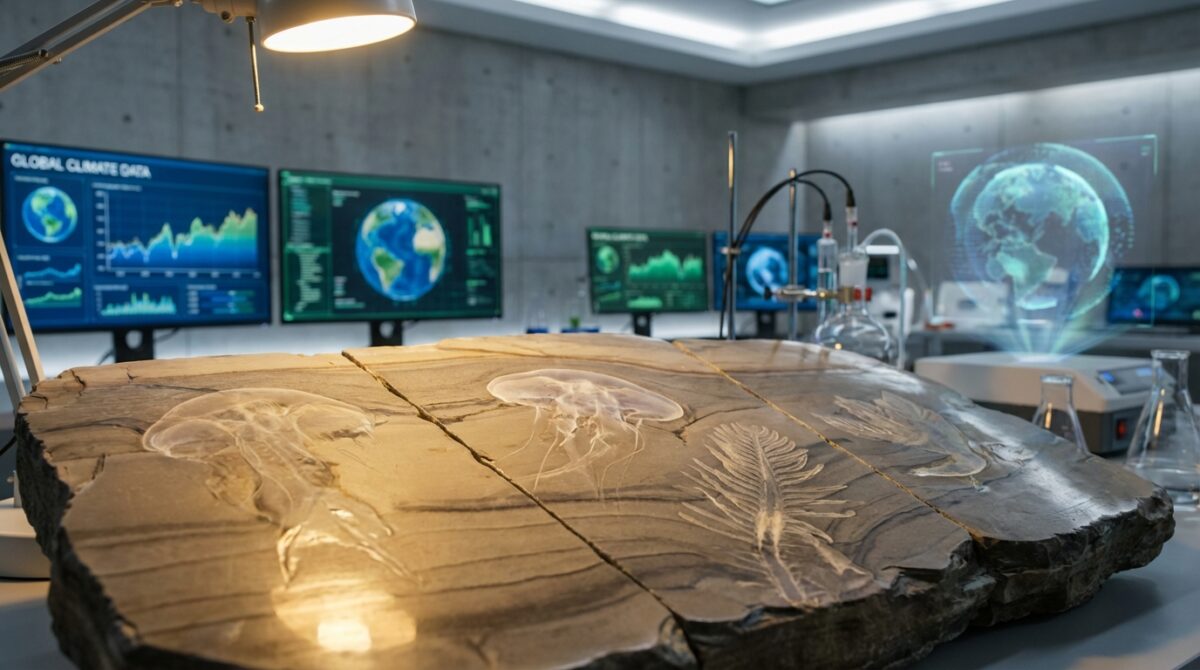
An international team led by biologist M. Eleonora Rossi (University of Bristol) decided to tackle the problem at its roots. By combining fossil data and sequences from 133 protein-coding genes, she established a new evolutionary clock. The result: the origin of sponges dates to between 600 and 615 million years ago, narrowing the gap between genetics and the geological record—without forcing them to artificially coincide.
The first animals without mineral skeletons
The key point of this study can be summed up in one phrase: the first sponges were soft-bodied organisms. No rigid skeleton, no mineralized spicules, and thus very little chance of fossilization. So when Clara looks at her “empty” rock slides, she might actually be viewing the remains of invisible animals, whose bodies decomposed leaving no lasting framework.
This conclusion aligns with other research on early metazoans, such as those presented by the Oxford University Museum of Natural History about the “First Animals.” The animal world probably did not start with armored creatures, but with soft, unobtrusive mats anchored to the seafloor, already altering ocean chemistry and paving the way for the later burst of diversity.
When sponge skeletons evolved multiple times
To go further, Rossi’s team didn’t just date the origin of sponges. They reconstructed the history of their skeletons. Today, some species make calcite structures, others use silica, and some remain almost entirely without a framework. Beneath these varied forms, the genomes tell divergent stories, with different gene sets called upon to build apparently similar structural elements.
By modeling transitions between “soft-bodied”, “calcareous skeleton” and “siliceous skeleton” states using a Markov process, the researchers tested dozens of evolution scenarios. Almost all the models rule out the idea that the first sponges had mineralized skeletons. Only an unrealistic scenario, treating all types of mineral as equivalent, gives an ambiguous result.
A challenge to assumptions about the success of early animals
You might think that gaining mineral spines gave primitive sponges an instant, decisive advantage. The data tell a different story. The first branches of the group diversified while still skeleton-free early. Spicules appear later—and multiple times—in different lineages. The weapon that propelled these animal origins forward thus remains unidentified.
For Clara, this viewpoint changes the way she reads each rock section. It’s not just hard parts that matter—but also everything that has vanished. Studies of other lineages, such as the reinterpretation of strange fossils described in Earth’s most bizarre fossils, show the same trend: beginnings dominated by fragile bodies, quickly erased from the record.
How these early animals reshaped Earth’s history
If the first sponges already formed dense communities on the seafloor, they probably acted as true ecosystem engineers. By filtering enormous volumes of water, they changed nutrient circulation and local oxygenation. These changes paved the way for the explosion of biological diversity that later defines the Cambrian period, detailed in reviews like The rise of the first animals.
Sponges are also considered the first builders of animal reefs. Understanding their beginnings thus opens a window onto the very first reef systems. These soft, almost ghostly seascapes helped permanently transform the atmosphere and oceans, setting the stage for the familiar animal life forms—including humans.
How this revolution changes modern paleontology
Recent work, such as those highlighted on science outreach platforms or in reviews like evolutionary mystery solved, pushes researchers to rethink how to search for the first animals. The simple absence of hard parts no longer means an absence of complex life. Rock chemistry, microscopic cellular fossils and genetic signals are now as decisive as the spectacular museum specimens.
For passionate science readers, this story echoes other subtle revolutions—such as discoveries about our microbiome, explored in-depth in analyses like the revelations about microbiome power. In both cases, what matters is invisible to the naked eye, yet it profoundly changes our perception of life.
Key takeaways from this new view on animal origins
For your next science-loving conversations, a few points are worth keeping in mind. They sum up this shift in perspective on the dawn of the animal world and on how paleontology now interprets the oldest rocks on our planet.
Here are the key ideas to remember:
- The first sponges—probable pioneers of the animal kingdom—were soft-bodied organisms without mineral skeletons.
- Spicules appeared several times independently, as silica or calcite, in already diverse lineages.
- The fossil record of the Precambrian is poor in animal remains not due to lack of life, but because of the lack of hard parts.
- These early animals shaped the first reefs and set the stage for the surge in biological diversity of the Cambrian period.
- Understanding these beginnings sheds light on the co-evolution between life and environment throughout Earth’s history.
Why don’t the first sponges appear clearly in the fossil record?
The first sponges were probably lacking in mineral skeletons. Their soft bodies decomposed quickly, leaving little lasting trace. Silica or calcite spicules, which fossilize well, only appear much later in already diverse lineages—explaining the gap between genetic evidence and the fossil record.
How do we know the first animals were skeleton-free?
Researchers combine DNA analysis of living sponges, molecular dating, and statistical models of skeletal evolution. These models test different scenarios and show it’s highly likely the earliest sponges lacked mineralized skeletons. Genome structure and the diversity of spicule types support this conclusion.
How do these discoveries change our view of the Cambrian period?
The Cambrian period no longer looks like a sudden appearance of complex animals out of nowhere. New research indicates a world of soft-bodied animals pre-dated it by tens of millions of years. The ‘Cambrian revolution’ is better seen as the acquisition and spread of hard parts, which made these creatures much more visible in the fossil record.
What impact did these early animals have on Earth’s history?
Scientists Discover Ancient Genes Older Than Life
The epic return of epicyon: prehistoric america’s fearsome bone-crushing predator
By filtering water, building the first reefs, and altering nutrient flows, the first sponges helped transform the oceans and atmosphere. This early ecological engineering allowed new habitats to develop and fostered the emergence of other animal groups, leaving a lasting influence on life’s evolution on Earth.
Why does this research matter even to non-specialists?
This research shows that small, inconspicuous creatures can reshape an entire planet. It reminds us that the unseen—whether microorganisms, microbiomes or ancient soft-bodied animals—can play a central role in the workings of life. This idea resonates with many current issues in ecology, health, and climate.