
Show summary Hide summary
- What the new DNA study really changes
- How advanced genetics overturned earlier Beachy Head theories
- Reconstructing the face and life of a local Roman Briton
- Methodology, confidence levels, and scientific limitations
- Why this forensic reevaluation matters beyond Beachy Head
- Key takeaways from the Beachy Head Woman DNA study
The woman once introduced as a symbol of Roman Britain’s global diversity has turned out to be local. That single twist reshapes how you think about History, race, and scientific certainty. A new DNA study has recast the story of the Beachy Head Woman from “first Black Briton” to “young rural Briton in a connected empire”.
This scientific reevaluation, led by researchers at University College London (UCL) and the UK’s Natural History Museum, used high-quality ancient genetics data to overturn a decade of speculation. Published in the Journal of Archaeological Science, the work exemplifies how advances in forensic and archaeological science can correct well-meaning but inaccurate narratives.
What the new DNA study really changes
According to the new analysis, the Beachy Head Woman’s genetic profile most closely matches rural populations from Roman-era Britain, especially southern England. Researchers found no evidence of recent sub-Saharan African or Mediterranean ancestry, challenging earlier claims that she came from far beyond the province.
THOR AI Cracks a Century-Old Physics Mystery Within Seconds
Scientists Unveil How AI Boosts Human Creativity
The work, described in detail in sources such as UCL’s report on her British origins and a synthesis on SciTechDaily, shows how much conclusions can shift when better data become available. The team reports high-confidence genome-wide data, allowing comparisons across thousands of ancient and modern individuals, rather than the fragmentary snippets used in 2017.
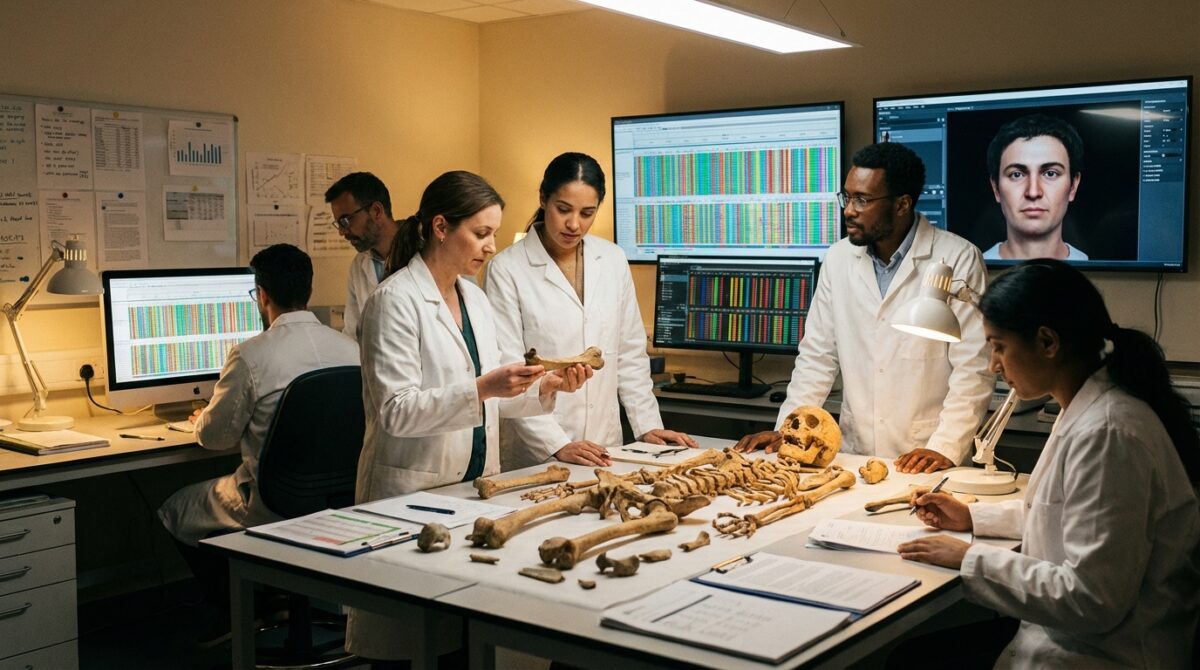
From basement discovery to scientific case study
The skeleton was rediscovered in 2012 in the basement of Eastbourne Town Hall during the Eastbourne Ancestors Project. A handwritten label suggested the remains came from near the dramatic cliffs of Beachy Head, probably excavated in the 1950s, but almost nothing else was recorded.
Osteological analysis indicated a woman aged about 18–25, just over 1.5 metres tall, who died between 129 and 311 CE, firmly within the Roman occupation. A healed leg injury showed she survived at least one serious trauma, while isotopic chemistry pointed to a diet that regularly included marine resources, consistent with life on the Sussex coast.
How advanced genetics overturned earlier Beachy Head theories
The turning point came when ancient DNA specialist Dr Selina Brace and colleagues at the Natural History Museum returned to the skeleton with next-generation sequencing tools. In one sentence, their method was simple: extract DNA from dense bone, sequence it at high coverage, then compare it statistically to thousands of reference genomes.
Earlier attempts in 2017 had struggled with low-quality fragments, which tentatively pointed towards a Mediterranean affinity. Given the limited data, those results were never peer-reviewed or formally published. The new project, highlighted on the Natural History Museum’s own coverage and by outlets such as ScienceAlert, finally delivered genome-wide coverage robust enough for statistical confidence.
What the genetic evidence actually shows
Using updated reference datasets of Roman-era British genomes, UCL researcher Dr William Marsh and the team applied standard population genetics tools, including principal component analysis and formal ancestry modelling. Across these tests, the Beachy Head Woman clustered tightly with local Romano-British individuals, not with Mediterranean or African groups.
Independent outlets such as CNN’s coverage of the DNA analysis and Earth.com’s summary of the reevaluated identity underscore the same message: she was almost certainly local to Britain. The authors emphasise probabilities rather than absolutes, but within current datasets, a British origin is strongly supported.
Reconstructing the face and life of a local Roman Briton
The high-quality genetic data also enabled a separate forensic analysis of appearance. Pigmentation genes, interpreted with modern forensic algorithms, suggest the Beachy Head Woman most likely had light skin, blue eyes and fair hair. These traits fed into an updated digital facial reconstruction that replaces earlier, darker-skinned representations.
This does not mean such features were universal in Roman Britain, only that this particular individual probably looked this way. According to coverage on ArchaeologyMag’s detailed feature and a synthesis on Phys.org, the new reconstruction is now displayed with clear interpretive notes, stressing that genetic predictions are probabilistic and that appearance alone should never determine assumed ancestry.
Roman Britain, mobility, and why one skeleton matters
The Roman province of Britannia was deeply plugged into imperial trade and military networks, with documented links to Gaul, the Balkans and North Africa. Other ancient DNA studies have confirmed individuals with mixed European and sub-Saharan ancestry in early medieval Dorset and Kent, demonstrating that long-distance movement did occur.
Against this backdrop, the Beachy Head Woman shows something quieter but equally interesting: an apparently local young woman living in a coastal landscape threaded with forts, villas and trade routes. Her story illustrates how an ordinary life in a distant province was embedded in the wider imperial system without requiring long-distance migration.
Methodology, confidence levels, and scientific limitations
The research team generated high-coverage genome data from carefully selected skeletal elements, then filtered out contamination before statistical comparison. Radiocarbon dating provided a time window of roughly 129–311 CE, while stable isotopes assessed diet. Together, these methods produced a multidimensional profile of origin, time and lifestyle.
Confidence in her local ancestry is high relative to currently available data, but not absolute. The statistical models show her genetic signature is most similar to reference individuals from Roman Britain, and unlike those of Mediterranean or African populations. However, the authors stress that ancient DNA reference panels remain incomplete, which leaves room for future refinements.
What this study cannot prove
The researchers are careful to distinguish between correlation and causation. Genetics can show similarity to known populations; it cannot directly explain why her community ate more seafood or how her leg was injured. Cultural practices, social identity and personal experiences leave much weaker biological traces than ancestry.
Coverage such as MSN’s report on the stunned scientific reaction and the analysis on ScienceDaily’s recent release repeats the researchers’ caution: one skeleton cannot stand in for all of Roman Britain. The study corrects this individual’s story; it does not erase extensive evidence for wider imperial mobility.
Why this forensic reevaluation matters beyond Beachy Head
For curators and educators, the study forces museums to revisit how they present race and migration in the past. Exhibits once framed the Beachy Head Woman as proof of early African presence; now, updated panels explain the scientific journey from initial assumption to revised conclusion, showcasing how evidence evolves.
This case also carries a broader warning for heritage debates. Inferring ancestry primarily from perceived skin colour, hair texture or facial structure can lock modern stereotypes onto ancient people. The Beachy Head Woman demonstrates how Archaeology, Genetics and forensic science must work together to avoid such pitfalls.
How this connects to other research frontiers
The same sequencing and statistical methods used here now influence many fields, from environmental science to medical research. Projects exploring how deforestation alters mosquito behaviour, such as this investigation of mosquito preference for human blood, or how microbial communities shape our bodies, like the oral microbiome study on obesity prevention, all rely on similar genomic pipelines.
Readers interested in the social meaning of such science can explore synthesis pieces on ancient DNA and identity or broader research roundups such as studies of sourdough microbes. Across these domains, the Beachy Head Woman stands as a case study in how high-quality data can reset public narratives.
Key takeaways from the Beachy Head Woman DNA study
For a reader trying to keep track of what has genuinely changed, a few points summarise the impact of this Groundbreaking study. Each shows how a single skeleton can influence debates about identity, migration and scientific practice.
- Ancestry: High-quality DNA links her most strongly to rural Roman-era Britain, not to recent African or Mediterranean origins.
- Appearance: Forensic genetics predicts light skin, blue eyes and fair hair, revising earlier artistic reconstructions.
- Method: Improved sequencing and larger reference datasets enabled far more reliable comparisons than in 2017.
- Context: Roman Britain still shows evidence of long-distance migrants; this individual simply was not one of them.
- Lesson: Scientific narratives must remain open to revision as methods improve, especially for sensitive topics like race.
Those broader lessons echo across research, from ancient DNA case studies like the analyses collated on SciTechDaily and ArchaeologyMag to sustainability reports on climate adaptation or environmental change on Earth observation projects. The Beachy Head Woman’s story ultimately shows how careful reevaluation can make the past both more accurate and more human.
Was the Beachy Head Woman actually Black?
Early interpretations suggested recent sub-Saharan African ancestry, based largely on appearance and low-quality genetic data. The new peer-reviewed DNA study by UCL and the Natural History Museum finds no evidence for recent African or Mediterranean ancestry. Her genome aligns most strongly with rural populations in Roman-era Britain, indicating she was probably local to southern England.
How certain is the new DNA analysis about her origins?
Within current datasets, the evidence for local British ancestry is strong. Researchers obtained high-coverage ancient DNA and compared it with thousands of ancient and modern genomes. However, reference data for some regions remain incomplete, so a small degree of uncertainty always persists. The authors therefore present their conclusions as highly probable rather than absolute.
Does this study mean there were no Africans in Roman Britain?
No. Historical texts, inscriptions and other archaeological finds show that people from North Africa and beyond did live in Roman Britain. Other ancient DNA studies have identified individuals with mixed European and sub-Saharan ancestry in later periods. This study only revises the story of one woman, not the entire population of Roman Britain.
How did scientists predict the Beachy Head Woman’s appearance?
Challenging Childbirths: Insights into the Birthing Struggles of Extinct Australopithecus Relatives
Researchers Uncover 400-Million-Year-Old Genetic ‘Switches’ Hidden Within Plants
Researchers analysed specific genetic variants linked to traits such as skin, eye and hair colour. Using modern forensic models developed from large contemporary datasets, they estimated that she most likely had light skin, blue eyes and fair hair. These predictions are probabilistic, so they indicate likelihoods, not a photographic reconstruction of her exact appearance.
Why did earlier studies misinterpret her ancestry?
Earlier analyses relied on poorly preserved DNA and on visual assumptions about her facial features and earlier reconstructions. The limited genetic fragments tentatively hinted at Mediterranean links but were never strong enough for publication. With improved sequencing technology, contamination control and richer reference panels, the new study could reassess her genome more accurately and overturn those early, uncertain ideas.