
Show summary Hide summary
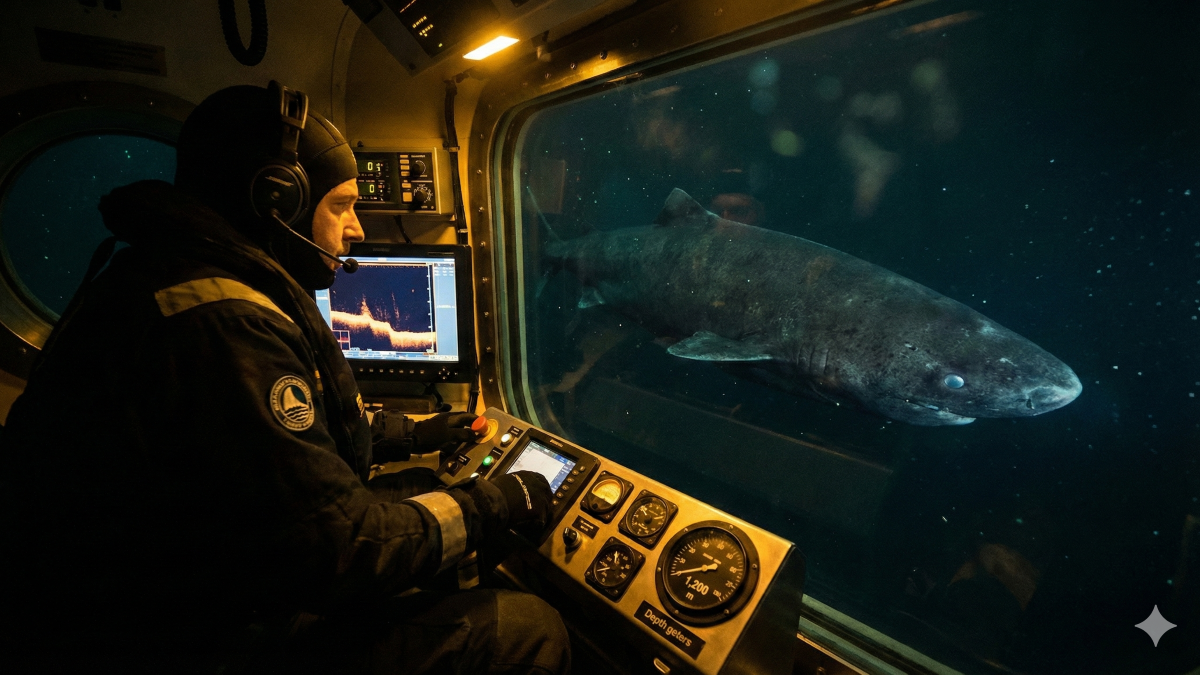
At 600 meters below the Arctic ice, a shark older than most human institutions glides through near-total darkness. Long thought almost blind and barely alive, this centuries-old Greenland shark is now forcing scientists to rewrite what aging, vision and survival mean in a rapidly warming ocean.
Behind its slack jaw and worn-sock appearance lies a story that links deep sea mysteries, climate disruption and the quiet crisis facing long-lived marine species. As researchers finally decode this animal, they also uncover how fragile our understanding of ocean life still is.
Greenland sharks: Living fossils in a changing ocean
Greenland Sharks, Somniosus microcephalus, drift through the ocean depths of the Arctic and North Atlantic at speeds slower than an escalator. Adults can reach six metres in length, yet grow only about one centimetre per year, which already hints at extraordinary animal longevity. A 2016 study in Science estimated some individuals could surpass 400 years.
A supervolcano almost erased humans 74,000 years ago—what we did to survive shocked scientists
Pirouetting and gaping: What scientists just saw as humpback migration begins—and why it’s causing serious debate
Those early age estimates, explored in resources like recent lifespan research summaries, suggested that a few might have been alive when Shakespeare wrote his plays. Marine biologists now caution that radiocarbon dating, so powerful for artefacts thousands of years old, carries wider error margins for animals “only” a few centuries old. Even so, the consensus remains: these sharks are the longest-living known vertebrates.
Slow movement, hidden power: Rethinking shark behavior
The stereotype paints Greenland Sharks as clumsy scavengers, barely capable of a hunt. Their slow movement certainly invites that judgement. Yet stomach analyses have revealed remains of polar bears, moose, narwhals and belugas. Not all of that menu can be explained by scavenging alone, especially in shallow Arctic bays where Inuit hunters have long described active attacks.
Bio-logging and submersible observations, such as those shared in pieces like accounts of Greenland sharks still hunting in Greenland’s waters, show individuals diving almost vertically between surface and seafloor, adjusting their position with fine, beluga-like fin movements. Instead of lumbering relics, they appear as patient ambush predators, using the darkness and cold as allies.
Not blind after all: What their eyes reveal about aging
For decades, cloudy eyes and parasites hanging from their corneas convinced researchers that Greenland Sharks were effectively blind. Vision seemed irrelevant in water where sunlight rarely penetrates. Yet a new international study of their retinas, highlighted by outlets such as reports on their unexpected sight, reveals something else entirely.
Retinal tissue from sharks estimated to be more than 100 years old appears structurally intact. Genetic and molecular analyses indicate that these eyes can still detect light and contrast, despite constant assault from parasites and freezing temperatures. As marine biologists put it, their eyesight seems “built to last centuries”, a phrase explored in detail by coverage such as recent vision and longevity features.
Longevity science in the ocean depths
This resilience has immediate relevance beyond marine biology. If eye cells remain functional for hundreds of years in a hostile environment, what protective mechanisms are at work? Some articles, including analyses of how Greenland sharks keep their vision for 400 years, point to unusually slow metabolism and robust cellular repair as likely contributors.
Human aging research is already following these leads. Features such as discussions on what centuries-old sharks mean for human lifespan explore how understanding shark DNA stability, protein integrity and low-energy lifestyles might inform new therapies. The Arctic, in other words, doubles as a laboratory for future medicine.
Climate pressures on centuries-old Greenland sharks
While physiology fascinates, the clock is ticking on the environment these animals depend on. The Arctic warms at roughly four times the global average, shrinking sea ice, reshaping food webs and opening new shipping lanes. For a shark that may need a century to reach maturity, disturbance in a single decade could reverberate across generations.
Greenland Sharks are generalists and probably flexible eaters, which may help them adapt as prey moves. Warming will likely push them deeper, into colder layers or into new regions, echoing rare sightings in tropical basins documented by sources such as reports of a 500-year-old shark far from home in the Caribbean. Yet the deeper they retreat, the harder it becomes for scientists to monitor their numbers or protect their habitats.
Invisible risks: Fishing, policy and knowledge gaps
Another challenge lies in their invisibility to policy. Operating mostly beyond the reach of standard fisheries, Greenland Sharks often appear only as bycatch statistics or anecdotes. Even their name misleads; they are not confined to Greenland but likely roam large swaths of the North Atlantic and beyond.
For regulators such as North Atlantic fisheries organisations, a single shark potentially crossing an entire ocean over a lifetime raises tough questions. What scale of marine conservation measures is appropriate for an animal that might live twice as long as a nation’s current management plan? Protecting them means planning on a timescale closer to cathedrals than election cycles.
From mystery to action: What you can do now
While specialist teams deploy submersibles in Arctic fjords, the decisions made far from the ice will shape these sharks’ future. Every tonne of carbon kept out of the atmosphere slows ocean warming and helps stabilise the deep refuges where Greenland Sharks hide from surface disruption.
For readers who want to turn fascination into action, a few steps matter:
- Choose low-carbon transport and energy whenever possible to limit Arctic warming that drives habitat shifts.
- Support organisations working on shark behavior research and bycatch reduction in northern fisheries.
- Back high-seas protection and Arctic conservation treaties that factor in deep-living species.
- Reduce seafood consumption from poorly regulated stocks that may overlap with shark ranges.
- Stay informed through long-form explorations, such as analyses of their mysterious biology or features on their potential longevity “superpowers”.
Every small decision on land echoes in the deep sea. For an animal that may witness four or five human centuries, the next twenty years of policy and lifestyle choices will decide whether it continues gliding, unseen, beneath the ice — or becomes just another lost chapter in the ocean’s unwritten history.
Are Greenland sharks really the oldest living vertebrates?
Current evidence suggests that Greenland Sharks are the longest-living vertebrates known, with radiocarbon dating indicating lifespans that can exceed 250 to 400 years. Scientists emphasise that the exact maximum age remains uncertain due to methodological limitations, but all available data point to extraordinary longevity compared with other fishes, birds or mammals.
Are Greenland sharks completely blind?
Despite their cloudy eyes and parasitic copepods on the cornea, recent retinal studies show that Greenland Sharks are not completely blind. Their retinas remain structurally intact and capable of detecting light and contrast even in very old individuals, meaning they likely use vision together with smell and electroreception to navigate and hunt in dark Arctic waters.
Where do Greenland sharks live?
Greenland Sharks primarily inhabit cold waters of the Arctic and North Atlantic, often at depths ranging from a few hundred to more than a thousand metres. Because low temperatures can occur at depth in lower latitudes, individuals have occasionally been recorded much farther south, including deep tropical basins, revealing that their distribution is broader and more complex than their name suggests.
How does climate change affect Greenland sharks?
Rapid Arctic warming alters sea ice, prey distribution and ocean layering, likely pushing Greenland Sharks into deeper, colder habitats and possibly new regions. Their long generation times make them vulnerable to rapid environmental shifts and increased human activity such as shipping and fishing. However, their flexible diet may offer some resilience if effective marine conservation measures limit additional pressures.
What can individuals do to help protect Greenland sharks?
Labour’s Clean Air Act Is Facing a Major Hurdle—Charities Warn Hidden Delays Could Leave UK Air Unsafe
Stunning fossil discovery just shattered scientists’ beliefs about when animal life began—here’s why they’re reeling
Individuals can reduce personal greenhouse gas emissions, support sustainable seafood choices and back organisations working on Arctic and high-seas conservation. Advocating for science-based fisheries management, bycatch reduction and large protected areas that include deep habitats also contributes indirectly to safeguarding Greenland Sharks and other long-lived deep-sea species.