
Show summary Hide summary
- What we now know about virus spread in U.S. cities
- Detailed results: air travel, hubs, and hidden contagion
- Beyond H1N1 and COVID: a flexible framework for future epidemics
- Limits, correlations, and what remains uncertain
- How fast did COVID and H1N1 reach most U.S. cities?
- Did air travel matter more than commuting for virus spread?
- Can wastewater surveillance really slow a pandemic?
- Does this study prove that travel bans will prevent epidemics?
- How can city health departments use these findings today?
Within just a few weeks, both COVID and H1N1 had already slipped into most major U.S. cities, quietly building an epidemic base before hospitals or officials even noticed. That is what a new Columbia University study now shows, reshaping how early a pandemic response really needs to start. How COVID and H1N1 swept through U.S. cities reveals the urgency of early intervention.
The work, led by researchers at the Columbia University Mailman School of Public Health and published in Proceedings of the National Academy of Sciences (PNAS), directly compares how the 2009 H1N1 flu and the 2020 COVID-19 pandemics moved across the country. It reveals how fast virus spread accelerates once it enters shared travel hubs, and why classic tools like case counts arrive too late.
What we now know about virus spread in U.S. cities
The research team, including senior author Sen Pei, PhD, reconstructed the early geographic expansion of both outbreaks across more than 300 U.S. metropolitan areas. Their simulations indicate that, within a few weeks of the first detected cases, both H1N1 and COVID showed sustained transmission in the majority of large cities.
Why BMI Falls Short in Measuring Your Health – Discover What Truly Matters
AI Reveals the Hidden Genetic Switchboards Steering Alzheimer’s Disease
In numerical terms, the 2009 H1N1 outbreak caused about 274,304 hospitalizations and 12,469 deaths in the United States. Official counts for COVID now exceed 1.2 million deaths nationwide. These tallies highlight impact, but the model focuses on something different: how the infection rate surged from city to city before those outcomes became visible.
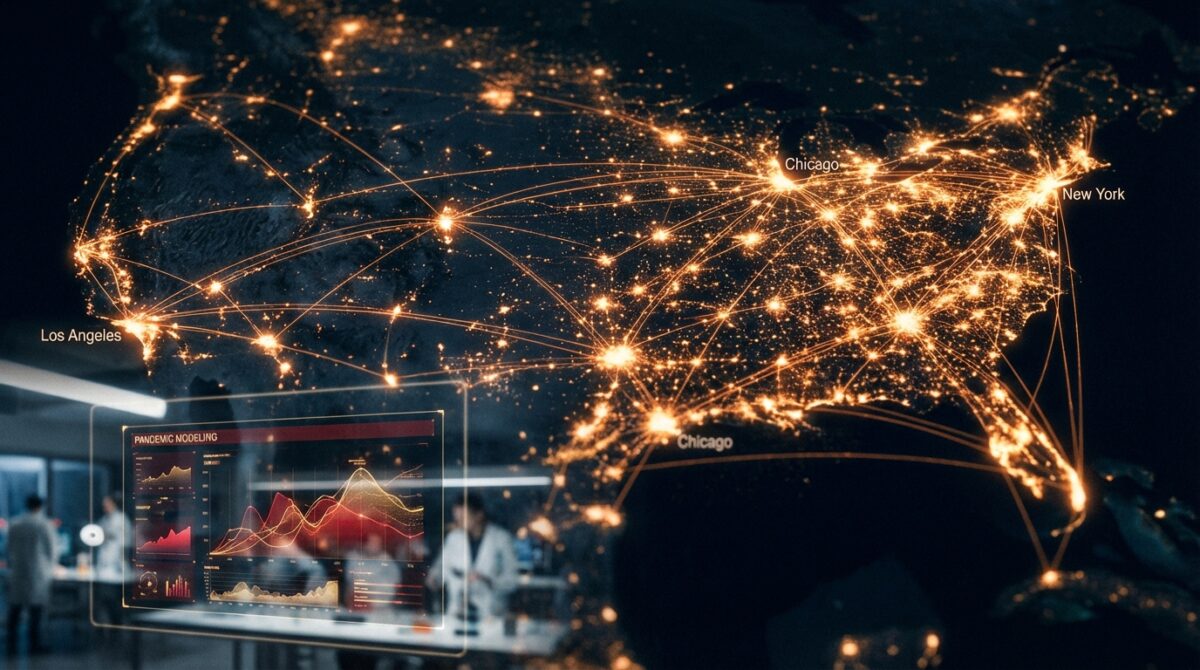
How Columbia scientists modeled H1N1 and COVID spread
To keep the approach transparent, the method rests on one clear idea: combine realistic data on how each virus transmits with detailed information on how people move between cities. The team integrated air travel networks, daily commuting flows, and the possibility of stochastic superspreading into a large-scale computer simulation calibrated separately for H1N1 and COVID.
They then ran thousands of scenarios to estimate when each metropolitan area likely crossed key thresholds of local contagion. Instead of assuming perfect knowledge, the model incorporated randomness, reflecting how one infected traveler might trigger an outbreak in one location yet not in another, even under similar conditions. This probabilistic approach allowed estimation of confidence around when each city became seeded.
Detailed results: air travel, hubs, and hidden contagion
One of the sharpest findings concerns timing. For both pandemics, the simulations suggest that many U.S. cities had ongoing community transmission in place before early warnings or formal interventions kicked in. In other words, the public health system started reacting while the virus already held a strong position on the ground.
Air travel emerged as a primary driver. Large hubs such as New York and Atlanta functioned as shared junctions, feeding infections into multiple regions. Commuter flows inside metro areas still mattered for the local infection rate, but flights did the heavy lifting for long-distance spread. For COVID, which features a higher basic reproduction number than H1N1, that long-range seeding translated to denser and faster-growing early clusters. Cities consider scrapping rental ‘junk fees’ may have implications for housing affordability in areas affected by rapid pandemic spread.
Uncertainty played a central role in the results. Some mid-sized cities showed highly variable arrival times across simulations, driven by the timing of a few critical introductions. This variability means that, in real time, no one can know with precision which city will flare first, even with good surveillance. Yet the overall pattern remains robust: once a highly transmissible pathogen gains a foothold in a few hubs, the national map lights up within weeks.
What this tells us about outbreak detection and public health
These findings carry direct implications for public health planning. Because the initial phase of a pandemic unfolds faster than classic indicators reveal, waiting for hospital data or reported cases means acting at least one step behind. The study reinforces the idea that early-phase strategies must assume wider, invisible spread than detected numbers suggest.
Senior author Sen Pei highlights the potential of expanding wastewater surveillance. By monitoring viral fragments in sewage, health officials can detect rising levels of SARS-CoV-2 or influenza-like viruses even when clinical testing remains limited. This study strengthens prior work by showing that, in a world where most U.S. cities become seeded quickly, broad wastewater coverage might be one of the few tools fast enough to keep pace.
Beyond H1N1 and COVID: a flexible framework for future epidemics
The first author, Renquan Zhang from Dalian University of Technology, and co-authors from Columbia, Princeton, and the U.S. National Institutes of Health designed their framework to extend beyond these two events. Rather than fitting only influenza or coronavirus data, the model can be adapted to new respiratory threats with different levels of transmissibility and severity.
Key contextual factors also enter the picture. Seasonal school calendars, winter holidays with increased travel, city-level demographics, and weather patterns can shift the timing and intensity of epidemic waves. For a city health department like the fictional “Metroville Health Authority,” this means that preparedness plans must align with the local calendar, not just national curves, especially when holiday flights and indoor gatherings boost contagion.
- Human mobility: air routes and commuting shape where the next cluster appears.
- Demographics: age structure and household size affect transmission chains.
- Seasonality: temperature and humidity influence respiratory virus spread.
- Behavior: masking, social mixing, and vaccination coverage modify the effective reproduction number.
For readers who follow research policy and real-time modeling, this work fits within over a decade of efforts by Jeffrey Shaman, Sen Pei, and colleagues to build forecasting systems that inform decisions. Their tools, often used by agencies in charge of outbreak response, estimate where an epidemic is likely to peak and which cities risk rapid surges.
Limits, correlations, and what remains uncertain
The study relies on simulated reconstructions rather than direct observation, which introduces uncertainty. Although the model incorporates mobility data and known transmission parameters, it cannot perfectly capture testing availability, local policies, or informal behavior changes. The authors therefore frame their estimates as probabilistic windows, not exact arrival dates with absolute certainty.
Another key nuance: the analysis highlights strong associations between air travel and the speed of virus spread, but it does not prove a simple one-directional causation for every city. Some locations may have experienced slow growth despite frequent flights, due to factors like early distancing, high prior immunity, or sheer chance. This distinction between correlation and causation matters for policymakers deciding whether to restrict travel or invest in screening.
On the practical side, the research suggests several actionable paths for city leaders and health services, which readers can explore further through resources such as detailed public health scenario analyses or broader discussions on epidemic preparedness strategies. While no single measure can stop a fast-moving pandemic, layered approaches—wastewater monitoring, rapid data sharing, and early communication—can buy valuable time.
How fast did COVID and H1N1 reach most U.S. cities?
According to the Columbia University simulations, both COVID and H1N1 established community transmission in the majority of large U.S. cities within a few weeks of initial introductions. This spread often occurred before case data or hospitalizations signaled clear outbreaks to local authorities.
Did air travel matter more than commuting for virus spread?
Yes. The study found that long-distance air travel played a larger role than daily commuting in seeding new metropolitan outbreaks. Commuting mainly influenced how quickly infections grew inside a city, while flights linked distant regions and accelerated national spread.
Can wastewater surveillance really slow a pandemic?
Wastewater monitoring cannot stop a pandemic on its own, but it can provide earlier warning of rising infection levels than clinical testing alone. When combined with targeted measures like masking in high-risk settings or rapid vaccination campaigns, it may help slow early transmission.
Does this study prove that travel bans will prevent epidemics?
This Groundbreaking Discovery Could Pave the Way for Effective Male Contraception
Nasal Spray Shows Promise in Blocking Infections from All Flu Strains
No. The research shows a strong association between air travel and rapid seeding of cities, but it does not demonstrate that cutting flights would fully prevent epidemics. Travel measures can delay spread in some cases, yet other factors—local behavior, immunity, and chance introductions—also shape outcomes.
How can city health departments use these findings today?
City teams can use these insights to assume earlier and broader invisible spread during the first weeks of an emerging threat. Investing in wastewater surveillance, strengthening data sharing with neighboring regions, and planning flexible hospital surge capacity all align with the patterns highlighted by the study.