Show summary Hide summary
- Ancient bees turning fossilized bones into nursery chambers
- From wasps to bees: decoding an unusual trace fossil
- Why this rare discovery matters for paleontology
- Harsh karst landscapes pushing bees underground
- What this fossil preservation teaches about hidden ecosystems
- FAQ
- How do bees use fossilised bones for nesting?
- Why is the discovery of bees nesting in fossils significant for science?
- What conditions allow bees to nest inside fossils rather than in soil?
- Are there other recorded cases of bees nesting in fossils?
- What does this finding tell us about the relationship between ancient animals and insects?
A giant owl’s leftovers, a vanished rodent and ancient bees quietly sharing the same cave: this sounds like a legend, yet it is a real rare discovery that forces a rethink of how insects used prehistoric skeletons to survive.
Ancient bees turning fossilized bones into nursery chambers
Thousands of years ago on Hispaniola, a giant barn owl dropped a hutia carcass on a cave floor. The bird fed its chicks and left scattered remains behind. Long after the owl departed, prehistoric insects arrived, searching for places to start new generations.
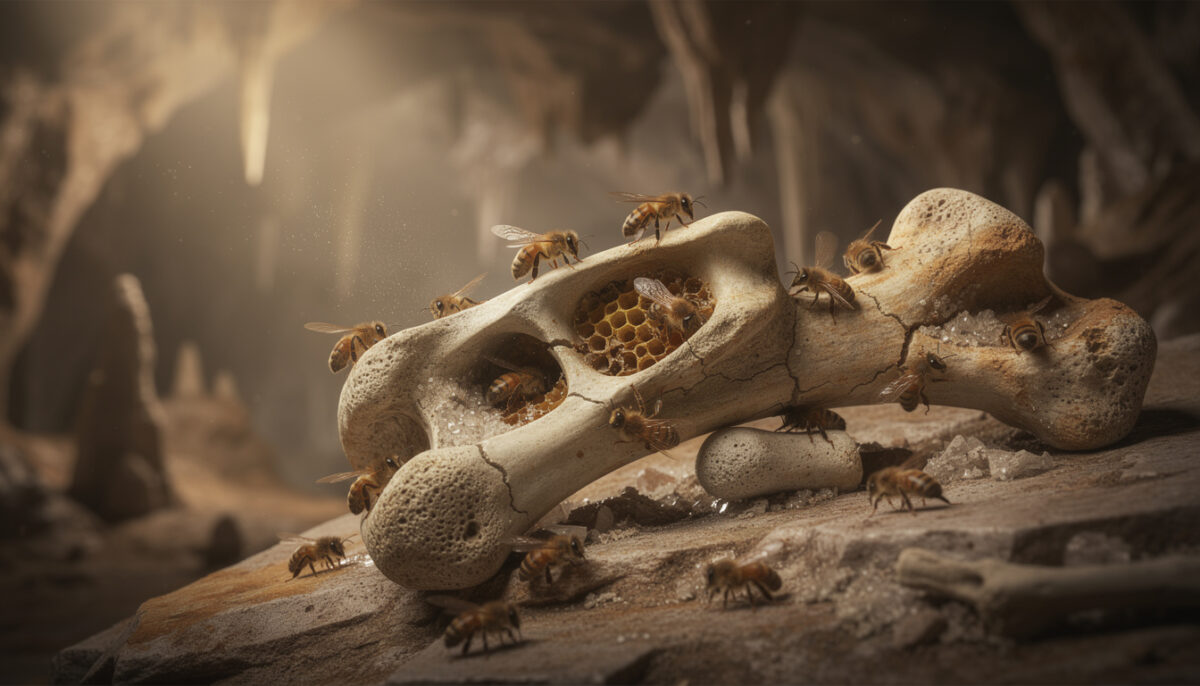
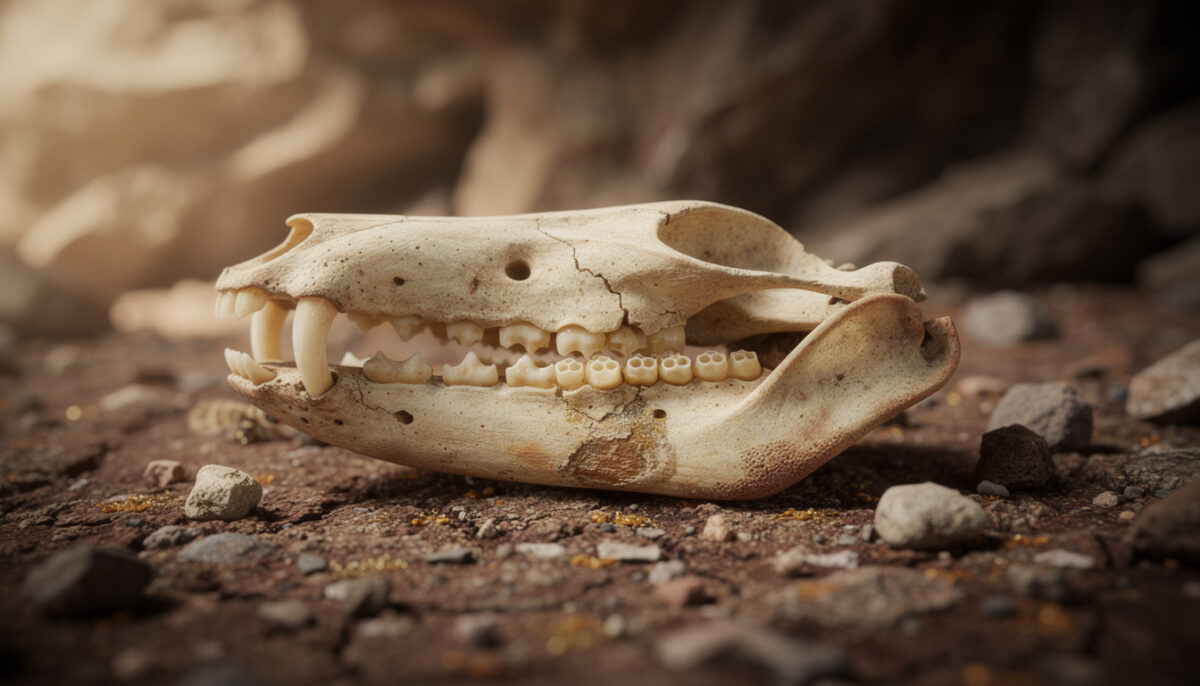
Burrowing bees dug into the fine, clay-rich silt that had settled in the darker parts of the cave. Before reaching their usual nesting depth, they hit pieces of fossilized bones. The hutia jaws still contained empty tooth sockets, or alveoli, almost perfectly sized for bee nesting. Those ready-made cavities became tiny apartments for larvae sealed with mud, pollen and waxy secretions.
A Colossal Arctic Melt Releases Carbon Locked Away for Millennia
From Dawn Chorus to First Wingbeats: The UK Witnesses Its Earliest Spring Yet
Cave excavation that revealed fossils inside fossils
Centuries later, paleontologist Lazaro Viñola Lopez explored Cueva de Mono in the southern Dominican Republic. During the cave excavation, his goal was simple: document a rare hutia species in a former owl feeding site packed with bones, eggshells and sediment.
Instead of cleaning every fossil immediately, he inspected each jaw carefully. One tooth socket looked wrong: its inner surface was smooth and glossy rather than rough like normal bone. That small detail triggered a chain of analyses that turned a routine archaeological find into a headline-making case of “fossils inside fossils.”
From wasps to bees: decoding an unusual trace fossil
At first, Lopez thought of an earlier field season in Montana, where he had seen wasp cocoons preserved among dinosaur remains. He assumed these Hispaniola structures were similar and even imagined a short note describing wasp nests in extinct rodent mandibles.
When colleague Mitchell Riegler joined the project, they revisited the material under a tight writing challenge. As they compared the cavities with ichnofossils described in studies like ancient bees burrowed inside bones, the pieces finally clicked: the walls were too smooth and polished for wasps.
Waxy signatures of prehistoric bee nesting behavior
Modern wasps usually chew plant fibers and mix them with saliva, leaving rough, fibrous textures. The Cueva de Mono structures showed the opposite. Their interiors were sealed with a waterproof, uniform lining, exactly what many solitary bees create using waxy secretions.
This texture, together with the shape of the cells and their arrangement, confirmed that the team was looking at ancient bees, not wasps. According to resources such as research from the Florida Museum, this is the first documented case where bees used pre-existing fossil cavities as nests without boring or reshaping the bone.
Why this rare discovery matters for paleontology
For specialists in paleontology and natural history, the value of these nests goes far beyond curiosity. They represent direct, three-dimensional evidence of behavior: how insects exploited a cave already shaped by predators and geology.
Only one other case of bees living inside a cave had ever been reported, and none showed insects simply moving into ancient bones. This makes the Hispaniola site a reference point, comparable to studies of unusual microclimates in cities or animal behavior under stress, such as those described in work on urban microclimates.
Stacked nests and multiple host animals
CT scans revealed that the bees did not limit themselves to hutia jaws. One nest filled the pulp cavity of a fossil sloth tooth, from tree sloths that disappeared in the Caribbean after human arrival. Another occupied the central canal of a hutia vertebra where the spinal cord once ran.
Some alveoli contained up to six nests stacked like Russian dolls, each new generation reusing the empty space left by previous bees. This sort of serial occupation is rare in the fossil record and shows how intensely insects can recycle suitable cavities when opportunities are scarce.
Harsh karst landscapes pushing bees underground
Why would burrowing bees, which usually nest in open ground, move into a dark cave full of predator leftovers? The answer lies in the harsh karst terrain above. Sharp limestone ridges had lost most of their original soils, leaving little stable substrate for tunneling.
Rainwater washed what little fine sediment existed into caves, forming pockets of soft, clay-rich silt. For bees, these underground deposits offered some of the only workable nesting material in the region. Bones scattered by generations of barn owls added protected cavities within that sediment, an unexpected bonus.
A cave threatened, then rescued just in time
The scientific story nearly ended before it began. At one point, developers considered transforming the cave into a septic tank. Faced with that prospect, Lopez and his colleagues organized a rapid recovery campaign, hauling out as many fossils as possible.
Their urgency preserved not only bones, but also fragile nest structures that reveal how prehistoric insects adapted to a challenging environment. This episode echoes broader discussions about safeguarding research sites, similar in spirit to work on how honey bees adjust their dances when humans watch them.
What this fossil preservation teaches about hidden ecosystems
The Cueva de Mono record shows an entire food web layered in stone: owls hunting hutias and sloths, rodents leaving bones, and solitary bees later using those remains as nurseries. Each layer adds behavioral details that skeletal anatomy alone could never provide.
For anyone fascinated by fossil preservation, this “fossils inside fossils” scenario highlights how much information can survive when excavation teams slow down, observe textures and question first impressions. One smooth tooth socket was enough to reveal a whole hidden ecosystem of ancient bees.
- Owls supplied the bones by repeatedly feeding in the cave.
- Rodents and sloths provided perfectly sized natural cavities.
- Solitary bees converted those cavities into stacked nests.
- Karst geology funneled soil into the cave, enabling burrowing.
- Scientists rescued and interpreted the site before development destroyed it.
How old are the bee nests found in the fossilized bones?
The nests were formed thousands of years ago, during a period when giant barn owls actively hunted rodents and sloths on Hispaniola. Dating of the surrounding sediments and associated fossils places the activity in the late Quaternary, long before modern human settlement in the region.
Why is this cave discovery considered so rare?
Burrowing bees usually nest in open soil, not inside caves or bones. Only one other cave-nesting case was known, and none showed bees simply occupying natural cavities in fossilized bones. This makes the Hispaniola material the first direct evidence of bees using ancient skeletons as ready-made nests.
How did researchers confirm that bees, not wasps, built these nests?
Microscopic analysis and CT scans revealed smooth, wax-coated inner walls instead of the rough, fibrous textures typical of wasp structures. The shape and layering of the cells matched known bee behavior, allowing scientists to confidently attribute the trace fossils to solitary bees.
What animals provided the bones for the bee nests?
Most nests appeared in jaws and vertebrae of hutias, a type of Caribbean rodent. At least one nest formed in the pulp cavity of a fossil sloth tooth. These remains accumulated as giant barn owls brought prey into the cave over many generations.
Can similar bee nests in fossils be found elsewhere?
Researchers suspect that comparable traces may exist in other fossil collections but were previously cleaned away or overlooked. The Hispaniola discovery encourages paleontologists to re-examine jawbones and vertebrae from other sites for smooth, wax-lined cavities that could indicate ancient bee activity.
FAQ
How do bees use fossilised bones for nesting?
Bees may take advantage of cavities in fossilised bones, such as empty tooth sockets, as ready-made chambers for their larvae. This unique nesting behaviour was observed with ancient bees nesting in fossils discovered in a Dominican cave.
Why is the discovery of bees nesting in fossils significant for science?
This rare find shows that insects adapted to prehistoric environments in creative ways, using available resources like bones. It also provides new insights into both ancient bee behaviour and how ecosystems functioned thousands of years ago.
What conditions allow bees to nest inside fossils rather than in soil?
Caves with bone debris offer unique, protected nesting sites, especially when bones have cavities suitable for bee nesting. Clay-rich silt and minimal disturbance help preserve these rare signs of bees nesting in fossils over millennia.
Are there other recorded cases of bees nesting in fossils?
Why Are the World’s Oceans Growing Darker? Exploring the Causes Behind This Global Phenomenon
How to Create a DIY Worm Farm That Can Compost Food Scraps, Paper, and Even a Whole Kangaroo
Such cases are extremely rare, which is why this Dominican cave discovery is so important. Most evidence comes from nest traces in wood or soil, making fossils an unusual but valuable record of bee behaviour.
What does this finding tell us about the relationship between ancient animals and insects?
It suggests a complex interplay where insects like bees repurposed the remains of larger animals for their own survival. The evidence of bees nesting in fossils highlights unexpected connections in prehistoric ecosystems.