Show summary Hide summary
- Boiling oceans beneath the ice: what the new study reveals
- How tidal forces heat subsurface oceans
- Moon size: when the small boil and the big break
- Astrobiology: could life survive in almost-boiling oceans?
- What future missions will try to detect
- Which moons are the best candidates for internal boiling oceans?
- Why do some icy worlds show fractures while others seem inactive?
- What’s the link between these hidden oceans and the search for life?
- How do scientists test these subsurface ocean scenarios?
- Do these findings influence future space exploration missions?
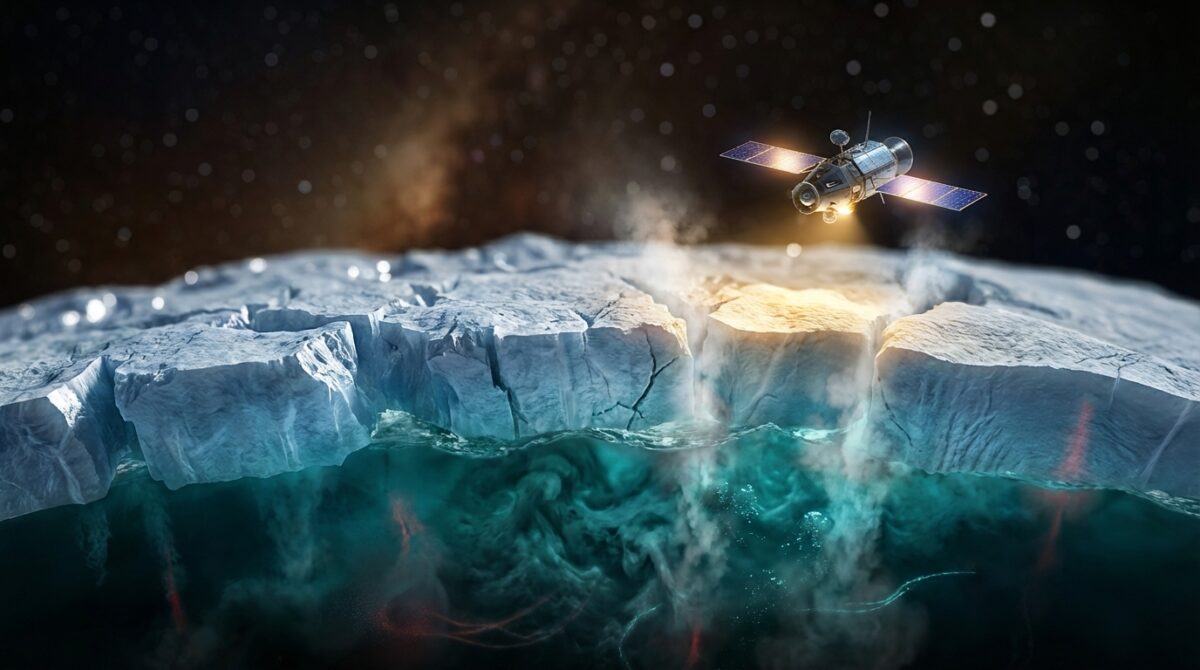
Imagine an ocean hotter than a jacuzzi, trapped beneath frozen crusts as thick as ice mountains. This isn’t science fiction—it’s what scientists now imagine lies at the heart of the small icy moons in our solar system.
This scenario of hidden boiling oceans completely changes the way you can look at these little white worlds orbiting Saturn or Uranus. For Clara, a fictional planetary scientist passionate about astrobiology, these moons have become her dream lab for tracking down extraterrestrial water… and perhaps some very real microbes.
Boiling oceans beneath the ice: what the new study reveals
Beyond Jupiter, Saturn, and Uranus, dozens of small moons spin through interplanetary cold. Several hide subsurface oceans, wedged between a frozen crust and a rocky core. Enceladus, for example, already spews water plumes from its polar cracks—a sign of intense thermal activity.
NASA Revamps Its Artemis Program for an Ambitious New Era of Moon Exploration
A Subtle Cosmic Whisper May Unlock the Secrets Behind the Universe’s Expansion
A study published in Nature Astronomy offers an unexpected angle: when the inner ice melts and the shell thins, the ocean can reach near-boiling conditions. The authors show that the drop in internal pressure, on some small bodies, can push water near the triple point, where ice, liquid, and vapor coexist.
Why internal pressure changes everything
On Earth, boiling water at high altitudes is easier because atmospheric pressure drops. On icy moons, it’s the same logic, but inside the body itself. When ice transforms to water, its volume shrinks and the pressure exerted on the ocean drops.
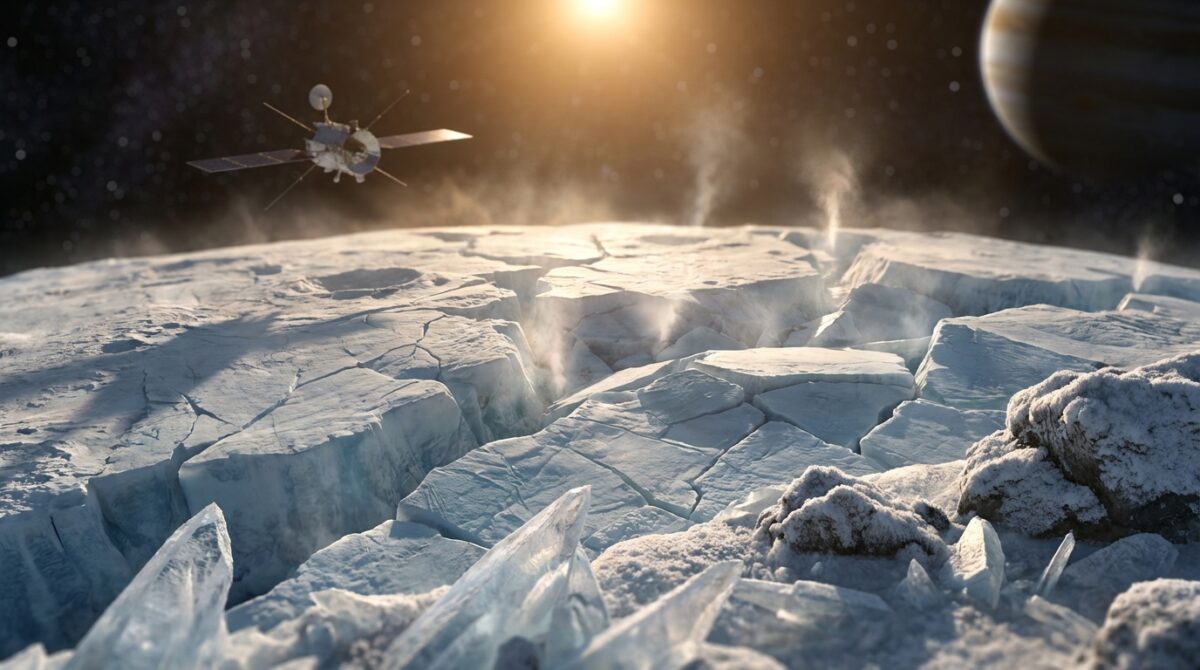
Simulations show that on moons like Mimas, Enceladus, or Miranda, this drop is enough to reach conditions where pockets of water can vaporize. These boiling ocean zones don’t reach the surface, yet they can reshape the landscape over millions of years.
How tidal forces heat subsurface oceans
For Clara, it all starts with the gravitational dance. With each orbit around their giant planet, these moons are stretched and then relaxed. This constant pumping generates heat—a bit like bending a paperclip until it warms up in your fingers.
When this tidal heating intensifies, the inner ice shell melts from below and becomes thinner. When it eases, the ice gains ground again, the ocean chemistry changes, and the crust thickens once more. These cycles of thinning and growth create both cracks, frozen mountains, and possible vapor chambers.
Strange landscapes sculpted by water vapor
Miranda, a small moon of Uranus, already looks like a geological patchwork in Voyager 2’s images. The coronae, those circular structures rimmed with steep cliffs, have intrigued specialists for decades. The study’s authors suggest that internal near-boiling episodes could have lifted, sunk, and then fractured these regions.
On Enceladus, the famous “tiger stripes” are evidence of another phase of the cycle, when the ice thickens and compresses the interior. The combination of high-pressure freezing phases and low-pressure degassing would create a highly varied geological menu, observable today by space exploration missions.
Moon size: when the small boil and the big break
The key, for Clara, comes down to a simple number: diameter. Research shows that the more modest moons are the best candidates for these confined boiling oceans. Their lower gravity allows internal pressures to drop more rapidly when the ice melts.
On Mimas, a sphere less than 250 miles wide, the interior ocean could experience these extreme episodes without the surface revealing much. A slight wobble, detected by orbital measurements, nevertheless betrays the presence of extraterrestrial water beneath a cratered, surprisingly calm surface.
Why big moons like Titania react differently
In contrast, more massive moons like Titania don’t allow their insides to drop so low in pressure. The simulation shows that, during a melting phase, the ice shell would crack before reaching the conditions necessary for water’s triple point.
As a result, these worlds would display large networks of fractures, evidence of a cycle in which the ice first thinned and then thickened again. For planetary science teams, comparing these morphologies helps identify which thermal scenario each moon has experienced.
Astrobiology: could life survive in almost-boiling oceans?
For a community focused on astrobiology, the question soon arises: can an ocean exposed to near-boiling phases still be habitable? Some terrestrial microorganisms withstand temperatures above 100 °C, near hydrothermal vents. These analogs offer clues for imagining similar niches beneath frozen crusts.
A detailed article on this research, presented by a recent scientific summary, notes that these episodes would be transient, framed by long, more stable periods. Gradients in temperature, salinity, and pressure could then sustain more varied ecosystems than we imagined.
What future missions will try to detect
Upcoming missions to ocean worlds will specifically target indirect signs of this internal thermal activity. Gravity variations, topographic anomalies, vapor or ice jets: every clue counts to reconstruct the dynamics of subsurface oceans.
Additional analyses, described by the publication in Nature Astronomy and several space exploration summaries, stress the need to connect interior geometry, pressure, and ocean chemistry. For Clara and for you, each new data point will help sketch these worlds more clearly—where water, ice, and vapor play a delicate game.
- Small moons: Lower internal pressure, higher risk of near-boiling episodes.
- Medium moons: Alternating cycles of crust cracking and freeze/thaw periods.
- Calm surfaces: Possible hidden ocean with no spectacular surface signs.
- Active plumes: Indicate direct coupling between interior ocean and space.
Which moons are the best candidates for internal boiling oceans?
Simulations highlight especially small icy moons like Mimas and Enceladus around Saturn, as well as Miranda around Uranus. Their low gravity allows a sufficient internal pressure drop, during ice melting, for conditions where water can coexist as ice, liquid, and vapor to occur. These episodes wouldn’t last continuously but would occur during phases of strong tidal heating.
Why do some icy worlds show fractures while others seem inactive?
It all depends on size, crust thickness, and thermal history. Larger moons, like Titania, reach stresses capable of cracking the ice before pressure allows internal vapor formation. The smaller ones can see pressure drop without breaking the shell, which lets the ocean boil locally, while keeping a seemingly frozen, cratered surface.
What’s the link between these hidden oceans and the search for life?
The presence of liquid extraterrestrial water, even deep below, remains a major criterion for astrobiology. Near-boiling phases can drive strong circulation, bring nutrients, and create chemical gradients. These conditions are reminiscent of certain terrestrial hydrothermal vents. Future missions will look for chemical and physical clues indicating if such environments have remained stable long enough to host microorganisms.
How do scientists test these subsurface ocean scenarios?
Understanding Legalities Owning Apollo Moon Rocks and Lunar Samples
Jupiter’s Moons Could Harbor the Building Blocks of Life from Their Formation
They combine numerical models, gravity measurements, landscape observations, and data from past missions. Work highlighted by specialist planetary science platforms compares different interior geometries and heat cycles. By adjusting parameters to reproduce observed landforms, such as Miranda’s coronae or Enceladus’s “tiger stripes,” they refine scenarios where the internal ocean goes through phases of strong vaporization.
Do these findings influence future space exploration missions?
Yes, these studies guide the choice of targets, instruments, and orbits. Knowing where pressure gradients and thermal activity are most pronounced helps prioritize certain moons for detailed flybys. Engineers can also adapt spectrometers and radars to detect signs of water vapor, recent fractures, or changes in crust thickness that would betray the presence of boiling oceans beneath the frozen crusts.