
Show summary Hide summary
- How students turned big data into a cosmic time capsule
- An “ancient immigrant” entering the Milky Way
- A rare chemical signature and a new view of star formation
- Inside the student experience: from homework to headline
- What this means for future cosmic explorers
- Why is SDSSJ0715-7334 considered one of the oldest known stars?
- How did students prove the star came from another galaxy?
- What makes this ancient star chemically unique?
- Can other students make similar discoveries using public data?
- Why are metal-poor stars so valuable to astronomy research?
- FAQ
- How do astronomers identify an ancient star entering the Milky Way?
- Why is discovering an ancient star in the Milky Way significant?
- Can students contribute to major astronomical discoveries?
- What does the chemical fingerprint of an ancient star reveal?
- How rare is it to find a star from the dawn of the universe in our galaxy?
A group project, a borrowed telescope, and a late-night observation turned into a cosmic discovery: students spotted an ancient star drifting into the Milky Way, carrying a message from the early universe. Here is how they pulled it off.
While most undergraduate work stays in notebooks, ten University of Chicago students rewrote a piece of astronomy history. Guided by Professor Alex Ji, they uncovered one of the oldest, most pristine stars ever measured, a rare witness to the first waves of star formation after the Big Bang.
How students turned big data into a cosmic time capsule
The story starts far from any telescope, inside a computer lab filled with SDSS files. The Sloan Digital Sky Survey, a global program involving more than 75 institutions, has been mapping the sky for a quarter of a century, releasing vast datasets to the scientific community.
How a Minuscule Claw in a 500-Million-Year-Old Fossil Revolutionized Our Understanding of Spider Origins
Landspace Conducts Test of 220-Ton Methane Engine Paving the Way for Next-Gen Heavy-Lift Rockets
In the “Field Course in Astrophysics,” Ji asked his students to dive into this ocean of spectra and pick out strange objects. Week after week, they sifted through thousands of stars, flagging anything with an unusual chemical fingerprint, eventually narrowing the list to 77 promising targets for live observation.
From database lines to a mountaintop in Chile
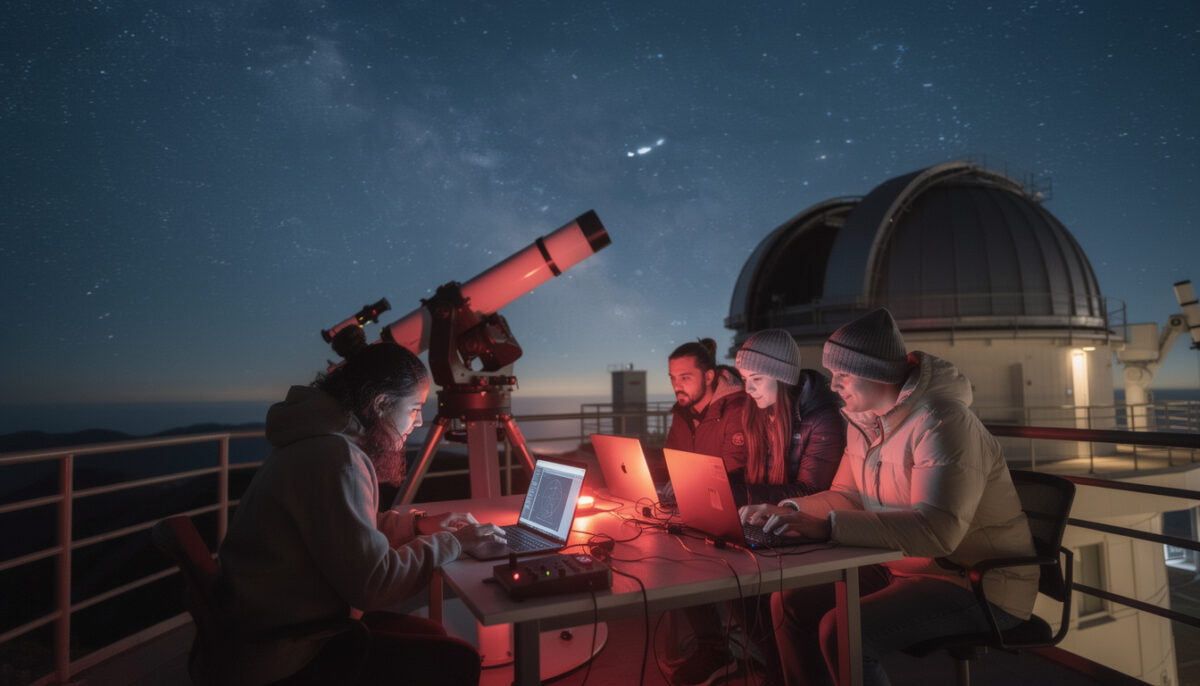
Spring Break usually means beaches; for this group it meant the thin air of Las Campanas Observatory in Chile. Using the Magellan telescope equipped with the MIKE spectrograph, they started checking their list, ten-minute exposure after ten-minute exposure, like a cosmic production line.
On March 21st, the second star of the night stopped them in their tracks. Catalogued as SDSSJ0715-7334, it showed spectral lines so clean and metal-poor that the class immediately abandoned their original plan and devoted hours to this single, mysterious object.
An “ancient immigrant” entering the Milky Way
Detailed analysis revealed something extraordinary: the star was composed almost entirely of hydrogen and helium, with virtually no heavier elements. That purity marks it as an ancient star, likely from the second generation formed after the universe’s first luminous objects ignited.
The team then compared its motion and distance with data from the ESA’s Gaia mission. Tracing its orbit backward showed that SDSSJ0715-7334 did not originate in our galaxy but in the Large Magellanic Cloud, a nearby dwarf galaxy, before its galactic entry into the Milky Way billions of years ago.
What “most pristine star” really means
Astronomers call all elements heavier than helium “metals.” The proportion of these in a star, its metallicity, reveals when and where it formed. SDSSJ0715-7334 has only about 0.005% of the Sun’s metal content, less than half the previous record holder, making it arguably the most chemically pristine star yet recorded.
Students such as Ha Do measured abundances for many elements and found all of them drastically suppressed. That pattern tells a clear story: this object was born before multiple generations of supernovae had a chance to enrich its birth cloud, opening a direct window on the stellar origins of the early universe. For a related topic, see our Sun possibly fleeing the Milky Way’s core.
A rare chemical signature and a new view of star formation
To squeeze every clue from the data, Ji split the class into thematic teams. One group, led by Natalie Orrantia and Ha Do, focused on carbon. Their result was almost unsettling: the carbon signal was so weak it barely registered, even with high-resolution spectra.
Ji connected this to an unusual formation pathway previously seen only once. The near-absence of carbon suggests the star’s birth cloud was seeded by a very early sprinkling of cosmic dust, rather than the richer chemical cocktail typical of later epochs. That scenario reshapes how researchers think about star formation in tiny primordial galaxies.
Why this cosmic discovery matters beyond one star
One object rarely changes a whole field, yet SDSSJ0715-7334 acts like a calibration point for models of the first stellar populations. Its orbit confirms that galaxies can trade ancient stars, much like the scenario described for our Sun’s own possible migration in studies such as research on the Sun’s potential escape from the galactic core.
The find also showcases how surveys like SDSS and Gaia democratise discovery. Just as other teams use them to probe extreme X-ray emitters or pristine objects – highlighted in reports such as UChicago’s coverage of chemically pristine stars – this student class turned public data into a cutting-edge result.
Inside the student experience: from homework to headline
For Orrantia, one memory stands out: staring at the guiding camera all night, terrified that a technical glitch might ruin the precious long exposure. That mix of responsibility and adrenaline is very different from solving textbook problems under fluorescent lights.
Several students now plan graduate careers in astronomy, encouraged by seeing their names attached to a high-impact result. Their journey mirrors other breakthrough projects, from moon-hunting campaigns around giant planets to bold concepts like searches for habitable exoplanets, where persistent work with big datasets suddenly pays off. Find out more from our habitable exoplanets list.
What this means for future cosmic explorers
The SDSS collaboration emphasises that discoveries like this are not reserved for a small elite. With open archives, motivated students anywhere can trace orbits, inspect spectra, and stumble upon their own fossil from the dawn of the universe. The barrier is less about access and more about curiosity and patience.
If a handful of undergraduates can spot an ancient star slipping quietly into the Milky Way, how many more relics are waiting in the data? The lesson is simple: the sky is mapped, but the stories hidden inside those maps are far from exhausted.
- Use public surveys: SDSS, Gaia and similar projects let anyone work with professional-grade stellar data.
- Learn basic spectroscopy: understanding absorption lines is the gateway to reading a star’s chemical history.
- Track stellar motions: orbits often reveal whether an object is a local native or a galactic visitor.
- Work in teams: splitting tasks by element or method, as this class did, speeds up analysis and deepens insight.
- Follow up with telescopes: database hints become real breakthroughs only when high-resolution observations confirm them.
Why is SDSSJ0715-7334 considered one of the oldest known stars?
Its spectrum shows extremely low metallicity—about 0.005% of the Sun’s metal content. That scarcity of heavy elements means it formed before most supernovae had enriched the cosmos, placing it among the earliest generations of stars after the Big Bang.
How did students prove the star came from another galaxy?
They combined high-resolution spectra with precise distance and motion data from the Gaia mission. By reconstructing its orbit backward in time, they found that the trajectory leads back to the Large Magellanic Cloud, rather than originating inside the Milky Way.
What makes this ancient star chemically unique?
Beyond its record-low metals, the star shows an extremely low carbon abundance, barely detectable even with sensitive instruments. That rare pattern points to an early dust-based formation pathway seen only once before, offering fresh clues about conditions in the first small galaxies.
Can other students make similar discoveries using public data?
Yes. Large surveys like SDSS and Gaia release their datasets openly. With training in data analysis and spectroscopy, motivated students can identify unusual objects, propose follow-up observations, and potentially uncover their own relics from the early universe.
Why are metal-poor stars so valuable to astronomy research?
They act as fossils, preserving the chemical and dynamical state of the early universe. By measuring their composition and motion, astronomers test theories of star formation, galaxy assembly, and the build-up of elements that later became planets and, ultimately, life.
FAQ
How do astronomers identify an ancient star entering the Milky Way?
Astronomers look for unique chemical signatures in a star’s spectrum, which can reveal its age and origin. Stars from the early universe often contain fewer heavy elements, making ancient stars entering the Milky Way easier to identify.
Why is discovering an ancient star in the Milky Way significant?
Finding an ancient star milky way helps astronomers study the conditions of the early universe. These stars act as living fossils, offering insights into how our galaxy formed and evolved.
Can students contribute to major astronomical discoveries?
Yes, student-led projects using large datasets and modern telescopes can make important discoveries. This recent ancient star milky way finding shows that even undergraduate researchers can contribute to major scientific breakthroughs.
What does the chemical fingerprint of an ancient star reveal?
Colorado Startup Lux Aeterna Secures $10 Million to Pioneer Reusable Satellite Technology Shaping the Future Space Economy
Potential First Observation of a ‘Dirty Fireball’ Star Explosion Unveiled
The chemical fingerprint shows the elements present in the star, pointing to its age and the environment in which it formed. Ancient stars usually have very low amounts of heavy elements compared to younger stars.
How rare is it to find a star from the dawn of the universe in our galaxy?
Finding an ancient star from the early universe in the Milky Way is exceptionally rare. Most of these stars have already died out, so each new discovery is valuable for understanding our galaxy’s past.