Show summary Hide summary
You will be alive when a 400‑meter asteroid skims closer than TV satellites and turns into a moving point of light in the sky. During this Close Earth Flyby, a Private Firm plans to land on it for real, not just in simulations.
That Near-Earth Object is asteroid Apophis, first seen in 2004 and quickly feared as a possible impactor. Early models gave it up to a 2.7 per cent chance of crashing into Earth in 2029, enough to wipe out an area the size of a metropolis. Refined orbital data have since excluded a collision for at least a century, turning panic into a unique research opportunity.
Apophis 2029: a once-in-millennia space encounter
On 13 April 2029, Apophis will pass just 32,000 kilometres from Earth. That is below many geostationary satellites and close enough for you to spot it with the naked eye from dark locations. For an asteroid of this size, such a passage happens only once in thousands of years.
Hubble Space Telescope Captures Stunning Breakup of Comet C/2025 K1 (ATLAS) in Space
Rocket Lab Successfully Deploys Eighth Synspective Radar Imaging Satellite to Enhance Earth Observation
Space agencies and companies are rushing to be there. Multiple spacecraft from the US, Europe, Japan, and China are being prepared to monitor the asteroid before, during, and after the flyby. Reports like this detailed overview of a private company preparing to land on Apophis show how fast plans are converging on this date.
The Near-Earth Object once seen as a threat
When astronomers first tracked Apophis, the calculated impact probability made headlines and triggered comparisons with dinosaur-ending strikes. Studies of ancient craters and events such as the giant impact that formed a glass desert in Brazil reminded everyone that large rocks do hit our planet.
Apophis has since been removed from risk lists for the next 100 years. Yet its unusually close pass turns it into a natural laboratory for Planetary Defense, allowing teams to test how gravity, tides, and surface shifts behave on a real asteroid under Earth’s pull.
How a private firm plans an asteroid landing for 2029
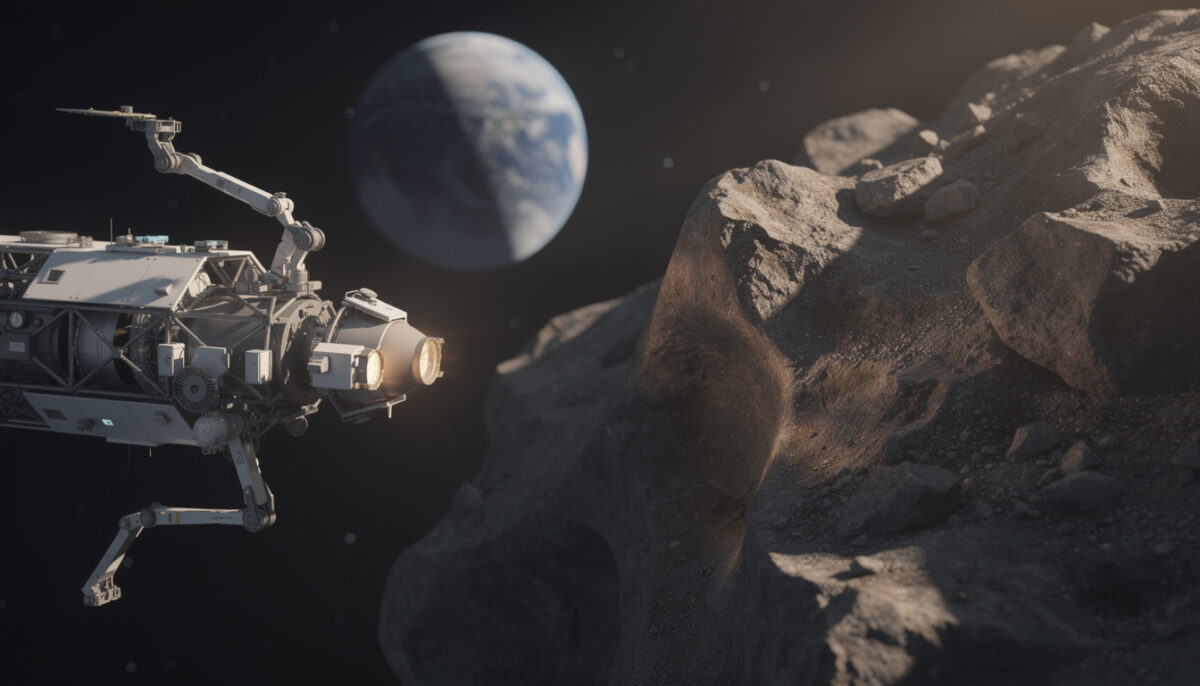
Enter ExLabs, a US startup positioning itself at the frontier of Asteroid Exploration and commercial Space Mission services. Its mothership, ApophisExL, has passed a key design review and targets launch in 2028, aiming to rendezvous with Apophis shortly before the flyby.
The concept is simple on paper and complex in practice. ApophisExL will act as a ride-share platform, carrying up to ten small spacecraft and instruments from different customers, including two Asteroid Landing systems: one from an undisclosed partner and one from Japan’s Chiba Institute of Technology.
Shoebox lander, one-hour descent
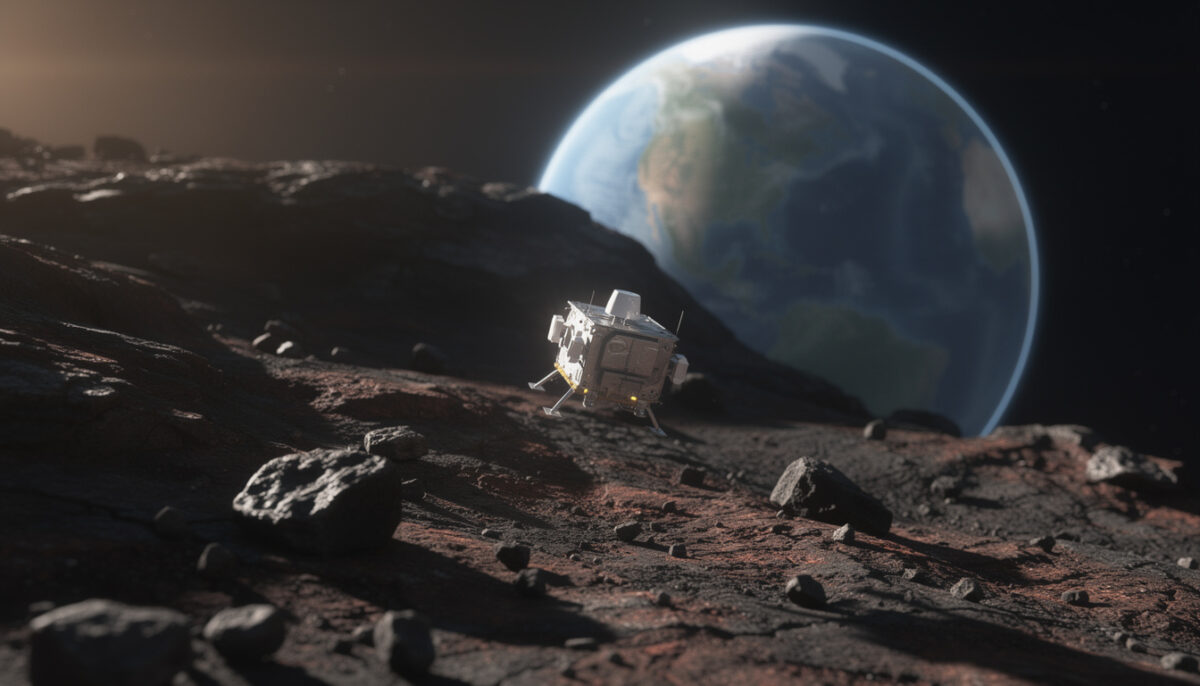
The Chiba lander is roughly the size of a shoebox, but its mission is ambitious. ExLabs plans to release it about 400 metres above Apophis. From there, it will descend at around 10 centimetres per second, taking close-up images all the way down.
After roughly an hour of controlled fall in microgravity, the craft should settle gently on the surface. The aim is to obtain high-resolution imagery and local surface data that no telescope or flyby can provide. For a private operator, achieving this would mark a new stage in Space Technology maturity.
Coordinated armada: ExLabs, Ramses and NASA probes
ExLabs will not be alone. The European-Japanese mission Ramses (Rapid Apophis Mission for Space Safety) is being designed to reach Apophis ahead of the flyby. Ramses will deploy its own lander equipped with a seismometer to listen for mini-quakes caused by Earth’s gravity.
Researchers expect landslides, boulder shifts, and subtle tremors as Apophis experiences tidal forces during its close pass. Ramses might even record the touchdowns of the ExLabs landers, giving scientists a rare chance to correlate surface vibrations with specific events on a small body.
Why landing happens after the Close Earth Flyby
ExLabs plans to attempt its landings up to a week after the closest approach. The timing is deliberate. Any impact or mishap before the flyby could slightly nudge Apophis’s path, with the risk being amplified by Earth’s gravity field.
By waiting until the asteroid has moved away, mission planners limit any chance of affecting its orbit. This approach protects both scientific goals and public confidence in Planetary Defense strategies, which already rely on detailed risk assessments like those discussed in this guide to evaluating asteroid impact danger.
What scientists hope to learn from asteroid Apophis
Researchers such as Patrick Michel, project scientist for Ramses, highlight several high-value questions. How does an asteroid’s regolith respond to a strong gravitational sweep? Do boulder fields rearrange, or does everything stay surprisingly stable?
Touching the surface answers more than just geology questions. Knowing the softness or hardness of Apophis’s outer layers informs future deflection techniques. If humanity ever needs to push a threatening asteroid off course, engineers must know whether they are dealing with solid rock, rubble, or something in between.
Key goals for this wave of Space Missions
Across government and commercial projects, four priorities dominate the planning for Apophis:
- Map surface changes before and after the flyby to see how Earth’s gravity reshapes the asteroid.
- Measure internal structure using seismometers and dynamical tracking of the asteroid’s spin and wobble.
- Test close-operations Space Technology, including navigation, landing and sample-contact manoeuvres near a small body.
- Validate Planetary Defense models that predict how asteroids respond to forces and potential deflection attempts.
Each objective feeds directly into future strategies for monitoring and, if needed, redirecting hazardous objects that pass near Earth.
From science fiction to business model in asteroid exploration
For ExLabs, Apophis is both a proving ground and a showroom. If ApophisExL can safely deploy several payloads and enable a successful Asteroid Landing, the company can later offer similar services around other Near-Earth Objects.
Other players are watching closely. NASA’s OSIRIS-APEX, a re-tasked sample-return spacecraft heading toward Apophis, and projects described in sources such as analyses of twin spacecraft joining the flyby, show how quickly the ecosystem around this asteroid is expanding.
Coordinating in a crowded sky
With probes from several continents converging on one relatively small rock, coordination becomes more than just good manners. Trajectories, landing sites, and communication windows must be shared to avoid interference.
Scientists stress that “the world will be watching.” A misstep or collision between missions would damage not only hardware but also public trust in complex, multinational Space Missions. Success, on the other hand, would signal that humanity can work together in space when it truly matters.
Will asteroid Apophis hit Earth in 2029?
No. Early calculations suggested a small chance of impact, but refined tracking has ruled out a collision in 2029 and for at least the next 100 years. The 2029 event is a very close pass, not a crash, which makes it perfect for scientific study and planetary defense tests.
How close will Apophis come during its flyby?
Apophis will pass about 32,000 kilometres from Earth’s surface, inside the belt of many geostationary satellites. That distance is close enough for observers under dark skies to see the asteroid as a moving point of light without a telescope.
What makes the private firm mission to Apophis special?
ExLabs aims to be the first private company to land on an asteroid during a historic close flyby. Its ApophisExL spacecraft will deploy multiple small payloads, including shoebox-sized landers that will attempt gentle touchdowns and capture detailed images of the surface.
Why are landings planned after the closest approach?
Astronomers Uncover Cosmic Collision That Tore Apart a Nearby Galaxy
Astronomers Unveil a Growing Family of Moons Orbiting Jupiter and Saturn
Mission teams want to avoid any possibility of changing Apophis’s orbit before Earth’s gravity acts on it. By landing a few days to a week after the flyby, they ensure that even an unexpected collision with the asteroid cannot significantly alter its trajectory toward our planet.
How does studying Apophis improve planetary defense?
By observing how Apophis’s surface and interior react to Earth’s tidal forces, scientists can refine models of asteroid behaviour. Data from seismometers, cameras, and tracking instruments will guide future impact-risk assessments and help design more reliable deflection missions if a truly dangerous asteroid is ever discovered.