
Show summary Hide summary
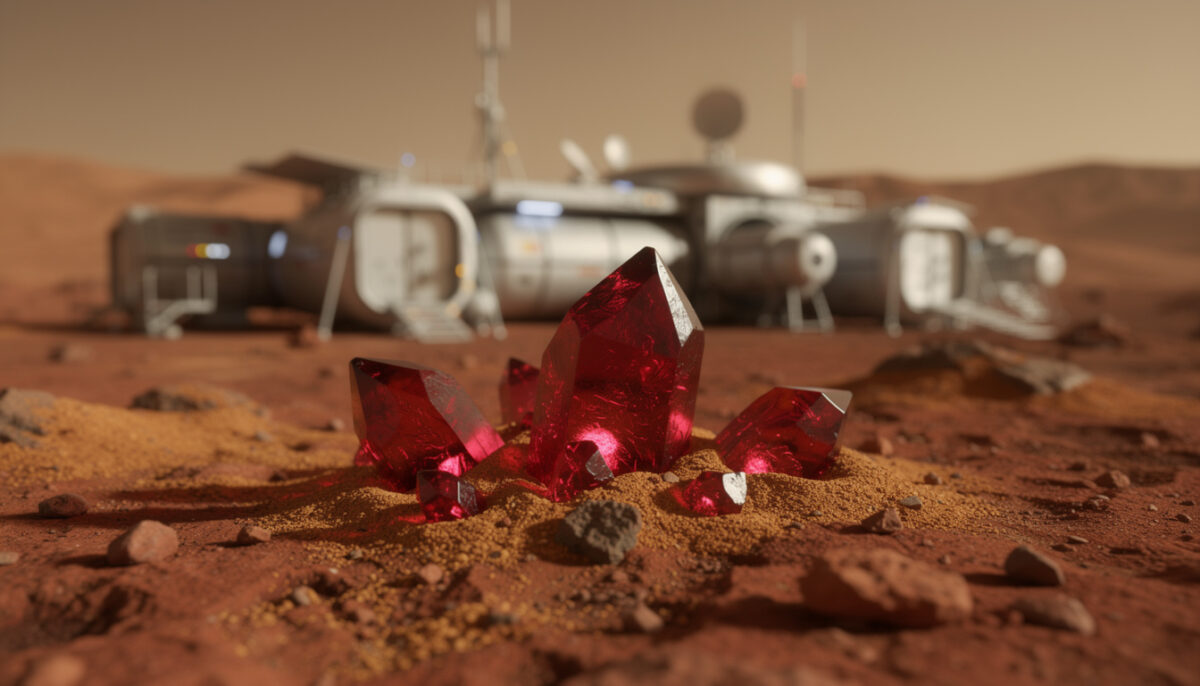
Picture your rover camera feed lighting up with tiny flashes on a dusty rock: Fluorescent, ruby-like gems glowing on Mars, where no one expected them. This discovery is more than a pretty picture. It rewrites parts of Martian geology and gives planetary science fans a completely new puzzle to solve.
Fluorescent ruby-like gems on Mars: what was found
NASA’s Perseverance rover has identified microscopic crystals inside Martian pebbles that behave like rubies and sapphires under laser light. These gems are made of corundum, the same mineral family as Earth’s rubies and sapphires, and they shine when hit by the rover’s laser, giving off a clear fluorescent signal. For a planet never known to host such minerals, this is a genuine first. You can read about the Apollo Moon Rocks Reveal New Insights Into Lunar Magnetic Mysteries for more on extraterrestrial mineral discoveries.
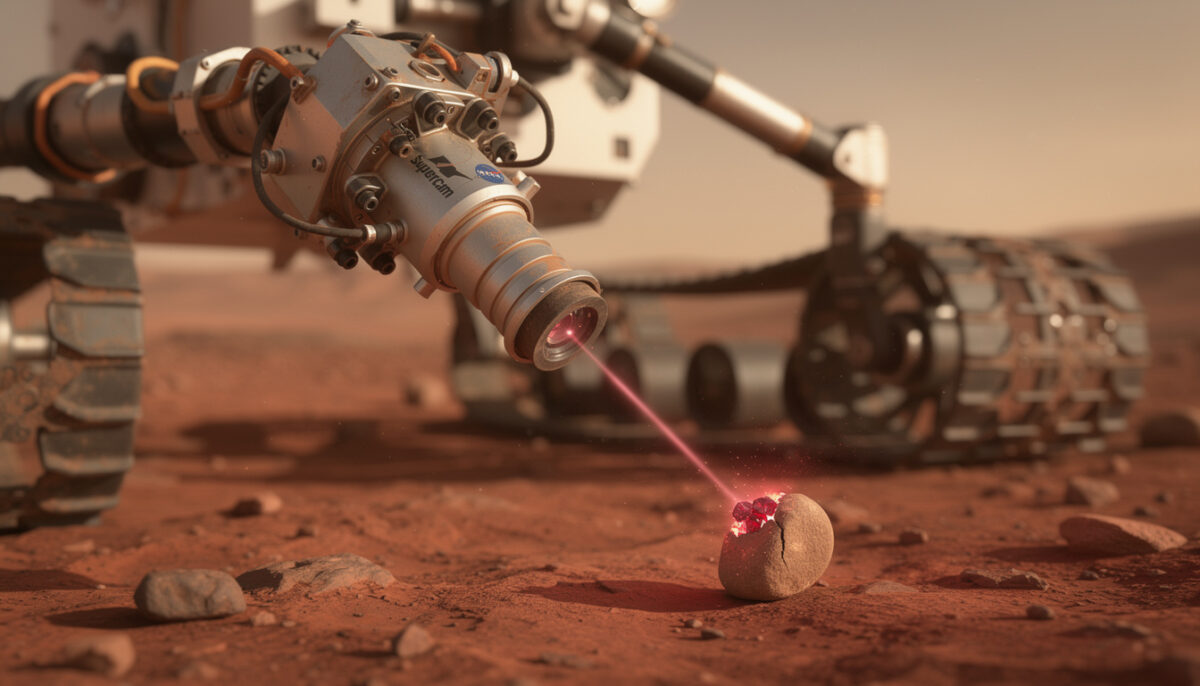
The story began on a rock nicknamed Hampden River, sitting on the rim of Jezero crater. When the rover’s instruments probed it, the spectral signature closely matched lab measurements of terrestrial rubies. Two other pebbles, called Coffee Cove and Smiths Harbour, showed the same pattern. Suddenly, Mars went from “dusty basalt world” to host of hidden precious stones.
Astrophotographer Captures Stunning Image of Thor’s Helmet Nebula Emitting Light from 15,000 Light-Years Away
Officina Stellare Secures $2 Million Deal to Develop Laser Communications Ground Station in Spain
How Perseverance’s lasers caught the Martian glow
The key player here is SuperCam, Perseverance’s mast-mounted instrument. It uses two different lasers: one vaporises a tiny patch of rock to analyse the resulting plasma, the other triggers luminescence to reveal how atoms are arranged. Two cameras then read the light in extreme detail, like a fingerprint for minerals. For these pebbles, both tests screamed “corundum”, matching Earth samples point for point.
Researchers such as Ann Ollila from Los Alamos National Laboratory shared the data at the Lunar and Planetary Science Conference in Texas. Independent experts in space materials, including Allan Treiman, admitted being caught off guard by these results. Multiple outlets, from specialist magazines to general media, quickly relayed how unexpected this signature looked for a supposedly tectonically quiet planet.
Why ruby-like corundum on Mars shocks geologists
On Earth, corundum usually forms in rocks linked with strong geology: mountain-building, crust deformation, and extreme pressure and temperature. These environments are often aluminium-rich and very poor in silica. Earth’s rubies from Myanmar or sapphires from Kashmir fit this picture. Mars, by contrast, has no plate tectonics, so the same recipe should not work there. That is exactly why this first Martian detection surprised specialists. To explore other surprising planetary phenomena, see Astronomers Believe They’ve Observed a Rare Collision Between Two Planets.
Instead of continents colliding, scientists now suspect impact events. When meteorites slammed into ancient Martian crust, they would have briefly reached pressures and temperatures high enough to reorganise aluminium-rich material into corundum. In other words, where Earth uses tectonic collisions as a furnace, Mars may have relied on violent impacts to forge its Ruby-Like grains.
Microscopic size, huge scientific implications
The crystals themselves are tiny, under 0.2 millimetres across. In rover images, the pebbles look like dull, white stones. No obvious red or blue sparkles that you would recognise as jewellery-grade gems. Only the fluorescent response under laser reveals their true nature. Researchers joked that they would love to pick one up and check if it looks red to the naked eye, but for now, that remains out of reach. This scenario parallels discoveries like those found in Jupiter’s Moons Could Harbor the Building Blocks of Life from Their Formation.
Even at this microscopic scale, though, these grains serve as time capsules. They record pressure, temperature, and chemistry conditions you cannot see otherwise. For planetary scientists, one well-characterised speck of corundum can be as informative as a whole boulder of ordinary basalt. That is why dedicated coverage, like the report on Perseverance’s gem hunt, has captured so much interest beyond traditional science circles.
What these Martian gems reveal about the planet’s history
These gems are not just curiosities; they are new constraints on how Mars evolved. Their presence suggests aluminium-rich layers in the crust, now partially exposed in Jezero crater. Combined with impact-driven formation, they point toward a period when meteorite bombardment reshaped local rocks and potentially affected early surface conditions, including how heat and fluids moved through the subsurface.
For a planetary geologist like our fictional researcher Dr. Sara Lee, working on returned samples planning, this changes priorities. Instead of focusing only on clays and volcanic rocks, she now has to consider how tiny corundum grains might encode temperature histories or shock pressures. One microscopic inclusion could tell her whether a pebble sat near an impact melt pool or cooled more gently at depth.
How this discovery guides future Mars exploration
Every new mineral type identified by Perseverance helps refine decisions about which samples to cache for eventual return to Earth. Corundum-bearing pebbles now join the list of high-value targets. Their fluorescent behaviour also validates the use of laser-induced techniques for spotting rare phases across distant planets, an approach that will matter on future missions to icy moons or asteroids.
The finding also boosts the connection between space exploration and high-pressure experimental labs back on Earth. By reproducing Martian-like impacts in the lab, teams can verify whether their synthetic corundum matches rover spectra. Several outlets, including international news reports, highlight how this loop between field robots and terrestrial labs is reshaping modern planetary science.
Key takeaways for space and geology enthusiasts
If you follow Mars missions closely, this discovery is worth bookmarking. It enriches your mental map of the planet: not just basalts, clays, and salts, but also rare minerals forged in extreme events. It links classic gemology from Earth with impact physics in deep space, and shows how much science can be extracted from less than a millimetre of crystal.
For fans tracking Perseverance’s road trip around Jezero, those unassuming names – Hampden River, Coffee Cove, Smiths Harbour – now stand beside more famous Martian sites. Each rock is a reminder that the most transformative clues often hide in the smallest grains.
- First fluorescent ruby-like gems on Mars: tiny corundum crystals found in three pebbles in Jezero crater.
- Detected by laser-based SuperCam: spectral signatures match terrestrial rubies and sapphires.
- Likely formed by impacts: meteorite shocks replaced the role of plate tectonics seen on Earth.
- Huge value for planetary science: new constraints on Martian geology, crust chemistry, and impact history.
- Future mission impact: guides which samples Perseverance should cache for possible Earth return.
Are the Martian gems real rubies and sapphires?
The crystals are made of corundum, the same mineral that forms rubies and sapphires on Earth. However, scientists cannot yet see their colour or clarity, only their spectral fingerprint and fluorescent response. In gemological terms, they behave like ruby-like or sapphire-like grains, but on a microscopic scale, not as jewellery stones.
How did these fluorescent gems form on Mars without plate tectonics?
Researchers think powerful meteorite impacts heated and compressed aluminium-rich rocks in a silica-poor environment, creating the right conditions for corundum to crystallise. On Earth, similar pressures and temperatures occur mainly through plate tectonics, but on Mars, impacts appear to have played that role.
Can Perseverance bring these corundum grains back to Earth?
Perseverance is collecting and sealing selected rock cores for a potential Mars Sample Return campaign. If mission planners judge the corundum-bearing pebbles as scientifically valuable and technically accessible, they can be drilled and cached. Any return, however, depends on future missions retrieving and transporting those tubes back to Earth.
Why does the fluorescence of the gems matter to scientists?
Fluorescence reveals how atoms are arranged in the crystal and can highlight trace elements, such as chromium or iron, that influence colour and formation conditions. On Mars, this glowing response confirms the presence of corundum and helps reconstruct the pressure, temperature, and chemical environment during crystal growth.
Could similar gems exist elsewhere in the solar system?
Wherever aluminium-rich rocks experience intense heating and compression, corundum can potentially form. That means other rocky planets, large moons, or even some asteroids might host similar grains. The Martian discovery encourages future missions to carry laser-based instruments to search for corundum and related minerals beyond Mars.
FAQ
What are ruby gems on Mars and how were they discovered?
Ruby gems on Mars refer to fluorescent, ruby-like crystals identified by NASA’s Perseverance rover inside Martian pebbles. These gems, composed of corundum, revealed their presence when they glowed under the rover’s laser, marking the first such discovery on Mars.
Are the ruby gems on Mars the same as rubies found on Earth?
The ruby gems on Mars are chemically similar to terrestrial rubies because they are made of corundum. However, their formation process and Martian environment make them unique compared to those on Earth.
Why is the discovery of ruby gems on Mars significant for science?
Finding ruby gems on Mars challenges previous assumptions about Martian geology and mineral diversity. It opens new questions about Mars’s geological history and the processes that could create such gems on another planet.
Where on Mars were the ruby gems found?
Artemis 2 Moon Rocket Returns to Launch Pad | Stunning Space Image Feature for March 20, 2026
Blue Origin Enters the Competition for Orbital Data Centers
The ruby gems on Mars were first identified in rocks located on the rim of the Jezero crater, including specimens nicknamed Hampden River, Coffee Cove, and Smiths Harbour. These areas exhibited strong fluorescent signals during rover analysis.
What could the ruby gems on Mars tell us about the planet’s past?
The presence of ruby gems on Mars suggests unique geological conditions and possibly a more complex history of mineral formation. Studying these gems may reveal new insights into the planet’s ancient environment and water activity.