
Show summary Hide summary
Imagine a radio signal so intense that, for a split second, it outshines an entire galaxy in radio waves. Astronomers have just traced such a Fast Radio Burst directly to its birthplace, opening a new chapter for Radio Astronomy and cosmic forensics.
This story follows how one extraordinary detection, FRB 20250316A—nicknamed RBFLOAT—went from a millisecond blip to a precisely located celestial event in a nearby galaxy, thanks to a global team working almost in real time. For more on related cosmic phenomena, see how radio waves unveil the secrets leading up to a star’s cataclysmic explosion.
The brightest fast radio burst ever pinpointed in space
On March 16, 2025, the CHIME telescope caught an unusually intense Fast Radio Burst, now catalogued as FRB 20250316A. The burst lasted about a fifth of a second, yet during that instant it became one of the brightest radio sources ever recorded. Your entire experience of this cosmic phenomenon would have fit into a blink.
Our Sun Possibly Fled the Milky Way’s Core Alongside Thousands of Sibling Stars
A Black Hole and Neutron Star Engage in a Mysterious Oval Dance Before Colliding
FRBs are ultra-brief flashes of radio waves crossing intergalactic space. Since 2018, CHIME has logged thousands of them, but pinpointing their exact burst origin has usually been tricky. For RBFLOAT, astronomers were ready: a new CHIME/FRB Outrigger array in British Columbia, Northern California and West Virginia was finally online, turning a fleeting signal into a precisely mapped target. Explore more about the invisible forces potentially ripping the universe apart for a deeper understanding of cosmic structures.
How very long baseline interferometry cracked the FRB mystery
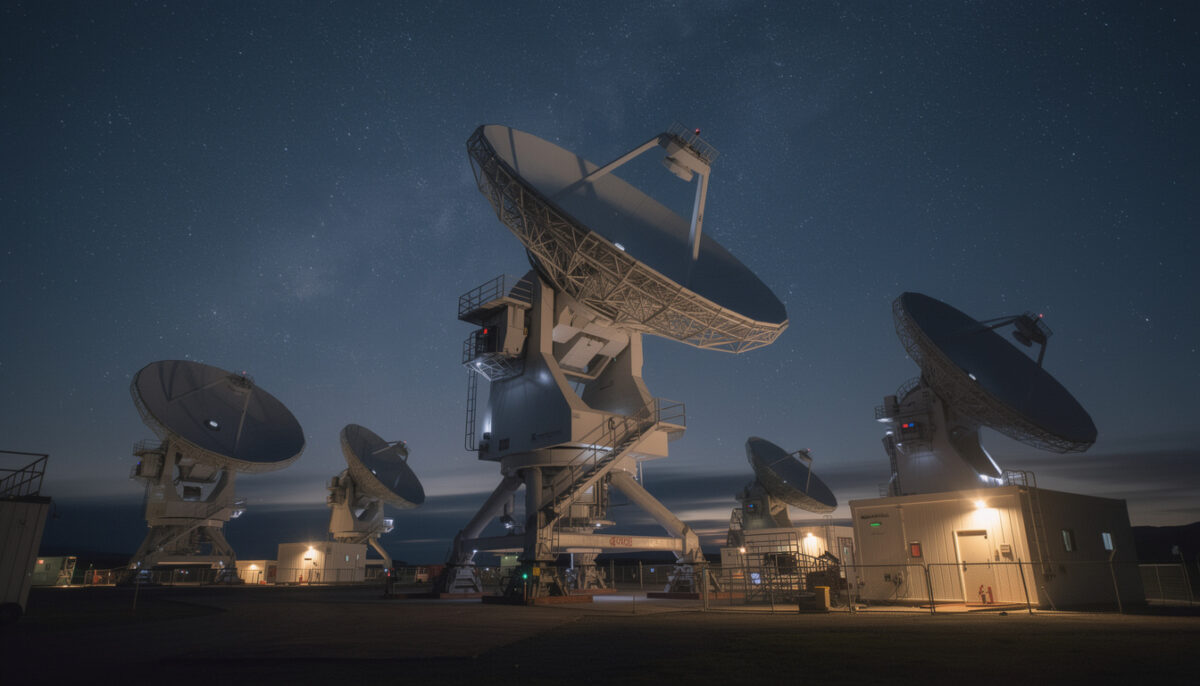
The outriggers act like small copies of CHIME, spread across North America. By combining their data through Very Long Baseline Interferometry, astronomers measured tiny timing differences in the arriving radio waves. That timing pattern let them triangulate the burst origin with astonishing accuracy.
Mattias Lazda, a doctoral researcher at the University of Toronto, described how a power outage almost ruined everything. A few hours after the detection, one crucial station went dark. Had the burst arrived later, that piece of the interferometry puzzle would be missing, and the most intense FRB on record would have remained just another anonymous spike in the noise. Discover more about how astronomers unveil a breathtaking radio color portrait of the Milky Way.
A nearby galaxy, a tiny region and a huge insight
The analysis pointed to the outskirts of NGC 4141, a galaxy roughly 130 million light-years away in Ursa Major. For Astronomy, that distance counts as the local neighborhood, giving researchers a rare chance to examine a relatively ordinary-looking FRB in striking detail.
By combining CHIME and outrigger data, the team shrank the source region down to only about 45 light-years across, smaller than many star clusters. One astronomer compared the feat to spotting a guitar pick from 1,000 kilometers away. That level of precision matches the best earlier cases reported by projects like Very Large Array studies of bright FRBs, but here it involves the most intense event CHIME has ever seen.
Teamwork, Zoom calls and a Sunday science sprint
When CHIME flagged RBFLOAT, it was a Sunday afternoon for many collaborators. Amanda Cook, leading the radio analysis, recalls how scientists quickly gathered in an online meeting, sharing plots, code snippets and rapidly evolving interpretations. The aim was simple: lock down the position fast enough to trigger follow-up telescopes.
This coordinated response mirrors other recent campaigns in Astrophysics where teams chase fleeting space transients, from gravitational-wave mergers to unusual supernova “chirps” discussed in reports such as magnetar-related signal studies. RBFLOAT joins that new era, where quick reaction transforms a random blip into a fully characterized astrophysical event.
James Webb spots a faint glow at the burst origin
With the coordinates nailed down, the James Webb Space Telescope could finally zoom in on the exact spot in NGC 4141. Webb’s near-infrared cameras revealed a surprisingly faint signal right where RBFLOAT originated, the first time individual stars around such an intense FRB have been clearly resolved.
Peter Blanchard and colleagues interpreted this glow as either a red giant star or a fading “light echo” from the celestial event itself. That ambiguity might sound frustrating, yet it marks a step change: Radio Astronomy can now link millisecond bursts to specific stellar environments, not just fuzzy galactic blobs, echoing earlier localization milestones covered by outlets like Smithsonian’s reporting on bright FRBs.
What the host environment reveals about FRBs
RBFLOAT’s neighborhood lies in the outer regions of its galaxy, away from the busiest star-forming zones. That contrasts with some repeating FRBs that sit in dense, energetic regions. The comparison sharpens debates on whether different FRB classes arise from different engines.
By mapping stellar types around the source, Webb helps researchers test scenarios ranging from highly magnetized neutron stars to one-off explosions. The environment may tell you more about the engine than the burst itself, turning host-galaxy cartography into a core tool of modern Astronomy.
A non-repeating burst that challenges leading theories
One of the big surprises: despite its intensity, FRB 20250316A has not repeated. Researchers combed through more than six years of CHIME data for the same sky location and found nothing else. For a field where many best-studied sources are prolific repeaters, that silence matters.
This absence of follow-up flashes pushes theorists to revisit models. Some earlier work, including analyses highlighted in deep dives on powerful FRBs detected by CHIME, leaned on the idea that all FRBs repeat if you wait long enough. RBFLOAT opens the door to more explosive, one-time engines, at least for a subset of events.
What this means for the future of radio astronomy
For students of Astrophysics like our fictional grad student Maya, RBFLOAT is a template for how next-generation observatories will work. Wide-field monitors catch the first hint, outrigger arrays nail the coordinates, and multiwavelength giants like JWST dissect the aftermath.
This pipeline turns FRBs from curiosities into precise tools. Their radio waves carry imprints of plasma, magnetic fields, and matter between galaxies, letting scientists probe how the universe is structured and how galaxies evolve, much like recent work using radio precursors to track the run-up to stellar explosions described in observational studies of pre-supernova radio activity.
Key takeaways from the RBFLOAT fast radio burst discovery
If you share this story with a fellow fan of extreme space events, a few points deserve to be highlighted. They sum up why RBFLOAT already stands as a reference case for every upcoming Fast Radio Burst campaign. For related discoveries, read about how Webb captures the last radiant exhalation of a dying star.
- RBFLOAT is one of the brightest FRBs ever recorded, briefly rivaling the total radio output of its host galaxy.
- Its origin was pinpointed to a 45 light-year region in NGC 4141 using CHIME plus outrigger Radio Astronomy techniques.
- James Webb detected a faint infrared counterpart, resolving individual stars around the burst origin for the first time at this brightness level.
- No repeat bursts have been seen in more than six years of data, challenging the assumption that all FRBs are repeaters.
- Two coordinated research papers now frame FRBs as precision tools for mapping cosmic matter, not just mysterious flashes.
What exactly is a Fast Radio Burst (FRB)?
A Fast Radio Burst is a very brief, intense pulse of radio waves coming from deep space. Each event typically lasts from a fraction of a millisecond up to a few seconds. Despite their short duration, FRBs can release more radio energy than the Sun emits over several days, turning them into powerful probes for understanding matter between galaxies.
Why is FRB 20250316A, or RBFLOAT, so important?
RBFLOAT stands out because it is one of the most intense FRBs ever detected and has been localized with extraordinary precision to the outskirts of the nearby galaxy NGC 4141. This combination of brightness, accurate sky position and follow-up observations with the James Webb Space Telescope makes it a benchmark case for testing FRB theories and studying their environments.
Has RBFLOAT produced any additional bursts?
No repeat bursts have been observed from the same location despite more than six years of monitoring data from CHIME. This non-repeating behavior distinguishes RBFLOAT from many of the best-known FRBs, which emit multiple bursts. The lack of repeats supports models involving more explosive, potentially one-off events for at least some FRBs.
How did astronomers determine the burst origin so precisely?
Astronomers Believe They’ve Observed a Rare Collision Between Two Planets
Unusual Chirping Signals from a Supernova Confirm the Long-Contested Magnetar Hypothesis
Astronomers relied on Very Long Baseline Interferometry using the CHIME/FRB Outrigger array, which combines signals from telescopes in British Columbia, Northern California, and West Virginia. Tiny timing differences in the arrival of the radio waves were converted into an accurate sky position, narrowing the source region down to about 45 light-years across in its host galaxy.
What role did the James Webb Space Telescope play in this discovery?
Once the radio telescopes locked down the FRB location, the James Webb Space Telescope pointed its infrared instruments at that patch of NGC 4141. Webb detected a faint infrared source at the exact FRB position and resolved nearby stars. These observations help researchers connect FRBs to specific stellar environments and refine theories about the kinds of objects capable of generating such powerful radio flashes.