Show summary Hide summary
- Astronomers track a star that suddenly “went bonkers”
- How planetary science explains such violent crashes
- Infrared glow reveals fresh debris from two planets
- What this astronomical discovery changes for exoplanets
- Why a single collision matters for life in the universe
- Key takeaways you can share in one message
- How do astronomers know two planets collided near Gaia20ehk?
- Why is a planetary collision such a rare event to observe?
- Could new planets or moons form from the Gaia20ehk debris?
- What role will future telescopes play in finding more collisions?
- Does this discovery change how we search for habitable exoplanets?
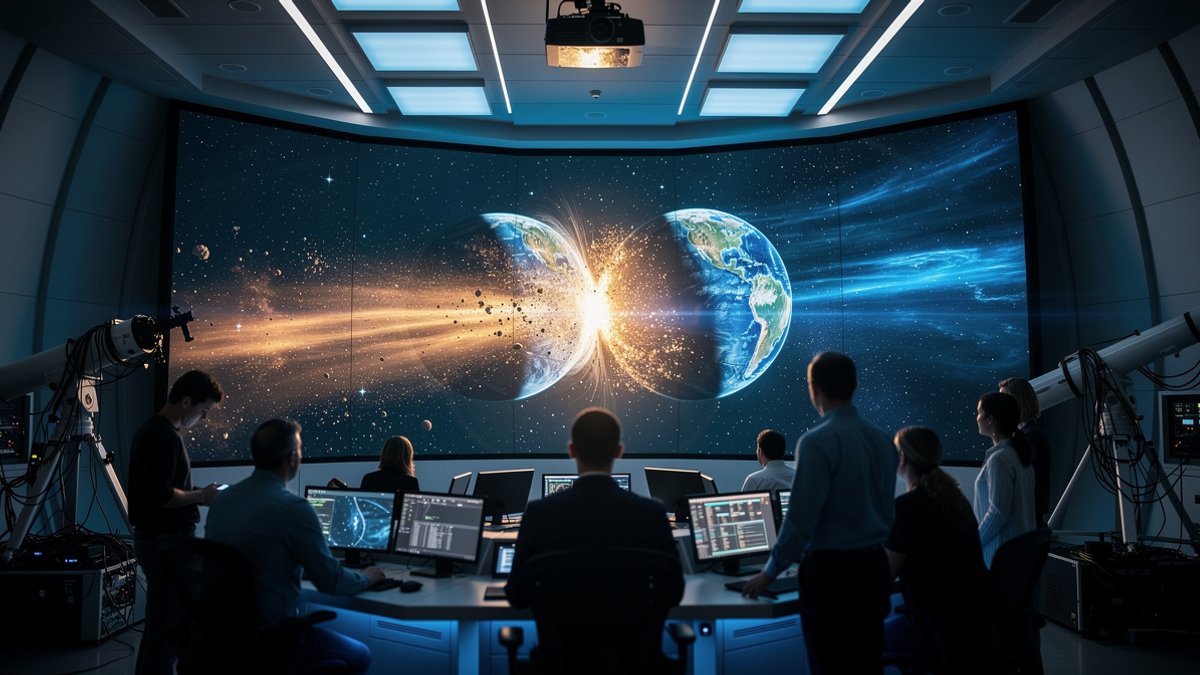
Imagine two planets the size of Jupiter grinding toward each other for years, then smashing together in a flash hotter than lava. That scene just played out 11,000 light years away, and astronomers think they caught the whole planetary collision observed in action.
For anyone who follows astronomy, this is the kind of rare event that instantly rewrites models, sparks debates, and fills late-night Slack channels in observatories.
Astronomers track a star that suddenly “went bonkers”
In 2020, researcher Anastasios (Andy) Tzanidakis was combing through archived data when a supposedly boring star, Gaia20ehk, jumped off the screen. This sun-like object, parked near the constellation Puppis about 11,000 light years from Earth, should have shone with textbook stability. Instead, its light curve looked like a lie detector test.
Unusual Chirping Signals from a Supernova Confirm the Long-Contested Magnetar Hypothesis
Chickpeas Poised to Become the Moon’s First Cultivated Crop
Data going back to 2016 revealed three clean dips in brightness, then around 2021, the star’s output started fluctuating wildly. For a main-sequence star, this kind of erratic flicker rang alarm bells. The team quickly ruled out stellar hiccups and began chasing another culprit: something large, dusty, and orbiting in front of the star.
From strange flicker to planetary collision hypothesis
The pattern pointed to enormous amounts of rock and dust crossing our line of sight. These clouds partially blocked Gaia20ehk’s light, creating prolonged dimming episodes. That behavior matched what you would expect after a violent cosmic impact between massive celestial bodies.
Multiple facilities happened to be watching the system, turning this into a rare multi-telescope event. Compared with other suspected collisions, this one looked unusually similar to scenarios proposed for the impact that formed Earth’s moon, giving planetary scientists something very personal to compare against.
How planetary science explains such violent crashes
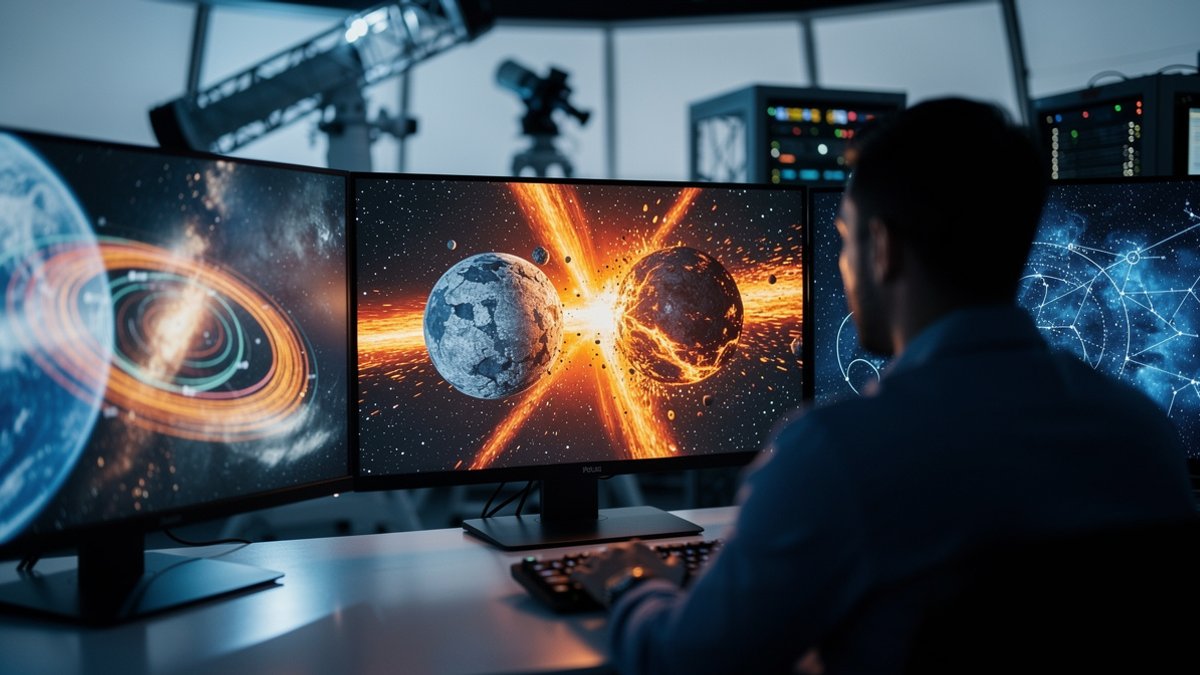
Around young stars, planet formation is more demolition derby than quiet construction site. Disks of gas, ice, and rocks swirl, clump, and repeatedly collide under gravity’s pull. Some growing worlds merge into larger planets, others are shattered or ejected into interstellar space.
Over tens of millions of years, this chaos gradually settles into a stable architecture like our solar system. Collisions large enough to melt or vaporize worlds are expected in theory, but catching one at the right moment, and from the right vantage point, demands an incredible stroke of observational luck.
Why we almost never see these rare events
Even if such impacts happen frequently across the galaxy, Earth must sit in the perfect line for the debris to cross in front of the star. On top of that, the dimming unfolds slowly, often over years. Researchers like Tzanidakis specialize in teasing out these long stories from decades of measurements rather than chasing short, dramatic bursts.
This slow-burn approach, similar to work behind studies like previous worlds-in-collision candidates, is opening a new window on the most violent phase of planet building, one spreadsheet at a time.
Infrared glow reveals fresh debris from two planets
The key breakthrough came when the team switched from visible to infrared data gathering. In visible light, Gaia20ehk dimmed and flickered. In infrared, the signal did the opposite: it surged. That inversion implied that whatever blocked the star was not cold dust, but intensely heated material glowing on its own.
A planetary collision observed releasing enormous energy offers a straightforward explanation. Earlier, more modest dips could mark grazing encounters as the two worlds spiraled inward. The later infrared spike would then capture the final catastrophic smash, when debris was heated to extreme temperatures.
A scenario echoing Earth and the moon’s violent past
Models of the Gaia20ehk system suggest the debris orbits at roughly one astronomical unit, around the same star-to-planet distance that Earth enjoys. That distance would keep material warm but not instantly vaporized, allowing dust and boulders to slowly clump together again.
If that interpretation holds, the cloud might eventually assemble into a new planet-moon pair, reminiscent of theories about how a Mars-sized body hit the early Earth. Studies like other reported world-ending impacts now have a fresh benchmark to compare against.
What this astronomical discovery changes for exoplanets
This single system forces a rethink of how astronomers interpret faint points in exoplanet surveys. A glowing, expanding dust cloud can mimic a regular planet reflecting starlight, blurring the line between “new world” and “fresh wreckage.” Upcoming instruments must learn to tell those two apart.
For researchers like our fictional observer “Leah,” a graduate student planning a survey of nearby planetary systems, Gaia20ehk becomes a cautionary tale. A neat light curve might hide a disaster still unfolding, rather than a calm, mature world. For more on planetary system formation, see our article on fluffy infant planets.
How new observatories could find dozens more crashes
The next generation of sky surveys, particularly the Legacy Survey of Space and Time at the Vera C. Rubin Observatory, is expected to transform this field. Rough estimates suggest it could uncover around a hundred similar impacts over a decade by scanning the sky night after night.
Combined with missions capturing phenomena from dying stars to spectacular auroras, such as those discussed in pieces like Webb’s observations of the Helix Nebula, a more complete timeline of planetary system evolution is finally in reach.
Why a single collision matters for life in the universe
Behind the drama of shattered worlds lies a quieter question: how often does a collision like this create conditions suitable for life? On Earth, the presence of a large moon influences tides, climate stability, and perhaps even tectonic behavior. Those factors play directly into long-term habitability. For related research, discover how Titan and Saturn’s rings were born.
Researchers investigating impacts, from exoplanet crashes to the risk of asteroids hitting Earth, see Gaia20ehk as another data point in a much larger statistical puzzle about how common Earth-like setups might be.
Key takeaways you can share in one message
If you had to explain this story quickly to a fellow space-obsessed friend, you could highlight a few core points. These capture why this astronomical discovery is already influencing how experts think about planetary science and habitability.
- A sun-like star flickered strangely, leading to the suspicion of a recent impact between two giant planets.
- Visible light dimmed while infrared brightened, signaling hot, glowing debris rather than a simple dust cloud.
- The debris orbits near one astronomical unit, echoing scenarios for the Earth-moon impact.
- Future surveys may find many more collisions, reshaping how astronomers interpret young planetary systems.
- These events inform the search for life by showing how violent histories can still lead to habitable worlds.
Together, these clues turn Gaia20ehk from a random speck in the sky into a live laboratory for watching new worlds being dismantled and potentially rebuilt.
How do astronomers know two planets collided near Gaia20ehk?
The evidence comes from the star’s changing brightness across different wavelengths. Gaia20ehk dimmed and flickered in visible light while its infrared emission surged, indicating hot debris glowing on its own. The timing and scale of this signal match models where two massive planets repeatedly graze each other, then finally merge in a violent impact that scatters rock and dust into orbit around the star.
Why is a planetary collision such a rare event to observe?
Collisions themselves are thought to be common during the early stages of planet formation, but catching one requires perfect alignment. The debris cloud must pass directly between Earth and the star to cause measurable dimming, and the changes can unfold slowly over years. That combination of geometry and timing makes direct observations uncommon, which is why every well-documented case becomes hugely valuable for planetary science.
Could new planets or moons form from the Gaia20ehk debris?
Yes, that is a strong possibility. The debris appears to orbit at roughly one astronomical unit from the star, a region where material can cool and start to clump under gravity. Over thousands to millions of years, fragments could merge into a new planet, one or more moons, or a complex system of smaller bodies. This mirrors leading theories about how Earth and its moon emerged from a single giant impact.
What role will future telescopes play in finding more collisions?
Researchers Potentially Unveil a Novel Mineral Discovery on Mars
Cosmic Voids: The Invisible Forces Potentially Ripping the Universe Apart
Facilities like the Vera C. Rubin Observatory will repeatedly scan most of the sky, tracking brightness changes for billions of objects. That continuous monitoring dramatically improves chances of catching dimming and brightening signatures from collision debris. By combining these data with infrared and spectroscopic follow-up from other observatories, astronomers expect to build a sizable catalog of planetary crashes and compare them across many different star systems.
Does this discovery change how we search for habitable exoplanets?
It adds a new layer of caution and opportunity. Dust clouds from recent impacts can masquerade as normal planets in some datasets, so astronomers must distinguish true worlds from temporary debris. At the same time, studying these collisions clarifies how often Earth-like planet-moon systems might form. That information feeds directly into estimates of how many stable, life-supporting environments could exist across the galaxy.