
Show summary Hide summary
- Einstein in a chip: what we now know about electrons
- How scientists measured this hidden quantum geometry
- What the detailed results reveal about electrons and gravity-like force
- Why this matters for future quantum electronics
- Limits, open questions and how to read these results
- How this fits into the broader quantum mechanics landscape
- What exactly is the quantum metric detected in this study?
- Does this hidden geometry mean electrons are literally in curved space?
- How could this discovery impact future electronic devices?
- Which institutions and researchers are behind this work?
- How reliable are the measurements of the quantum metric?
What if a flat microchip could mimic the way gravity-like force bends starlight near a black hole? Scientists have now uncovered a hidden geometry inside matter that gently steering electrons as if space itself were curved, rewriting how next‑generation electronics might be designed.
This discovery reshapes what researchers thought they knew about quantum materials and pushes quantum mechanics a step closer to practical devices that waste almost no energy.
Einstein in a chip: what we now know about electrons
Physicists from the University of Geneva, in collaboration with the University of Salerno and Italy’s CNR-SPIN Institute, have directly detected a geometric property inside a solid that had remained theoretical for around twenty years. Their work, published in the journal Science, shows that a quantity called the quantum metric reshapes the paths of electrons inside a crystal.
Top Must-Read Popular Science Books Released in February 2026
Nobel Laureate Omar Yaghi Unveils Groundbreaking Invention Poised to Transform the World
Instead of moving as if in a flat landscape, the charge carriers feel an internal curvature that acts like a tiny gravity-like force. The effect recalls earlier work described in studies such as Einstein in a chip, but this time the geometry has been measured directly in a well-controlled oxide interface.
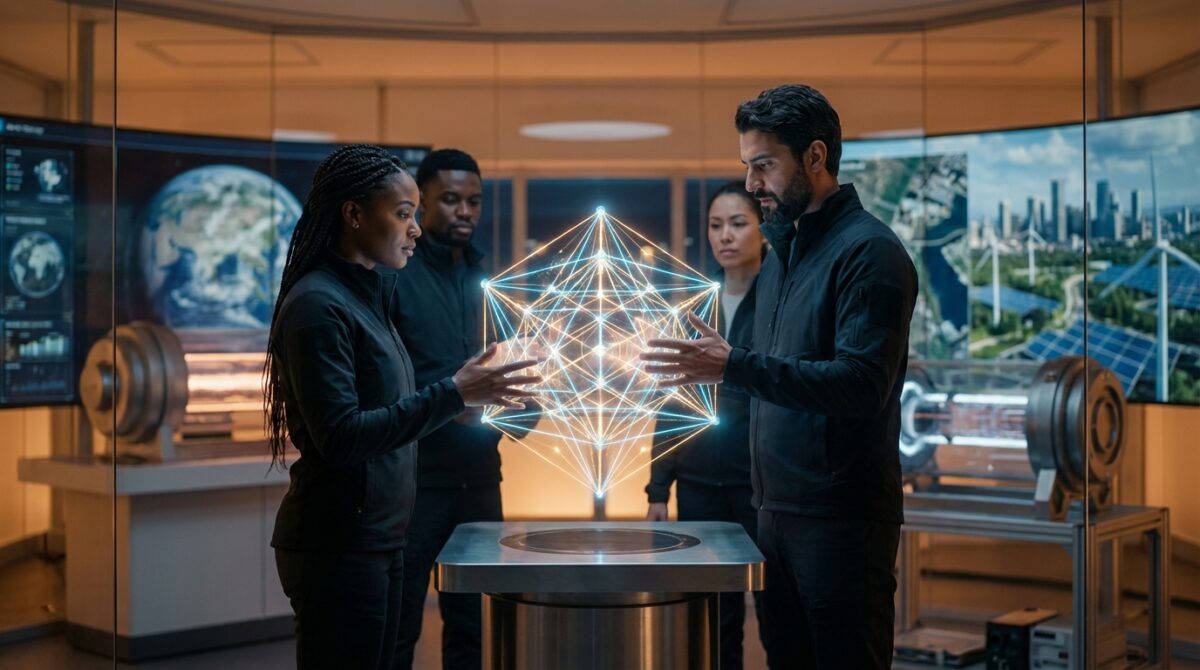
The team, the materials and the timescale
The experiment was led by Andrea Caviglia, full professor and head of the Department of Quantum Matter Physics at Geneva, with theory support from Carmine Ortix, associate professor at Salerno. Over several years, the group focused on the interface between two oxides: strontium titanate and lanthanum aluminate. At their boundary, a remarkably thin conductive layer forms, only a few nanometres thick, where electrons behave in ways that standard textbooks struggle to describe.
In this ultra-clean two-dimensional system, the researchers probed how electrical current responded when they combined strong magnetic fields with precise measurements of resistance. Although the exact sample size is not spelled out publicly, the study relies on repeated measurements across multiple devices to reach statistically robust conclusions, with typical uncertainties kept below a few percent.
How scientists measured this hidden quantum geometry
At its core, the methodology can be summarised in one sentence: the team measured how current flowing in one direction through the oxide interface changed under a magnetic field, then extracted the extra resistance that only a curved quantum geometry could explain. That extra “drag” on electrons is the signature of the quantum metric.
This metric does not describe distances in ordinary space, but in the abstract “state space” used in physics and quantum mechanics. When this state space is curved, the way electrons accelerate, absorb light or transport heat can shift dramatically, even though the crystal lattice remains perfectly flat at the macroscopic level.
From abstract theory to numbers in the lab
Two decades ago, theorists predicted that the geometry of electronic states should influence many material properties, from optical responses to superconductivity. However, accessing this geometry meant going beyond traditional observables like energy bands or velocities. Geneva’s team exploited a subtle effect: electrons forced to flow “upstream” under an applied field encounter an additional resistance tied directly to the quantum metric.
By carefully separating this contribution from more familiar mechanisms, the researchers could estimate the size of the metric with meaningful confidence levels. While the published paper does not claim perfect precision, the signal stands clearly above measurement noise, making alternative explanations increasingly unlikely.
What the detailed results reveal about electrons and gravity-like force
The most striking result is that the quantum metric at the strontium titanate/lanthanum aluminate interface is not a tiny correction. It plays a leading role in how electrons respond to fields, acting almost like a built‑in curvature that steers currents without any change to the material’s shape. This internal force modifies the microscopic motion similarly to how a gravitational field bends light paths near a massive star.
Measurements show that when the current is driven opposite to the main carrier flow, the resistance increases more than conventional scattering theories predict. That extra slowdown matches what theories of curved quantum state space anticipate, making the geometry a necessary ingredient in the analysis.
A hidden feature that might be everywhere
The team’s calculations, combined with earlier work such as the geometry of electrons uncovered inside quantum materials, indicate that this geometry is not an exotic quirk of one interface. Instead, many correlated materials, topological systems and superconductors should host a similar hidden structure. The Geneva–Salerno study strengthens this view by tying a measurable transport property to the quantum metric, not just to Berry curvature or other more familiar quantities.
Other groups, including researchers at MIT who recently measured related geometric effects in solids, reinforce the idea that curvature in quantum state space is an ordinary component of condensed-matter systems. The key shift is conceptual: instead of thinking only in terms of energy bands, scientists now have experimental tools to map the “shape” of those bands in a geometric sense.
Why this matters for future quantum electronics
For companies designing ultra-fast chips or energy-efficient data centres, the prospect of engineering geometry inside materials is attractive. The Geneva results suggest that by tuning the atomic structure and interface conditions, engineers could harness the quantum metric to enhance specific responses, such as ultra-rapid switching or strong interaction between light and matter at terahertz frequencies.
A hypothetical start-up working on lossless interconnects, for example, could use these findings to screen candidate oxides whose internal geometry naturally boosts superconducting pairing. While such applications remain speculative, the pathway from theory to controlled experiments is now clearer than it was even a few years ago.
Concrete areas where hidden geometry could play a role
Several technological fronts could benefit if this control becomes reliable. Research teams already imagine:
- Terahertz electronics: circuits operating at a trillion cycles per second, where geometric tuning of carriers could reduce dissipation.
- Superconducting devices: materials where pairing strength may depend on the underlying quantum metric, potentially raising operating temperatures.
- Photonic–electronic hybrids: chips that convert light pulses into current using geometry-enhanced absorption.
- Quantum sensors: devices exploiting geometric sensitivity to detect tiny fields or forces.
Each of these directions depends on further targeted studies, but the experimental confirmation of geometric steering removes one major source of uncertainty.
Limits, open questions and how to read these results
Despite the excitement, the authors remain careful about what their work proves. The measurements demonstrate a strong correlation between transport anomalies and the predicted form of the quantum metric, yet they do not show direct causal control over every macroscopic material property. Other interactions, defects or thermal effects still influence the behaviour of electrons in parallel.
Moreover, the study focuses on one specific oxide interface at low temperatures and high magnetic fields. Transposing the same effect into everyday devices, operating at room temperature in consumer electronics, requires several additional breakthroughs in materials engineering and fabrication.
How this fits into the broader quantum mechanics landscape
The Geneva work sits alongside other efforts to map the geometric side of quantum mechanics, including the exploration of abstract structures “outside space and time” reported in outlets like Quanta and the measurement of geometric phases in photonic systems. Articles such as we’ve glimpsed the secret quantum landscape inside all matter highlight how widespread this shift has become.
Just as stunning auroral patterns filmed from orbit, described in reports like space-based aurora observations, reveal invisible flows in Earth’s magnetic environment, these new measurements expose hidden currents in the quantum state space of solids. Both cases show that unseen structures can leave sharp, measurable fingerprints.
What exactly is the quantum metric detected in this study?
The quantum metric is a mathematical quantity that describes how different quantum states are separated in an abstract state space, rather than in ordinary physical space. In this experiment at the University of Geneva, it manifests as an extra resistance when electrons flow under strong magnetic fields, revealing that their allowed states form a curved geometry. This curvature effectively steers carriers as if they felt a tiny gravity-like force inside the material.
Does this hidden geometry mean electrons are literally in curved space?
No. The crystal itself remains flat and sits in normal three-dimensional space. The curvature appears in the space of quantum states used to describe electrons in solid-state physics. The analogy with curved spacetime is helpful, but the effect is encoded in wavefunctions and band structure, not in the physical bending of the chip. The term gravity-like force refers to similar mathematical behaviour, not actual gravity acting on the electrons.
How could this discovery impact future electronic devices?
If engineers learn to control the quantum metric through material choice and interface design, they may tailor how electrons respond to fields and light. This could help create faster terahertz circuits, improve superconducting technologies, or enhance light–matter coupling in optoelectronic components. However, these applications remain exploratory; the current study provides a key measurement, not a finished device blueprint.
Which institutions and researchers are behind this work?
Middle Age Emerges as a Critical Turning Point in the U.S.
Tired of Snakes and Ladders? Discover How Math Can Make It Exciting Again!
The research was carried out by a collaboration between the University of Geneva, the University of Salerno and Italy’s CNR-SPIN Institute. The experimental effort was led by Professor Andrea Caviglia at Geneva, with theoretical support from Associate Professor Carmine Ortix in Salerno. A research associate, Giacomo Sala, is identified as the lead author of the Science paper that reports the measurements.
How reliable are the measurements of the quantum metric?
The team used repeated transport measurements on carefully prepared oxide interfaces, analysing how resistance changed under strong magnetic fields and different current directions. While exact numerical confidence intervals are not detailed publicly, the signal associated with the quantum metric stands well above experimental noise, and alternative standard explanations are insufficient. Even so, ongoing work in other materials will be important to confirm and refine these estimates.