
Show summary Hide summary
- Yawning, brain fluid dynamics and a hidden reset button
- Brain cooling, carotid flow and what yawning changes in your head
- Neuroscience insights: unique yawn signatures and brain control
- From brain scans to daily life: why yawning research matters
- What this means for future neuroscience and space-age tools
- Key takeaways about yawning and fluid inside your brain
- What happens to cerebrospinal fluid when you yawn?
- Does yawning really cool down the brain?
- Why is yawning contagious if it is about fluid dynamics?
- Can excessive yawning indicate a health problem?
- How could yawning research help everyday life?
Every time you yawn on a crowded train or during a late Zoom call, something almost invisible happens deep in your head. For a few seconds, the fluid dynamics inside your brain are completely rearranged, as if someone briefly rewired your internal plumbing.
New MRI work on Yawning shows that this familiar reflex quietly redirects blood and Cerebrospinal Fluid (CSF). The result ressemble a tiny, built-in reset for brain circulation, alertness and maybe even brain cleaning – and each person seems to have a unique “yawn signature”.
Yawning, brain fluid dynamics and a hidden reset button
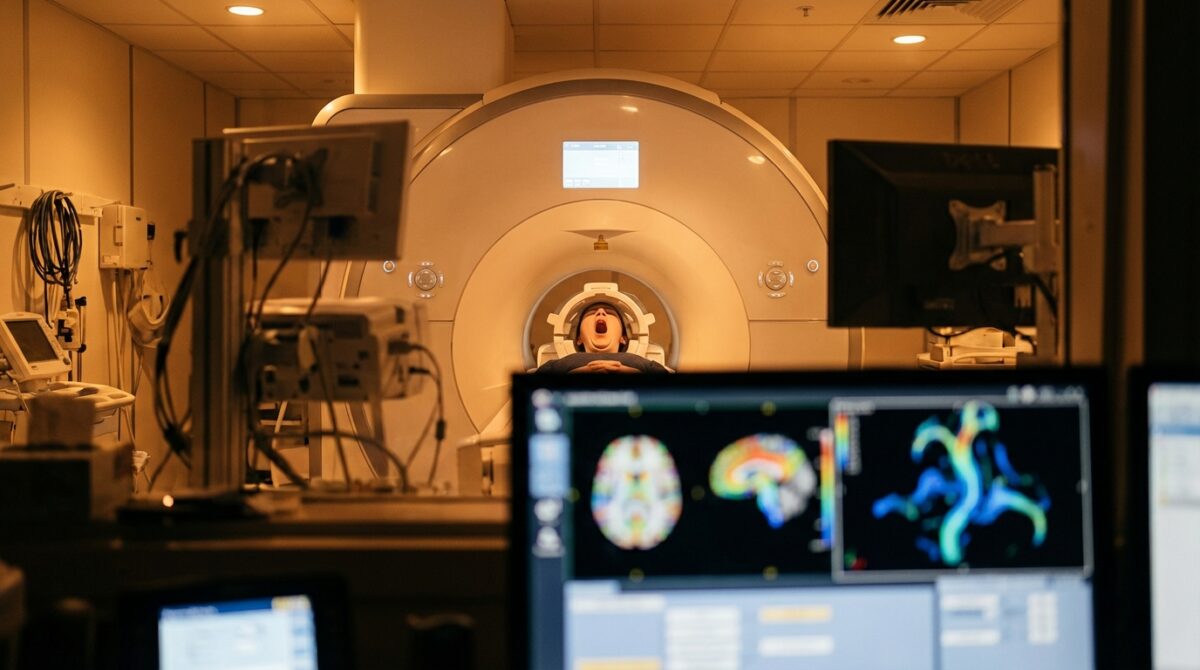
To uncover what really happens during a yawn, researchers at Neuroscience Research Australia asked 22 healthy adults to lie in an MRI scanner. They compared four situations: relaxed breathing, a natural yawn, voluntary yawn suppression and a strong deliberate breath.
Marine Animal Virus Linked to Unusual Eye Conditions in Humans
Exploring the Powerful Impact of the Heart-Brain Connection on Your Well-being
The expectation sounded simple: a forceful inhalation and a yawn should move CSF out of the skull in roughly the same way. The scans told another story. During a yawn, CSF and venous blood flowed together, often heading away from the brain and down toward the spinal column, creating a distinct pattern of Intracranial Pressure changes that did not appear during standard deep breathing.

The yawning mechanism the MRI made visible
During ordinary deep breaths, venous blood usually exits the skull while CSF flows in the opposite direction, balancing volumes in a kind of internal see-saw. Yawning broke that rule. The scan sequences showed CSF and venous blood moving in tandem, as if the yawn had briefly synchronized both flows.
Researchers suspect the coordinated pull of neck, throat and tongue muscles creates this shift. A single yawn may only move a few millilitres of CSF, yet repeated across a day, that represents many small nudges to internal fluid dynamics, each altering Neural Activity conditions for a moment.
Brain cooling, carotid flow and what yawning changes in your head
One of the most striking numbers from the study concerns arterial inflow. During a yawn, blood arriving through the internal carotid artery increased by more than a third compared with a strong voluntary breath. Extra space created by CSF and venous outflow seems to let that surge happen.
This boost has revived the idea of Brain Cooling. More incoming blood can carry heat away and stabilise temperature around key centres of Neural Activity. Some neuroscientists argue that this supports thermoregulation theories, while others see it mainly as a way to reset local chemistry and waste levels.
Yawning, waste clearance and alertness spikes
CSF acts as a transport medium for metabolic waste, shuttling by-products toward clearance pathways. Short, repeated CSF shifts during yawns may complement the glymphatic system, which already flushes the brain more vigorously during sleep. Articles like recent analyses of yawning and fluid inside your brain explore this cleaning angle.
Another proposed pathway involves adenosine, a molecule that builds up as wake time increases. By stirring fluid around the brainstem, yawns might temporarily lower local adenosine levels, reducing sleep pressure and briefly boosting alertness. That could explain why people often yawn just before needing to refocus during long drives or late-night study sessions.
Neuroscience insights: unique yawn signatures and brain control
Inside the scanner, every participant yawned differently. Tongue movement patterns, timing and range formed what looked like an individual “yawn fingerprint”. Yet, despite this variety, the same basic internal choreography emerged: CSF and venous blood shifting together, followed by the carotid inflow spike.
Such regularity strengthens the idea that the Yawning Mechanism is hard-wired in brain circuits, rather than just a social habit. Work summarised in resources like The Neuro Yawn: Why Your Brain Makes You Do It and overviews of which brain regions control yawning highlights the role of hypothalamus, brainstem and several neurotransmitters in triggering the behaviour.
Contagious yawns, social brain and fluid shifts
To spark yawns inside the noisy, confined MRI tube, researchers relied on contagiousness. Volunteers watched videos of people yawning until their own reflex kicked in. Interestingly, the contagious yawns captured on the scans were shorter than typical spontaneous yawns, which usually last around six seconds.
That difference means the observed CSF and blood changes might actually underestimate the impact of everyday yawns. Longer spontaneous yawns could generate stronger or more sustained shifts in brain circulation, especially during periods of fatigue or emotional tension.
From brain scans to daily life: why yawning research matters
What starts as a curiosity in the scanner quickly touches real-world health. Subtle shifts in Intracranial Pressure and CSF motion matter for people living with migraine, hydrocephalus or head injury. Understanding how yawns move fluid and blood may help doctors interpret symptoms such as sudden bursts of yawning before a headache or seizure.
On the performance side, coaches and clinicians are looking at yawning as a potential early indicator of cognitive fatigue. Athletes, air-traffic controllers or e-sports players who yawn more at certain moments may be slipping into a state where temperature, chemistry and microcirculation in specific brain zones need resetting.
What this means for future neuroscience and space-age tools
The MRI study that inspired this work used clinical scanners, but the approaches resemble those deployed in space medicine, where agencies like NASA track fluid shifts in astronauts. Spaceflight alters CSF distribution and Intracranial Pressure, raising questions that echo yawning research: how do tiny, repeated fluid changes affect alertness, vision and long-term brain health?
Open-access publications such as recent reports on yawning and brain fluid effects and technical manuscripts like detailed physiology papers on yawning are already feeding engineering models. These models help simulate how normal reflexes interact with blood flow, CSF movement and neural networks, on Earth and in orbit.
Key takeaways about yawning and fluid inside your brain
Bringing these threads together, yawning stops looking like a meaningless reflex. Instead, it resembles a compact neuromechanical routine tuned by evolution across reptiles, birds, mammals and humans.
- CSF and venous blood often move in the same direction during a yawn, unlike typical breathing.
- A yawn can boost carotid arterial inflow by more than one third compared with a strong voluntary breath.
- Contagious yawns show measurable shifts in Fluid Dynamics; spontaneous yawns may have an even larger impact.
- Subtle changes in Neural Activity, waste clearance and Brain Cooling likely combine to refresh alertness.
- Every person seems to display an individual yawning signature in tongue and jaw motion.
This mix of biomechanics, social behaviour and internal hydraulics turns a simple yawn into a window on how living brains keep themselves stable, clean and ready to think.
What happens to cerebrospinal fluid when you yawn?
During a yawn, MRI scans show that cerebrospinal fluid often moves together with venous blood, usually away from the brain toward the spinal column. This pattern differs from regular deep breathing, where venous blood and CSF often flow in opposite directions, and it briefly alters intracranial pressure and brain circulation.
Does yawning really cool down the brain?
Several researchers argue that yawning contributes to brain cooling because it increases blood flow through the internal carotid artery and changes airflow in the nasal and oral cavities. The new MRI data support a role for increased arterial inflow, which could help stabilise local temperature, although some scientists think chemical reset and waste clearance may be just as important.
Why is yawning contagious if it is about fluid dynamics?
Contagious yawning likely taps into social and empathy networks in the brain, while still using the same mechanical routine that shifts CSF and blood. When you see or hear someone yawn, circuits in the brainstem and higher social areas fire together, triggering the same fluid and pressure changes that a spontaneous yawn would create.
Can excessive yawning indicate a health problem?
Which Type of Olive Oil Boosts Brain Health the Most?
Scientists Confirm: E-Cigarettes Outperform Patches and Gum as Smoking Cessation Tools
A sudden rise in yawning frequency can sometimes signal issues such as disturbed cerebral circulation, medication side effects or sleep-related disorders. Because yawns alter intracranial pressure and fluid dynamics, repeated episodes at unusual times deserve medical attention, especially if they come with headaches, vision changes or extreme fatigue.
How could yawning research help everyday life?
Understanding the yawning mechanism helps refine diagnostic tools, improve brain models and guide strategies for managing fatigue. Tracking yawns in pilots, drivers or shift workers could offer a simple behavioural marker of declining alertness, while insights into CSF movement may inspire new therapies for conditions linked to abnormal brain fluid dynamics.