
Show summary Hide summary
- Light as a remote control for crystal formation
- Real-time growth, melting and sculpting of crystals
- Why this changes the game for optics and photonics
- What this means for the future of light-programmable matter
- How do scientists actually use light as a remote control for crystals?
- What makes this crystal manipulation different from traditional methods?
- Why is this important for optics and photonics applications?
- Could this technique scale beyond microscopic laboratory systems?
- How does this research fit into broader material science trends?
You flip a remote control to change TV channels. Now imagine doing the same with matter itself, using only light to build, erase, and reshape crystals in real time. That is what a team of NYU scientists has just pulled off—an achievement described in scientists just turned light into a remote control for crystals.
The researchers have discovered a way to program tiny particles with light, turning illumination into a kind of software for materials. Their method lets them grow and melt microscopic crystals on demand, offering a preview of future material science where structure changes at the flick of a switch.
Light as a remote control for crystal formation
At the heart of this work lies a simple question: can light act like a remote control for matter, not just for screens or lasers? NYU chemist Stefano Sacanna and his team answered yes by focusing on colloids, microscopic spheres floating in liquid that can self-organize into highly ordered crystals. These colloidal crystals already underpin parts of modern photonics, from sensors to advanced optical coatings.
Is Geothermal Energy Poised to Spark a Global Revival?
5 Astonishing Facts Unveiling world’s largest hydroelectric dam
Traditionally, controlling where and when these structures appear required laborious changes in salt concentration, temperature, or particle design. Once conditions were fixed, the assembly process largely ran on autopilot. Sacanna describes the longstanding frustration: crystals tended to form “where and when they want.” This new approach rewrites that rulebook and gives researchers live, fine-grained control.
How photoacids turn illumination into a switch
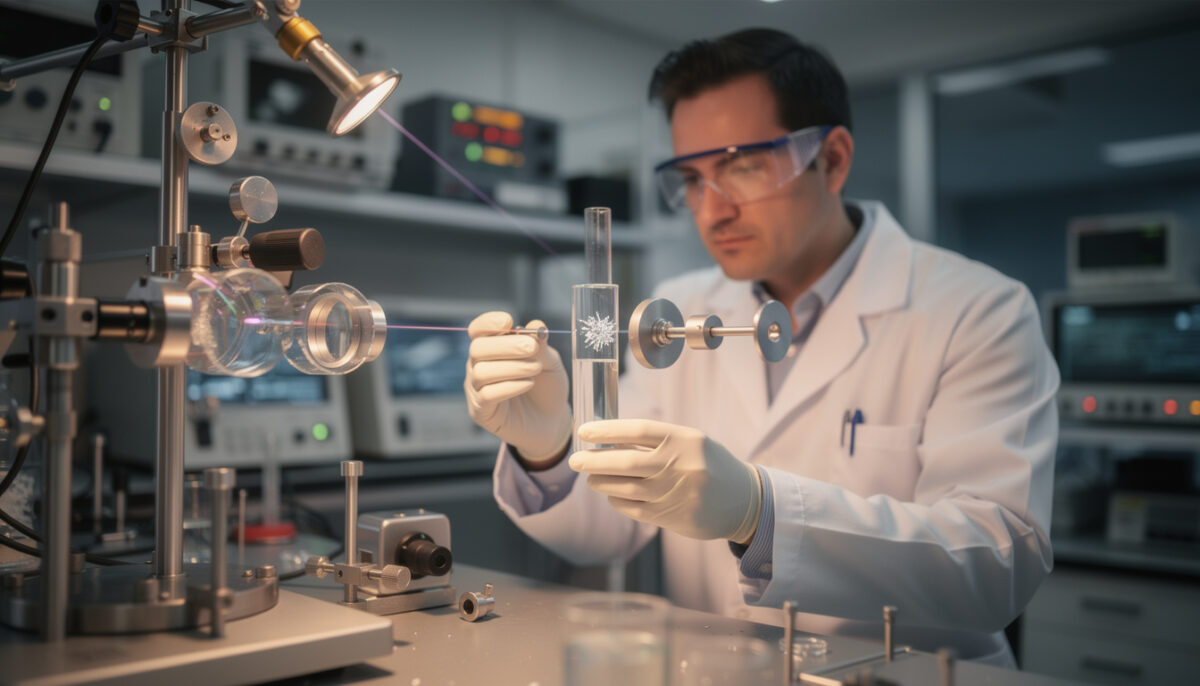
The key trick involves photoacids, molecules that briefly become more acidic when exposed to light. Sacanna’s team mixed these light-sensitive molecules into a liquid filled with colloidal particles. Once illuminated, the photoacids changed how they interacted with the particle surfaces, effectively tuning the particles’ electric charge.
Charge determines whether particles attract or repel one another. By shaping this interaction, the group learned to manipulate whether particles clumped into ordered crystals or stayed dispersed. A modest increase in light intensity could mean the difference between particles locking into place or floating freely. This gave the team a clean, optical dial to steer self-assembly.
Real-time growth, melting and sculpting of crystals
Once the system responded reliably to light, the researchers began treating the sample like a responsive canvas. By changing brightness, duration, and spatial pattern, they could spark crystallization in a targeted region, then dissolve it seconds later. Under the microscope, blobs of particles froze into ordered lattices, then liquefied again when the illumination changed.
Postdoctoral researcher Steven van Kesteren describes “shooting” light at dense clusters and watching them melt, then re-solidify into more uniform structures. The experiments aligned neatly with computer simulations run by co-author Glen Hocky, who used models to predict how shifting interactions in space or time shape self-assembly. Together, the tests showed that you can effectively draw, erase, and redraw structures inside one tiny volume of fluid.
One-pot setup: no redesign, no endless tweaking
Many advanced self-assembly experiments require custom-designed particles or repeated chemical adjustments. Sacanna’s group instead worked with a practical “one pot” configuration. They loaded particles, solvent, and photoacids into a single cell, then did everything else with light. No new salts, no new batches of particles, no complex mechanical interventions.
This simplicity matters for labs that want to reproduce or extend the findings. As highlighted in reports such as new ways to grow materials on demand and other coverage of this work, the strategy is accessible to groups already equipped with basic optics and microscopy tools. That practicality could accelerate adoption across material science and soft-matter physics.
Why this changes the game for optics and photonics
Colloidal crystals interact with light in ways that make them attractive for photonics. Their ordered structures can control color, reflection, and transmission, much like the periodic patterns inside photonic chips. With this light-programmable method, those properties no longer need to be fixed during fabrication. They can instead be written, erased, and rewritten in real time.
Imagine an optical coating whose color pattern can be redrawn like pixels, or a sensor whose response changes depending on the illumination pattern projected onto it. Research on dynamic optical materials, often paired with laser technology, has been highlighted by outlets such as a flash of light can build and erase crystals instantly. The NYU system adds a robust, reversible platform for such ideas.
From labs to reconfigurable devices and future cities
Looking ahead, you can picture building components where material structure acts like software, updated through light patterns rather than mechanical replacement. Adaptive displays, tunable filters, or reprogrammable data-storage elements could all stem from this type of self-assembly. In infrastructure, similar principles might influence smart windows or responsive surfaces in emerging high-tech urban systems, where embedded materials react dynamically to environmental cues.
Beyond devices, the same optical control mindset echoes across modern science, from remote entangled atoms acting as single sensors to new approaches for on-demand growth of functional materials. In each case, the ambition is similar: use programmable fields—light, fields, or flows—to steer matter with increasing precision.
What this means for the future of light-programmable matter
For Hocky and colleagues, the system doubles as a testbed for theories of self-assembly where interactions are not static. Changing charge profiles across space or time lets them probe how structures nucleate, reorganize, or dissolve under shifting rules. That insight reaches beyond colloids to material science at larger or smaller scales.
The project, supported by agencies such as the US Army Research Office and the Swiss National Science Foundation, sits within a larger push toward responsive, adaptive matter. As optics, photonics, and laser technology advance, using light itself as a programmable tool for building and erasing crystals may become as routine in the lab as adjusting temperature or pH is today. Tomorrow’s materials could be less like static hardware and more like software-driven systems, updated at the speed of illumination.
- Light acts as a dial to control particle attraction and repulsion.
- Photoacids convert illumination patterns into local chemical changes.
- Crystals can be grown, melted, and reshaped in the same “one pot” sample.
- Applications span photonics, sensing, displays, and adaptive coatings.
- The approach deepens understanding of dynamic self-assembly in material science.
How do scientists actually use light as a remote control for crystals?
They add light‑sensitive molecules called photoacids to a liquid containing colloidal particles. When illuminated, the photoacids briefly change acidity and modify the electric charge at the particle surfaces. That alters how strongly particles attract or repel one another, letting researchers trigger crystal growth or melting simply by adjusting light intensity, duration, or pattern.
What makes this crystal manipulation different from traditional methods?
Conventional crystal growth typically relies on fixed conditions such as salt concentration, temperature, or particle design, offering little real‑time control. In this NYU work, the entire experiment stays in a single cell, and only the light changes. That one‑pot, reversible setup lets scientists start, stop, or reshape crystals on demand without redesigning the system each time.
Why is this important for optics and photonics applications?
Colloidal crystals strongly influence how light propagates, making them valuable for photonic devices, filters, and sensors. Being able to program these structures with light means optical properties like color, reflectivity, or transmission can be dynamically tuned. This opens paths to reconfigurable coatings, adaptive sensors, and display technologies whose behavior is written and rewritten by illumination rather than fixed during manufacturing.
Could this technique scale beyond microscopic laboratory systems?
Revolutionary Engine Harnesses Space’s Freezing Cold to Produce Power Overnight
Oregon Requires Heat Pumps in New Homes for Savings
The current experiments operate on microscopic colloidal particles viewed by optical microscopes, but the principles are general. Any system where interparticle forces depend on local chemistry or charge could, in principle, be driven by light‑controlled molecules. Scaling up will require engineering advances, yet the underlying concept of writing material structure optically is flexible and compatible with other self‑assembly strategies.
How does this research fit into broader material science trends?
Across material science, there is growing interest in responsive matter that changes properties under external stimuli such as light, fields, or mechanical stress. This work demonstrates a clean way to couple illumination to structure at the microscale. It complements efforts in laser‑based fabrication, active colloids, and programmable soft materials, all moving toward materials that behave more like updateable platforms than static objects.