

Show summary Hide summary
Imagine your local data centre, your car battery and your kettle all powered by the quiet heat under your feet. That is the bet investors, engineers and entire countries are making as geothermal energy poised to shift from niche curiosity to serious global player.
Geothermal energy’s quiet revival beneath the surface
For decades, geothermal energy sat in the shadow of wind turbines and solar farms. The resource seemed locked to volcanic hotspots, expensive to drill, and slow to scale. Now, a wave of energy innovation is turning that perception on its head and driving a real energy revival.
Improved drilling tools, smarter subsurface imaging and oil‑and‑gas style project management are all converging. Analysts tracking renewable energy markets, such as those behind global geothermal sector forecasts, see the industry doubling in value by the mid‑2030s. That shift matters because geothermal offers something wind and solar cannot: steady, weather‑proof sustainable power.
Scientists Transform Light into a Remote Control to Manipulate Crystals
5 Astonishing Facts Unveiling world’s largest hydroelectric dam
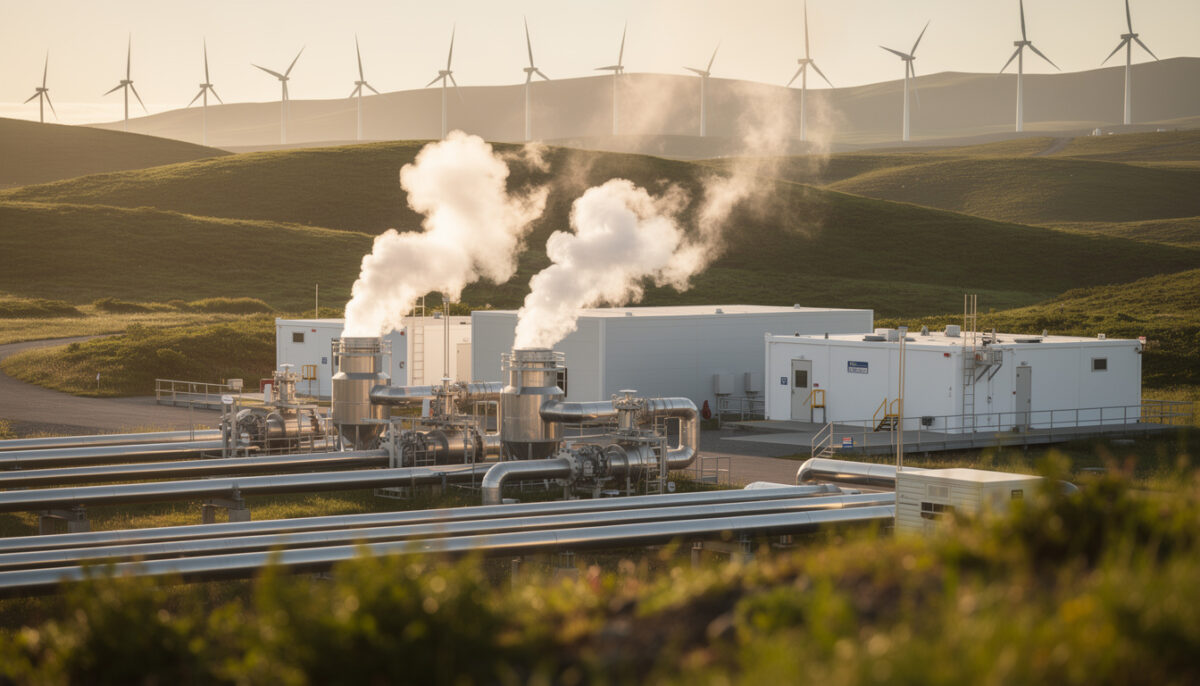
Cornwall’s United Downs: a blueprint for clean energy hubs
Nowhere captures this turning point better than United Downs in Cornwall. Long seen as a region of abandoned tin and copper mines, it is suddenly a test bed for 24/7 clean energy. Engineers there have tapped hot granite more than 5 kilometres down, where naturally radioactive minerals heat trapped water to around 190°C.
The plant feeds the UK grid with around 3 megawatts of electricity. That is modest on paper but huge symbolically: it is the first deep geothermal power delivered to the British system. The same wells also bring up brine loaded with lithium, linking geothermal to the battery supply chain and echoing the story explored in depth by analysts looking at Cornwall’s hidden lithium wealth.
Why geothermal energy is back on the global agenda
United Downs did not appear overnight. Early test wells were drilled during the oil crises of the 1970s, when governments briefly chased alternatives before returning to cheap hydrocarbons. Since then, global warming, grid instability, and security concerns have rewritten the energy script.
Today’s electricity systems lean heavily on wind and solar. Those sources slash the carbon footprint but fluctuate with clouds and calm days. Geothermal steps into that gap as a stable backbone. Studies like Stanford’s recent work on geothermal in the clean energy transition suggest it could supply a meaningful slice of new demand by mid‑century.
From volcano fringes to almost anywhere on Earth
Historically, geothermal power clustered in places like Iceland, Kenya, and parts of the US, where hot water naturally rises near the surface. That limited contribution to less than 1 per cent of global electricity, barely a footnote in the fight against global warming. The game changer is the rise of enhanced geothermal systems.
Using techniques borrowed from shale drilling, companies now drive horizontal wells, crack hot rock with high‑pressure water, and create networks of fractures that act like artificial underground radiators. This approach opens geothermal to huge swathes of the US, Europe and Asia, transforming a niche renewable resource into a mainstream option for baseload power.
United Downs: electricity, lithium and stacked revenue streams
The Cornwall story also reveals how economics are changing. Geologist‑led Geothermal Engineering Ltd spent years raising capital, facing what financiers saw as “oil‑and‑gas risk” without fossil‑fuel returns. Then chemistry intervened. Testing showed the hot brine carried enough lithium to matter for electric vehicle batteries.
Engineers plan to pass that brine through beads coated with special chemicals that capture lithium. After flushing and processing with CO2, the plant expects to produce around 100 tonnes of lithium carbonate per year initially, with ambitions to reach 2,000 tonnes. At full scale, mineral sales could out‑earn electricity by a factor of ten, turning the site into a multidimensional green technology hub rather than just a power station.
Europe’s geothermal sweet spots beyond the UK
Cornwall is relatively deep and expensive to drill, which makes nearby continental prospects look even better. Countries such as Hungary, Poland, and France sit above hot water reservoirs closer to the surface. Independent think tanks estimate they could bring online around 43 gigawatts of geothermal capacity at costs comparable to gas or coal plants.
Energy analysts stress that no single technology will dominate European grids. Wind, solar, hydro, and batteries still shoulder most of the work. Yet predictable low‑carbon generation from geothermal can smooth price spikes and supply gaps, especially during winter or long cloudy spells. In that sense, geothermal behaves like clean “baseload glue” holding increasingly variable systems together.
Next‑gen geothermal energy and the US data‑centre boom
If Europe is rediscovering its subsurface heat, the US is racing ahead on advanced drilling. One flagship example is Fervo Energy, emerging from Stanford research and now partnered with Google. Near Nevada data centres, Fervo is building a 115‑megawatt plant dedicated to digital workloads that cannot afford downtime.
By using diamond drill bits and oilfield‑style automation, Fervo reports cutting well drilling times from about 60 days to 20. Horizontal laterals and densely spaced fractures unlock three to four times more heat per site. Modelling suggests that by the late 2020s, such enhanced projects could deliver power below 80 dollars per megawatt‑hour across much of the US, competitive with new gas plants when carbon costs are considered.
Safety, seismicity and public acceptance
Any technology that manipulates deep rock attracts scrutiny. A German project in 2009 triggered a magnitude‑2.7 quake, fuelling local concern. Regulators and developers responded with stricter seismic monitoring, traffic‑light systems that halt injection when micro‑tremors rise and improved reservoir modelling.
Researchers now argue that, with careful siting and community engagement, risks can be kept low enough for insurance and bank financing. As more commercial plants exceed 20 megawatts and operate without incidents, lenders and residents are gradually treating geothermal as they do wind or hydro: not risk‑free, but manageable and worth the climate benefits.
How geothermal fits your clean energy future
For households and businesses, geothermal may still seem distant compared with rooftop solar or heat pumps. Yet the same underground networks backing data centres and industry can stabilise the grid that charges your laptop or EV. Investors already explore opportunities through platforms tracking geothermal as a green investment, betting on long‑lived assets instead of short‑cycle trading.
Policy support, like tax credits and streamlined permits, amplifies those private flows. Add rising electricity demand as transport and heating electrify, and geothermal becomes less a curiosity and more a quiet workhorse in a diversified renewable energy mix.
As more grids move toward deep decarbonisation, the underground heat that once warmed Roman baths is re‑emerging as a strategic asset for twenty‑first‑century sustainable power.
How does geothermal energy help fight global warming?
Geothermal plants emit very little CO2 across their full life cycle compared with coal or gas. Because they provide steady output, they reduce the need for fossil backup when wind and solar output drops. That combination cuts overall system emissions and supports long‑term climate goals.
Is geothermal energy only possible in volcanic regions?
Traditional projects favored volcanic hotspots, but enhanced geothermal systems now make development viable in many non‑volcanic areas. By drilling deeper and using horizontal wells and engineered fractures, developers can access heat in regions previously considered unsuitable.
Can geothermal energy and lithium extraction coexist sustainably?
At sites like United Downs, operators design closed‑loop systems. Hot brine circulates through the plant, lithium is extracted, and the fluid is reinjected into the reservoir. When managed carefully, this limits surface waste and maintains pressure underground, allowing power and minerals to be produced together.
How safe are enhanced geothermal systems for nearby communities?
Modern projects use dense seismic monitoring and strict operating limits. If micro‑earthquakes exceed agreed thresholds, injection is reduced or stopped. Experience from recent developments shows that, with proper oversight, induced seismicity can be kept low and comparable to other common industrial activities.
Will geothermal energy replace wind and solar on the grid?
Revolutionary Engine Harnesses Space’s Freezing Cold to Produce Power Overnight
Oregon Requires Heat Pumps in New Homes for Savings
Geothermal is more likely to complement than replace wind and solar. It shines as a stable, low‑carbon backbone that balances variable generation. The most resilient future grids are expected to mix several technologies, including geothermal, to deliver reliable and affordable clean power.