
Show summary Hide summary
- Extreme heat exposure: what the Oxford study reveals
- Why a 2°C temperature rise changes everyday energy use
- Health, work and migration under growing heat exposure
- From climate risk to climate resilience: what can change
- Practical steps for cities, governments and households
- What does 2°C of global warming actually mean for daily life?
- Which regions are projected to face the highest extreme heat exposure?
- Can better building design reduce extreme heat risks?
- How does climate change affect energy demand for cooling and heating?
- What actions can individuals take to adapt to more frequent heatwaves?
By mid-century, almost 4 billion people could be stepping out their front doors into Extreme Heat for weeks each year. That is not a distant, sci‑fi scenario. It is the world projected if Global Warming passes 2°C of Temperature Rise above pre‑industrial levels.
A new wave of Climate Science shows how this shift will reshape daily life: from the way children learn in overheated classrooms to whether hospitals, power grids and food systems can keep functioning during ever longer heatwaves.
Extreme heat exposure: what the Oxford study reveals
The new analysis, led by researchers at the University of Oxford and published in Nature Sustainability, maps how often temperatures move far beyond a comfortable 18°C baseline. Using high‑resolution computer models, the team tracked how many days per year communities will face intense Heat Exposure as Climate Change moves from about 1°C warming a decade ago, through 1.5°C in this decade, towards a possible 2°C around 2050.
How to Create a DIY Worm Farm That Can Compost Food Scraps, Paper, and Even a Whole Kangaroo
How Squid Triumphed Over Earth’s Greatest Extinction to Dominate the Oceans
In 2010, about 1.54 billion people – roughly 23% of the global population – were already living with Extreme Heat conditions. Under a 2°C Projection, that number rises to about 3.79 billion people, or 41% of the expected 2050 population. This is almost a doubling in just forty years, with the steepest jump happening as the planet crosses the 1.5°C threshold set in the Paris Agreement.
Global warming hotspots and who gets hit first
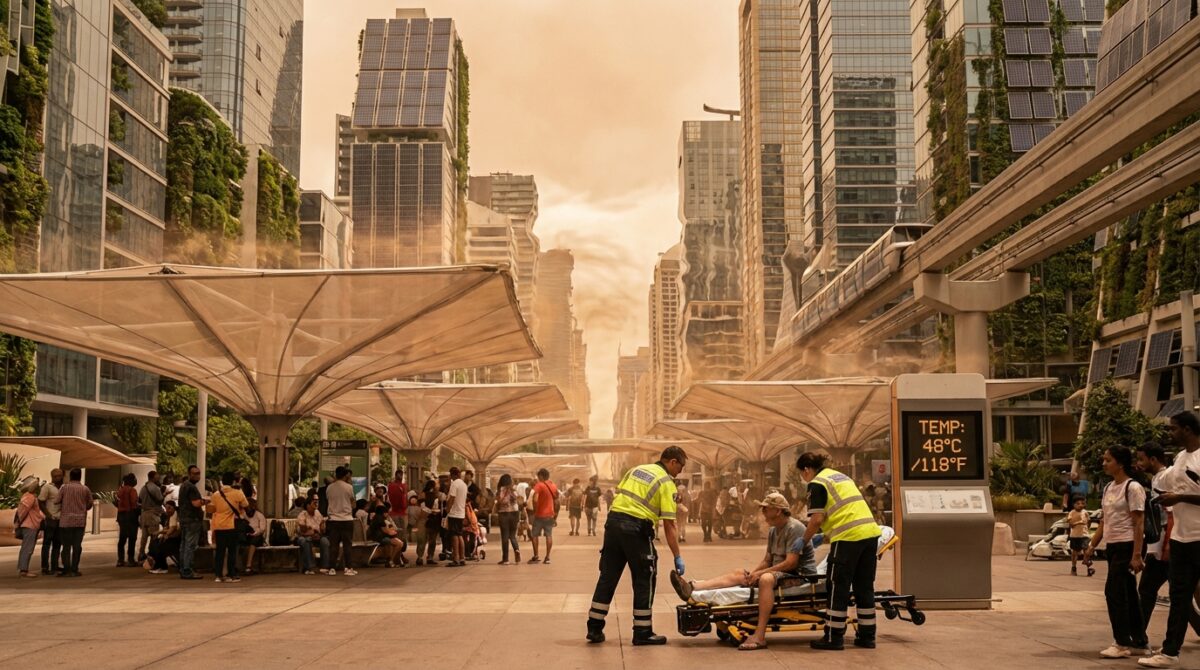
The study highlights a stark geographical pattern. The largest numbers of people exposed will be in India, Nigeria, Indonesia, Bangladesh, Pakistan and the Philippines. For many residents of these countries, Extreme Heat is already a daily reality during long dry seasons; at 2°C warming, it becomes longer, hotter and harder to escape.
The fastest growth in dangerous temperatures, however, strikes several lower‑income states with limited adaptive capacity. Central African Republic, Nigeria, South Sudan, Laos and Brazil emerge as some of the most rapidly escalating hotspots. For smallholder farmers, street vendors or children walking long distances to school, each extra week of oppressive heat translates into lost income, missed classes and rising health risks.
Why a 2°C temperature rise changes everyday energy use
As temperatures climb, the world’s energy demand map is being redrawn. According to the Oxford team, and supported by research compiled in the global population living with extreme heat briefing, the northern hemisphere’s need for heating will generally decline, while the demand for cooling surges across much of the tropics and southern hemisphere.
Separate modelling studies show that near the end of the century, global electricity use for air conditioning is expected to overtake, and then far exceed, the energy used for heating. For many utilities, this means summer afternoons, not winter nights, will become the most stressful moments for the grid. The Oxford dataset of heating and cooling “degree days” offers planners a detailed picture of where this tipping point arrives first.
When buildings are designed for cold but face heatwaves
One of the most unsettling findings is that countries used to cooler climates are not safe havens. Much of northern Europe, for example, built homes and offices to trap heat, not release it. During recent British heatwaves, ageing housing and office blocks have turned into heat traps, forcing the UK National Grid in 2023 to request the restart of two coal‑fired power units just to handle air‑conditioning demand.
This pattern is mirrored across parts of North America and East Asia. Insulation, sealed windows and dark roofs, once symbols of comfort and efficiency, become liabilities under extended Climate Change‑driven Heatwaves. The line between comfortable summer warmth and dangerous Environmental Impact can sometimes be a mere half‑degree of Global Warming.
Health, work and migration under growing heat exposure
For a fictional worker, Amina in Lagos, a single day of 38°C heat with high humidity already makes outdoor work feel punishing. Under a 2°C warming scenario, such days could cluster into long, relentless stretches. The Oxford study, echoed by research from Columbia University’s State of the Planet, warns that overshooting 1.5°C magnifies these stresses across many sectors at once.
Hospitals see more cases of dehydration, kidney strain and heatstroke. School performance falls as classrooms overheat. Outdoor labour in construction or agriculture becomes unsafe for several hours each day, cutting productivity and income. Beyond a certain threshold, migration patterns begin to shift as families weigh whether their home city remains livable.
Why impacts hit hardest between 1.5°C and 2°C
The most striking aspect of the Oxford work is the timing. The largest change in Extreme Heat exposure does not wait for 2°C; it unfolds rapidly near 1.5°C of Global Warming, roughly where the world is heading this decade. Lead author Radhika Khosla, from Oxford’s Smith School, stresses that health systems, energy networks and labour regulations need urgent upgrades now, not in thirty years.
This finding aligns with NASA analyses of compounding risks at 2°C warming, which indicate that heat, drought and heavy rain can increasingly arrive together. When almost half of humanity lives under frequent Heat Exposure, these compound events can knock out power, strain emergency services and damage crops in the same season.
From climate risk to climate resilience: what can change
While the numbers are stark, they are not destiny. The Oxford team emphasises that rapid cuts to emissions from oil, gas and coal can still constrain the Temperature Rise and limit the spread of Extreme Heat. For cities, utilities and households, adaptation decisions made this decade will decide whether future heatwaves become disasters or manageable shocks.
Some infrastructure and planning fields already respond. Studies on enhancing utility distribution planning explore how to strengthen power grids against sudden cooling surges, while research on smarter urban design helps reduce the “heat island” effect with reflective roofs and more trees. In parallel, net‑zero roadmaps from institutions such as the IPCC still show a path to stabilising the climate if emissions fall steeply before mid‑century.
Practical steps for cities, governments and households
Adapting to Extreme Heat does not rely on a single technology. It comes from a stack of actions at different scales, many of which overlap with sustainability goals and better everyday comfort. Crucially, they can be rolled out now while mitigation efforts continue.
- Cooler cities: more street trees, shaded public spaces, reflective or green roofs, and cooler building materials to limit urban heat islands.
- Resilient power systems: diversified renewables, storage, and grid upgrades to handle peaks in cooling demand without resorting to coal.
- Heat‑aware housing: cross‑ventilation, external shutters, light‑coloured façades and passive cooling in new and renovated buildings.
- Public health plans: early‑warning systems, designated “cool shelters”, workplace heat standards and medical training for heat illness.
- Personal choices: checking neighbours during heatwaves, adjusting working hours, and supporting policies that cut emissions and protect green spaces.
For future‑oriented municipalities, insights from smart city initiatives show how sensors, data and automated controls can manage heat risks in real time. The thread running through all these responses is clear: reshaping cities and energy systems for a hotter planet often also makes them cleaner, fairer and more liveable.
What does 2°C of global warming actually mean for daily life?
A 2°C rise in global average temperature does not sound large, but it dramatically changes how often and how intensely people experience heat. Under this level of warming, about 3.79 billion people could live with frequent extreme heat by 2050. This affects working hours, school days, transport reliability and even how much you pay for energy during long, hot seasons.
Which regions are projected to face the highest extreme heat exposure?
According to the Oxford study, the largest numbers of exposed people will be in India, Nigeria, Indonesia, Bangladesh, Pakistan and the Philippines. Some of the sharpest increases occur in Central African Republic, Nigeria, South Sudan, Laos and Brazil, where resources to adapt are often limited.
Can better building design reduce extreme heat risks?
Yes. Buildings designed with shading, cross‑ventilation, reflective roofs and good insulation against both cold and heat can significantly cut indoor temperatures during heatwaves. Upgrading housing, schools and hospitals in this way reduces health risks and lowers demand for mechanical air conditioning, easing pressure on power grids.
How does climate change affect energy demand for cooling and heating?
Jungle Wildlife Shares a Common Tree as Their Preferred Latrine Spot
How Beavers Transform Rivers into Potent Carbon Capture Ecosystems
With rising temperatures, demand for heating generally declines in cooler regions, while demand for cooling grows sharply in warmer areas. Studies suggest that, by the end of the century, global electricity use for air conditioning could surpass and far exceed that for heating, shifting when and where power systems face their highest stress.
What actions can individuals take to adapt to more frequent heatwaves?
Individuals can prepare by improving home shading and ventilation, staying hydrated, checking weather alerts and planning activities for cooler hours. Supporting urban greening projects, backing clean energy policies and looking out for vulnerable neighbours during heatwaves also helps build community resilience in a warming climate.