
Show summary Hide summary
- Ocean chemical injection: what happened in the Gulf of Maine?
- From farm fields to the high seas: the logic behind OAE
- Climate change mitigation or risky marine geoengineering?
- Money, carbon credits and the race to scale up
- How communities and scientists try to keep control
- Key questions any responsible OAE project must address
- What is ocean chemical injection in the context of climate change?
- How much carbon can ocean alkalinity enhancement realistically remove?
- Is ocean alkalinity enhancement safe for marine ecosystems?
- Does ocean chemical injection replace the need to cut emissions?
- Who decides whether large-scale marine geoengineering goes ahead?
Imagine scanning the sea and spotting a vast maroon slick on the horizon. Pollution disaster? Not this time. That red stain marked one of the boldest tests of ocean chemical injection ever attempted to confront global warming and ocean acidification in a single move. The idea behind these experiments has already attracted global media attention, including coverage like The Scientists Making Antacids for the Sea to Help Counter Global Warming.
Ocean chemical injection: what happened in the Gulf of Maine?
For four days, researchers released about 65,000 litres of alkaline solution, tinted red, into waters off Massachusetts. The test site lies in a productive area for cod, haddock, and lobster, a place where any mistake would be quickly felt by fishers.
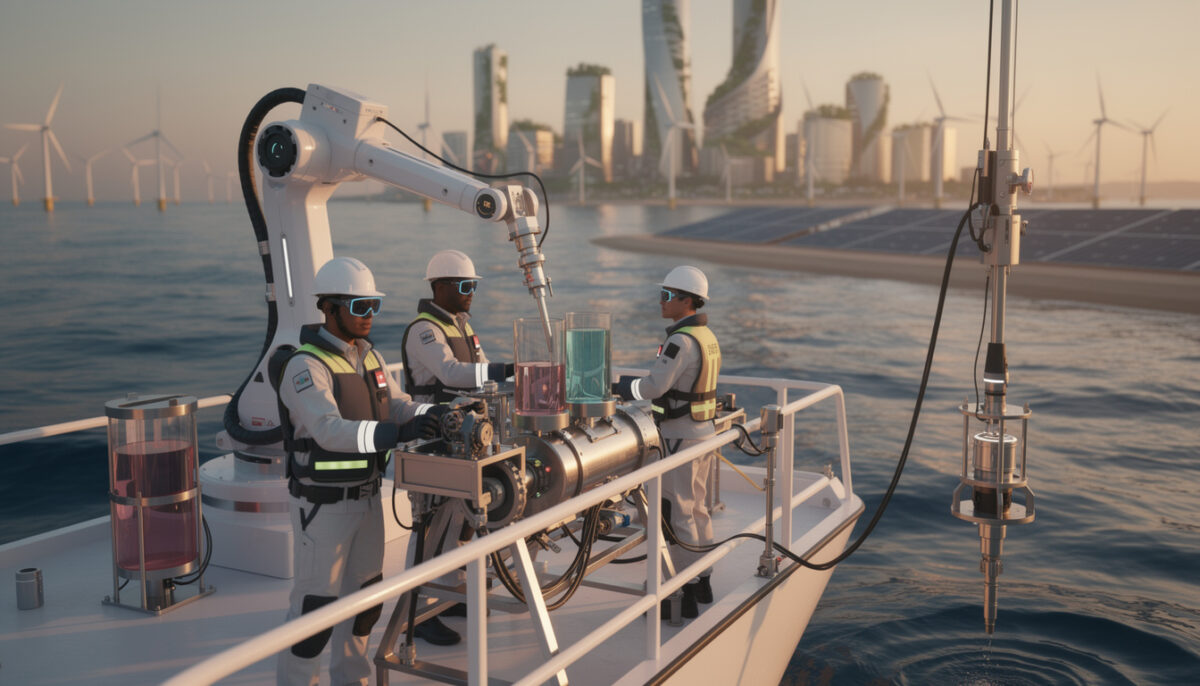
This trial, part of the Loc-Ness project, explored ocean alkalinity enhancement (OAE), a branch of marine geoengineering aimed at boosting the sea’s capacity for carbon sequestration. Instead of waiting millennia for rocks to weather naturally, scientists are trying to speed the carbon cycle using a carefully dosed “antacid for the ocean”.
Rediscovery of the Large Tortoiseshell Butterfly: Species No Longer Extinct in the UK
Evaluating the Environmental Footprint: Dairy Milk vs. Plant-Based Alternatives
How ocean alkalinity enhancement is supposed to work
The ocean already stores around 38,000 billion tonnes of carbon, mostly as dissolved bicarbonate. By adding alkaline substances such as sodium hydroxide, researchers slightly raise the pH, nudging the water to absorb more atmospheric CO₂ and lock it away as dissolved carbon.
During the Gulf of Maine experiment, instruments detected a local pH shift from about 7.95 to 8.3, close to estimated pre‑industrial values. At the same time, the team measured roughly 10 tonnes of carbon entering seawater within days, with models suggesting up to 50 tonnes of CO₂ removal over a year as the plume dispersed.
From farm fields to the high seas: the logic behind OAE

For your bearings, OAE is conceptually similar to agricultural liming. Two thousand years ago, Greek farmers spread crushed limestone to soften acidic soils and improve yields. In the 1980s, Scandinavian rivers damaged by acid rain were treated with alkaline lime, helping salmon return to Sweden’s Ätran River. If you’re interested in wider environmental risks, see the iconic climate goal.
The sea version scales that intuition to a planetary problem. As described in detail by the MIT Climate Portal, raising ocean alkalinity encourages extra CO₂ uptake while buffering acidification that threatens shellfish, coral reefs, and plankton. In theory, widespread deployment could support climate change mitigation alongside drastic emissions cuts.
Early results, tools and safety checks at sea
The Loc-Ness mission relied on autonomous gliders, long‑range underwater vehicles, and shipboard sensors to track the chemical plume. These tools followed both the red dye and changes in pH and dissolved carbon content hour by hour.
Initial surveys found no significant harm to plankton communities or to fish and lobster larvae in the test zone. Adult fish and marine mammals were not fully assessed, which is why researchers insist this was a first step, not a green light for global rollout. The message: promising signal, not final verdict.
Climate change mitigation or risky marine geoengineering?
Not everyone looks at ocean chemical injection with enthusiasm. Campaigners such as Benjamin Day from Friends of the Earth US warn about a growing push to exert tight control over natural systems, with unknown knock‑on effects.
They worry that large‑scale carbon dioxide removal at sea could trigger “catastrophic unforeseen consequences”, from altered food webs to regional shifts in ocean chemistry. Reports like this overview of ocean-based carbon removal experiments underline how heated the debate has become.
The stewardship argument: are we already geoengineering?
Researchers such as Phil Renforth counter that humanity is effectively running a giant uncontrolled experiment already by pouring CO₂ into the air each year. A large share dissolves into seawater, driving acidification and damaging fisheries you rely on. See also how security intelligence leaders discuss system-level environmental threats.
From this angle, OAE is not about domination, but about stewardship: using sustainable technology to manage unavoidable carbon in a safer, more predictable way. The key question becomes not “Should we intervene?” but “How do we intervene responsibly, or face uncontrolled change instead?”
Money, carbon credits and the race to scale up
As awareness grows, startups are racing to commercialise OAE and sell verified carbon credits. Registries like Isometric already certify some projects, while tech companies hungry for offsets buy removal claims to badge their operations as “net zero”.
Fisher and community advocate Sarah Schumann highlights a worry shared along the Massachusetts coast: could rigorous, transparent science become a Trojan horse for less cautious actors chasing profit, using the same ocean chemical injection tools but with weaker safeguards?
What large-scale deployment could look like
The US National Oceanic and Atmospheric Administration estimates that enhanced alkalinity might one day remove between 1 and 15 billion tonnes of CO₂ per year, at costs up to roughly $160 per tonne. Those numbers would place OAE among the more competitive carbon sequestration pathways.
Yet scaling from a 65,000‑litre field trial to industrial operations means facing logistics, energy use, material sourcing, and long‑term environmental impact head-on. No serious researcher suggests OAE replaces rapid emissions cuts; at best, it complements them as part of a broader climate toolbox. You can also learn how regions are handling acute climate impacts—see how ‘it sounds apocalyptic’ for regional biodiversity threats.
How communities and scientists try to keep control
Schumann joined the Loc-Ness vessel as an observer and took part in local meetings with fishers and tribal leaders. Around fifty such sessions were held along the Massachusetts coast to spell out the plan, listen to fears and adjust protocols.
That sort of process matters. For any future marine geoengineering project, social license could vanish overnight if coastal communities feel sidelined. Transparent data, open communication, and independent oversight will decide whether OAE becomes trusted climate change mitigation or another contested experiment blamed when something goes wrong offshore.
Key questions any responsible OAE project must address
Before backing ocean alkalinity enhancement, your checklist should include:
Measurability: Can added CO₂ uptake be quantified accurately over years, not days?
Ecological safety: Have impacts on food webs, fisheries and sensitive habitats been monitored beyond the short term?
Justice: Who bears the risks if something goes wrong, and who collects the benefits or carbon revenues?
Governance: Which national or international rules control deployment, verification and liability?
Complementarity: Does the project sit alongside deep emissions cuts, or distract from them?
Without clear answers, even the smartest technology risks losing public trust, no matter how elegant the chemistry looks on paper.
What is ocean chemical injection in the context of climate change?
Ocean chemical injection usually refers to adding alkaline substances, such as sodium hydroxide or crushed minerals, to seawater to slightly raise its alkalinity. This approach, known as ocean alkalinity enhancement, aims to increase the ocean’s capacity for carbon dioxide removal while also buffering against acidification that harms marine life.
How much carbon can ocean alkalinity enhancement realistically remove?
Current field trials operate at tiny scales, removing tens of tonnes of CO₂ at most. Modelling by agencies such as NOAA suggests that, if deployed widely and carefully, ocean alkalinity enhancement might remove 1–15 billion tonnes of CO₂ per year. Reaching those levels would require huge investment, strict governance, and confirmation that long-term environmental impacts remain acceptable.
Is ocean alkalinity enhancement safe for marine ecosystems?
Early experiments, including the Gulf of Maine test, have not shown significant short-term harm to plankton or larvae at low doses. However, researchers have not yet studied large-scale or long-term effects on full food webs, adult fish, or marine mammals. Safety therefore depends on cautious scaling, continuous monitoring, and strong independent oversight.
Does ocean chemical injection replace the need to cut emissions?
No. Scientists emphasise that any form of marine geoengineering can only complement deep, rapid cuts in greenhouse gas emissions. Ocean-based carbon removal might help balance hard-to-avoid emissions or draw down legacy CO₂, but it cannot compensate for continued large-scale fossil fuel use without worsening climate risks.
Who decides whether large-scale marine geoengineering goes ahead?
Love and Survival Beneath the Waves: How a Daring Marine Lab Rescued a Sea Snail from Extinction
Study Reveals Humanity is Accelerating Earth’s Warming at Unprecedented Rates
Decisions will involve national regulators, international agreements, scientific advisory bodies, and coastal communities. Because changes in the ocean spread across borders, many experts call for global governance frameworks, transparent public data, and community engagement before any large-scale deployment of ocean alkalinity enhancement or similar techniques.