
Show summary Hide summary
- Amazon deforestation and the weakening of atmospheric rivers
- From deforestation to aridity: the science behind the shift
- Towards a tipping point: savannisation risk and biodiversity loss
- Why atmospheric rivers over the Amazon matter for the whole planet
- New tools, satellites and paths to restoring the rainforest water cycle
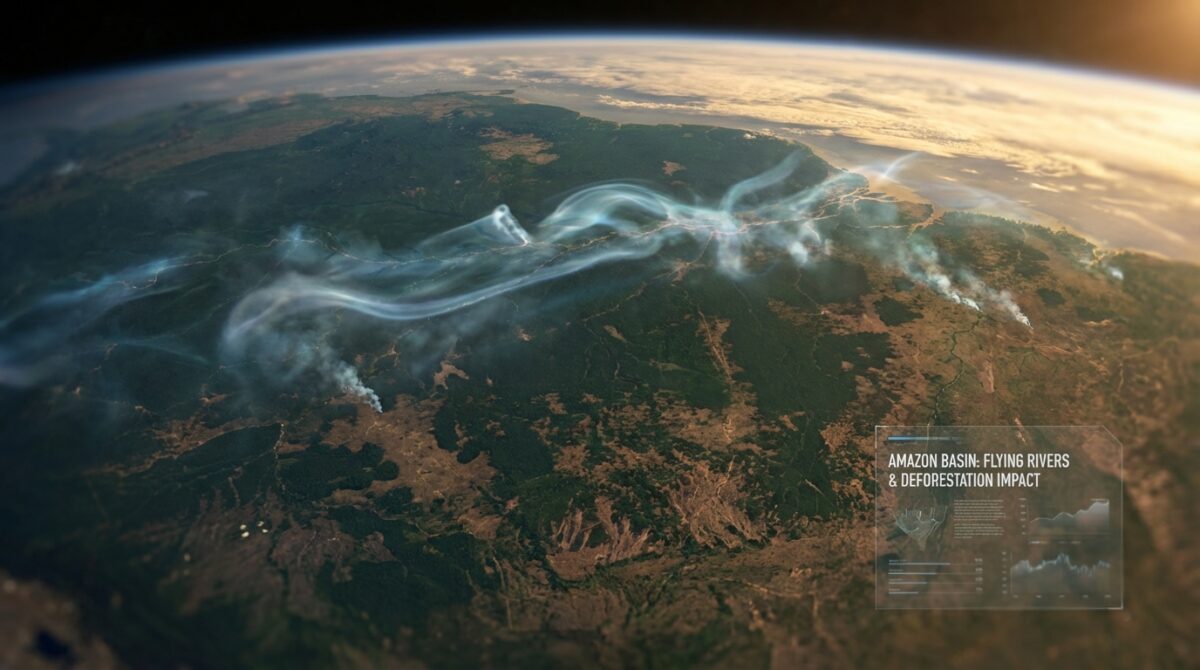
When rain begins to vanish from a place built on water, something fundamental is breaking. Over the Amazon, scientists now see that break forming in the sky itself, as deforestation quietly unravels the region’s vast atmospheric rivers and pushes the basin towards growing aridity.
This disruption is no distant abstraction. It is already reshaping weather patterns, farming prospects and fire risk across South America, while altering the global water cycle that helps stabilise your climate wherever you live.
Amazon deforestation and the weakening of atmospheric rivers
New analyses of satellite records and rain gauges reveal that rainfall over the southern Amazon has fallen by about 8 to 11 per cent since the 1980s. Over the same period, tree cover in this region declined by roughly 16 per cent, mostly as rainforest was burned and cleared for cattle pasture and soy production.
How to Create a DIY Worm Farm That Can Compost Food Scraps, Paper, and Even a Whole Kangaroo
How Squid Triumphed Over Earth’s Greatest Extinction to Dominate the Oceans
The northern Amazon, where large tracts of forest still stand, shows only minor and statistically weak changes in precipitation. This contrast offers a natural experiment across a basin more than 3000 kilometres wide, confirming what many climate models had hinted: remove forest, and the sky itself dries out.
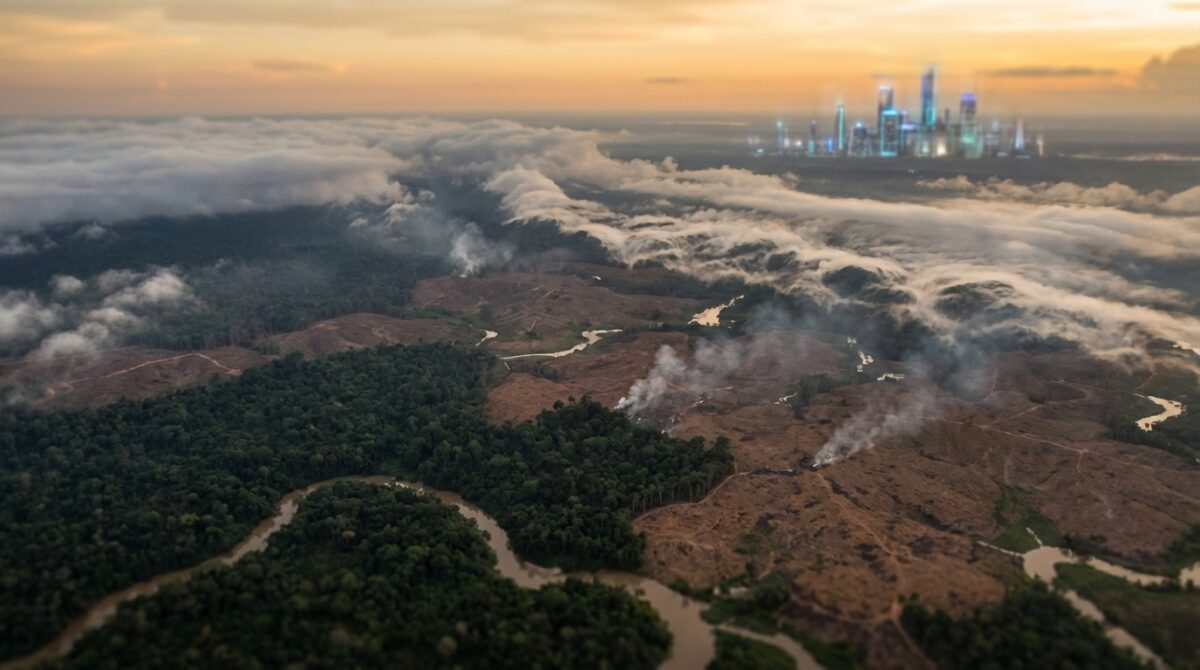
Flying rivers and a disrupted water cycle
Moisture over the Amazon begins as Atlantic Ocean vapour carried inland by trade winds. Over intact rainforest, trees pump this water back into the air through transpiration, creating “flying rivers” that recycle the same molecules of water five to seven times as clouds march westward.
When forest is cleared, more than half of the rainfall in that area runs straight into streams and back to the ocean instead of returning to the atmosphere. With fewer trees to slow the air, winds race over a smoother surface, allowing moisture to escape the region instead of condensing into thunderstorms.
From deforestation to aridity: the science behind the shift
Atmospheric modelling work led by researchers at the University of Leeds indicates that deforestation accounts for around 52 to 75 per cent of the observed drying in the southern basin. Global warming adds another layer of stress, but land-use change is already rewriting the local climate.
These findings align with studies reviewed by initiatives such as recent investigations into declining Amazon rainfall, which identify forest loss as the dominant driver of reduced dry-season precipitation since the mid‑1980s.
Positive feedbacks and shifting weather patterns
As tree cover shrinks, evapotranspiration falls, and the air becomes drier. That dryness raises vapour pressure deficit, meaning more moisture is pulled from leaves and soils. This in turn weakens cloud formation, making droughts longer and fires more likely, particularly in El Niño years.
Researchers describe a worrying feedback loop: deforestation increases aridity, and a drier atmosphere makes remaining forest more vulnerable to fire and dieback. Studies published in journals such as Geophysical Research Letters and Nature Communications, including work referenced by recent model–data comparisons, suggest that many climate models have underestimated this sensitivity by up to 50 per cent.
Towards a tipping point: savannisation risk and biodiversity loss
Several modelling efforts now indicate a significant probability that parts of the Amazon could shift towards a grassy, savannah‑like state later this century if warming reaches 1.5°C and deforestation continues. One recent assessment estimated a roughly 37 per cent chance of regional forest dieback by 2100, even without total collapse.
Such a transition would not turn the entire basin into desert, but it would produce a lower, shrubbier ecosystem that stores less carbon and supports fewer species. The loss of canopy complexity and constant humidity would drive biodiversity loss, affecting everything from jaguars to pollinating insects and soil microbes.
Human stories: from ranches to riverside communities
In Mato Grosso, a fictional rancher named Elisa finds that pastures established on former rainforest now face longer dry seasons and more intense fires. The very forest once considered “unused land” had, in fact, been sustaining her rainfall. Thousands of real producers across the southern Amazon are encountering a similar paradox.
Downstream, riverside communities see falling water levels, reduced fish stocks and more smoke-filled dry seasons. Analyses like research on how Amazon rivers respond to forest loss highlight how altered runoff and sediment loads damage aquatic ecosystems and traditional livelihoods at the same time that the sky above is drying.
Why atmospheric rivers over the Amazon matter for the whole planet
The Amazon’s atmospheric rivers help anchor South America’s monsoon system and influence rainfall as far away as the La Plata basin, a key breadbasket for Argentina, Paraguay and southern Brazil. When these flying rivers weaken, regions that depend on imported moisture face higher risk of crop failures and hydropower shortages.
Beyond the continent, the Amazon functions as a giant heat and moisture engine that interacts with planetary wave patterns. Changes in this engine may alter storm tracks, heat waves and even subtropical drought risk, though scientists emphasise that global teleconnections remain an active area of research.
Connections to health, cities and climate resilience
Forest loss does not only affect rain. Studies such as those summarised in analyses of mosquito behaviour in deforested landscapes show how altered microclimates can increase disease risk, with warmer, drier edges favouring species that thrive near humans.
Urban planners and energy analysts increasingly follow Amazon research because the basin’s stability influences everything from biofuel potential to the reliability of distant hydropower dams. A drier Amazon means higher wildfire emissions, more carbon in the atmosphere and greater climate change pressure on cities worldwide.
New tools, satellites and paths to restoring the rainforest water cycle
While no single space agency runs an “Amazon atmospheric rivers mission”, a network of Earth observation platforms from NASA, ESA and Brazilian agencies underpins these insights. Satellites track soil moisture, canopy structure and aerosol plumes, while rain gauges and flux towers verify what the instruments in orbit see.
Machine‑learning algorithms now merge decades of data into detailed maps that show how every new road or clearing subtly bends the path of moisture. Researchers are beginning to use these tools not only to diagnose damage, but also to design restoration strategies that can repair broken segments of the flying rivers.
From science to action: regeneration and policy choices
Some restoration experiments, described in syntheses like recent work on boosting forest regrowth, indicate that enriched soils and assisted natural regeneration can accelerate canopy recovery, helping to rebuild evapotranspiration locally. These projects remain small compared with the scale of the basin, yet they offer proof that the water cycle responds when trees return.
For policymakers and businesses, several practical levers emerge:
- Protect remaining intact forest, especially in the wettest core regions where atmospheric rivers are strongest.
- Restore strategic corridors that reconnect fragmented landscapes and stabilise regional moisture recycling.
- Reform land‑use incentives so that cattle and soy expansion occurs on already cleared land rather than fresh rainforest.
- Integrate water-cycle metrics into carbon markets, recognising that transpiration is as valuable as stored carbon.
The central message is clear: keeping the Amazon humid is not only an ecological concern; it is a form of climate infrastructure that safeguards food systems, energy security and breathable air far beyond the forest edge.
What are Amazon atmospheric rivers?
Atmospheric rivers over the Amazon are long, concentrated corridors of water vapour carried inland from the Atlantic Ocean. As this moisture moves over intact rainforest, trees recycle much of the water back into the atmosphere through transpiration, allowing the same moisture to fall as rain several times while crossing the basin.
How does deforestation increase aridity in the Amazon?
When forest is cleared, rainwater runs off more quickly into rivers instead of returning to the air. Evapotranspiration drops, clouds form less readily and dry seasons intensify. With smoother surfaces and fewer trees, winds also carry more moisture out of the region, deepening atmospheric dryness and raising fire risk.
Why does Amazon rainfall matter outside South America?
The Amazon influences continental and global weather patterns by releasing heat and moisture that interact with large-scale circulation. Weaker atmospheric rivers can disrupt the South American monsoon, affect agricultural regions far downstream and contribute to additional greenhouse gas emissions that influence climate globally.
Is the Amazon close to a tipping point?
Recent studies suggest a significant probability that portions of the forest could shift towards a drier, savannah-like state later this century if deforestation and warming continue. There is still scientific uncertainty about exact thresholds, but evidence shows the system is more sensitive to forest loss than many older climate models predicted.
What can help restore the Amazon water cycle?
Jungle Wildlife Shares a Common Tree as Their Preferred Latrine Spot
How Beavers Transform Rivers into Potent Carbon Capture Ecosystems
Protecting remaining intact forest, reforesting degraded areas, improving soil conditions and concentrating agriculture on already cleared land all support recovery of evapotranspiration. These actions help rebuild atmospheric moisture recycling, stabilise regional rainfall and reduce the risk of crossing irreversible ecological thresholds.