Show summary Hide summary
- How crushed rock turns fields into CO2 traps
- 1 billion tonnes of CO2 captured: promise or illusion?
- Obstacles, uncertainties and hidden risks of the technique
- How can farmers realistically prepare?
- Key steps for a pilot rock weathering project
- How does crushed rock capture CO2 on farms?
- What impact does this method have on crop yields?
- Is it really possible to achieve 1 billion tonnes of CO2 sequestration per year?
- What are the main risks for the environment and health?
- Is this approach enough for climate change mitigation?
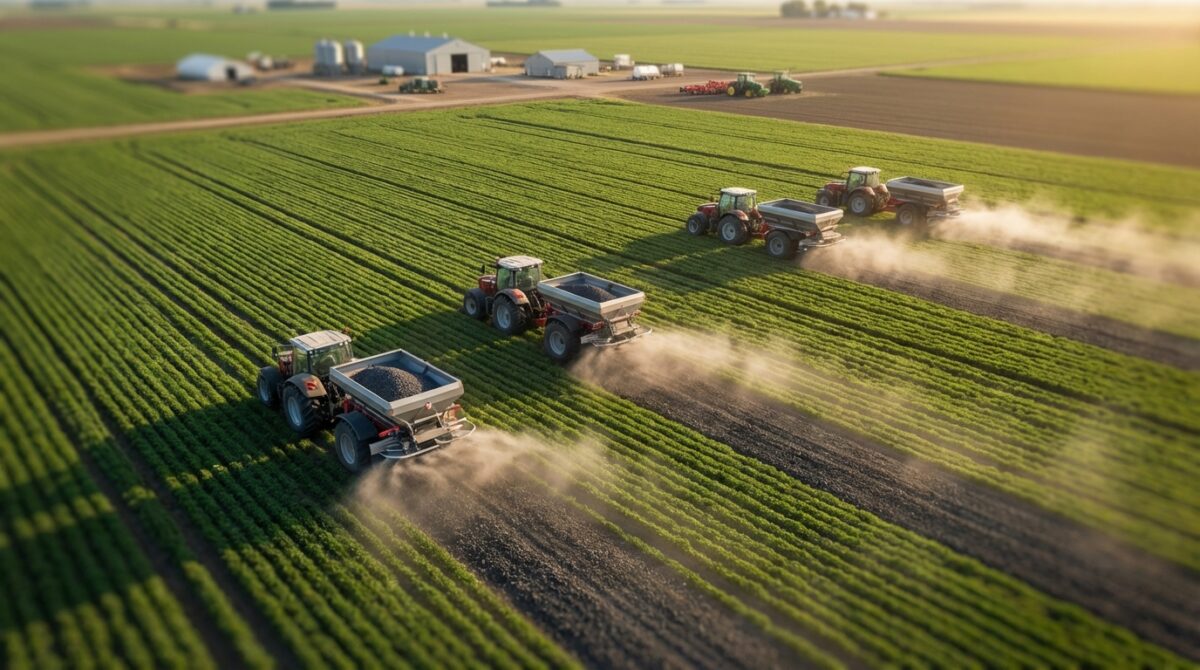
Imagine your farms transformed into real CO2 sponges, while also improving crop yields. No futuristic machines—just crushed rock spread across the fields. This idea, already tested on several continents, could target up to 1 billion tonnes of carbon dioxide captured every year.
This potential fascinates as much as it divides the scientific community. Between the promise of climate change mitigation and doubts about the logistics, the enhanced rock weathering method requires us to see agriculture as a major lever for greenhouse gas reduction and environmental sustainability.
How crushed rock turns fields into CO2 traps
At the heart of this approach is a very ancient chemical reaction. Rain absorbs carbon dioxide and forms a weak acid that reacts with crushed silicate rocks spread over farmland. The CO2 ends up stored as bicarbonates, carried off to rivers and then the ocean, where it remains trapped for millennia. This form of CO2 sequestration is directly inspired by the natural cycle of Earth’s rocks.
Gigantic Asteroid Strike 6.3 Million Years Ago Created Vast Glass Desert in Brazil
How an Innovative Plastic Made from Milk Disappears in 13 Weeks
By grinding these rocks into fine particles, researchers increase the surface area for contact with water, which speeds up the reactions. Trials conducted in the United States, particularly on test plots studied by the University of California and Cornell, have shown that adding crushed volcanic rock enabled measurable carbon capture even during severe drought. These results have been widely reported, as shown in the analysis published by researchers at UC Davis.
A soil amendment that also feeds crops
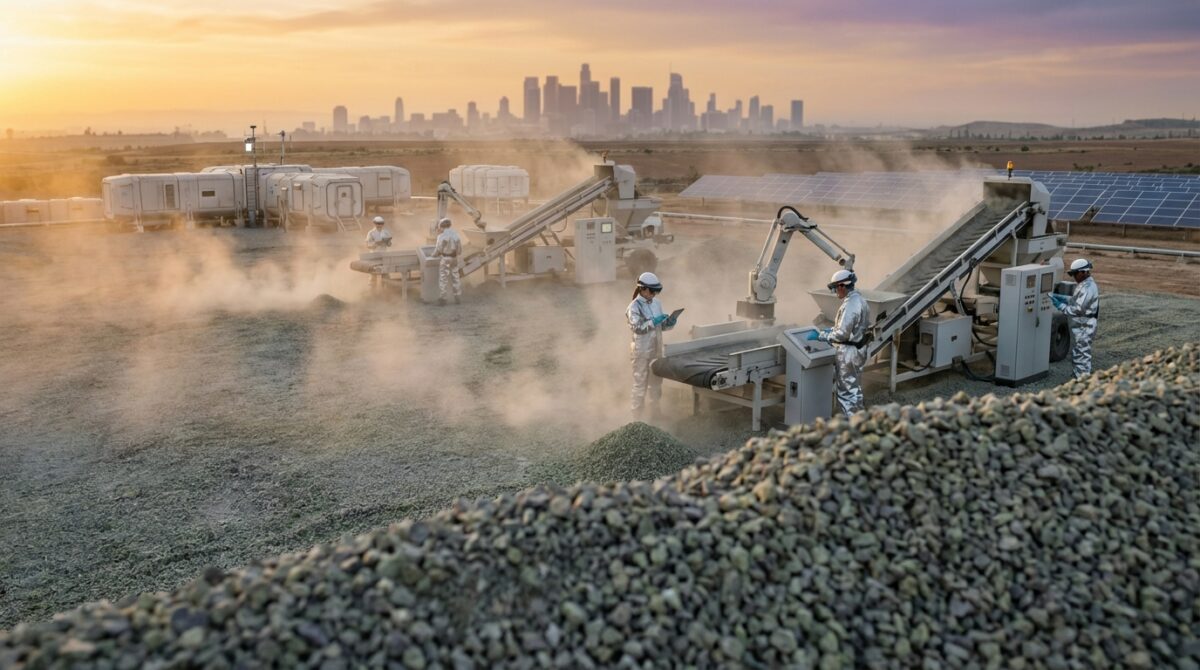
Beyond climate, farmers see this as a potentially profitable soil amendment. Silicates like basalt or olivine gradually release magnesium, calcium, and other nutrients. Early field studies sometimes show increased yields, as well as better nutrient uptake. For farmers, the idea of an amendment that enriches soil while generating carbon credits is especially attractive.
This convergence of agronomic performance and climate change mitigation explains the growing interest among major agricultural countries. Brazil, for example, is testing these rocks at scale to reduce its dependence on imported fertilizers. The approach is part of a broader innovation movement, where technologies are transforming emissions, as illustrated by some projects for industrial CO2 valorization.
1 billion tonnes of CO2 captured: promise or illusion?
The first global estimates sparked enthusiasm. Combining cultivated land, humid climates, and the availability of silicate rocks, several teams have estimated that enhanced rock weathering could remove up to 5 billion tonnes of CO2 per year by the end of the century. A detailed analysis, reported in recent studies on the potential for one billion tonnes, refines this range to 0.7 to 1.1 billion tonnes per year by 2100.
These figures need to be compared to the roughly 38 billion tonnes of CO2 from fossil fuels in 2025. The technique does not replace emissions reduction, but it could tip the scales for climate. The most optimistic scenarios, however, assume massive adoption, supported by public policy, logistical subsidies, and a strong market for carbon capture credits.
Gradual uptake, led by the Global South
Models predict a step-by-step ramp up. In the first decades, Europe and North America would achieve most of this CO2 sequestration, thanks to their mining and road infrastructure. Over time, supply chains for crushed rock would be developed in Asia, Latin America, and sub-Saharan Africa, regions where heat and rainfall accelerate the chemical weathering of rocks.
In these tropical areas, each tonne of basalt spread could generate more carbon credits than in temperate climates. Farmers like Amina, a maize producer in Kenya in a typical scenario, could supplement their income by selling these credits, while improving the fertility of their fields. This shift points to a transition in which agriculture becomes a central economic player in greenhouse gas reduction.
Obstacles, uncertainties and hidden risks of the technique
Skeptics remind us that this is no magic bullet. The rate of reaction depends heavily on soil moisture. Measurements show that on dry land, capture can be up to 25 times slower. In soils with high pH, rainfall reacts with existing carbonates rather than with crushed rock, cancelling out the net benefit for CO2 sequestration. In very acidic soils, another chemical process takes over and disrupts the soil’s overall carbon balance.
Another sticking point is the full emissions balance. Extracting, grinding, and transporting gigatonnes of rock requires a lot of energy. Some studies suggest that, in poorly optimized supply chains, the CO2 emitted could approach the amount captured. Finally, olivine and some mine tailings contain heavy metals such as nickel and chromium, raising questions about food safety. Several analyses, including those detailed by European teams, highlight these uncertainties to watch out for.
The logistics wall: where will the rocks come from?
A single figure sums up the challenge. To remove 1 gigatonne of CO2 each year, about 5 gigatonnes of silicate rock would need to be spread. On a global scale, this would mean establishing a whole new mining industry of a magnitude comparable to some of today’s largest material sectors. No one yet knows exactly which deposits will be tapped, or how to minimize local impacts on landscapes, water, or biodiversity.
This debate ties in with larger questions about resources, reminiscent of the controversies over lithium and quarries, widely discussed in the energy sector. For this climate change mitigation approach to remain consistent with environmental sustainability, policymakers will have to weigh global climate benefits against regional impacts, as with other massive infrastructure projects.
How can farmers realistically prepare?
Farmers won’t sign on to spread tonnes of crushed rock based on projections alone. They expect measurable protocols, economic guarantees, and local feedback. Agricultural organizations are already testing small plots, with measurements of carbon dioxide flows and soil analyses. The aim: to prove that this soil amendment improves profit margins and fits into work schedules without disrupting crops.
For a grain producer to adopt the method, several conditions must be met: access to a basalt or olivine quarry, competitive transport costs, reliable instruments to quantify carbon capture, and a stable credit market. The debates over measurement robustness echo those in other sectors of climate research, as described in reports on the risks and limits of carbon capture techniques.
Key steps for a pilot rock weathering project
A typical pilot program is often broken down into several clear phases. This roadmap helps farmers and cooperatives move forward without skipping steps and limit risk.
- Choose a rock type suitable for the local area, with low heavy metal content and realistic logistics.
- Define a test plot and establish a precise baseline for soils, yields, and emissions.
- Set grain size and application rate per hectare to balance costs, chemical effectiveness, and mechanical labor.
- Track CO2 flows, soil chemistry, and crop performance over several seasons.
- Assess the financial model, factoring in costs, carbon credits, and potential yield gains.
This step-by-step approach gives farmers and investors a more realistic perspective on the method’s profitability. It also allows them to compare this option with other greenhouse gas reduction solutions already available on farms.
How does crushed rock capture CO2 on farms?
Rain dissolves some atmospheric carbon dioxide, forming a weak acid. When it passes through finely crushed silicate rocks spread on fields, this acid reacts with the minerals. The CO2 is then transformed into stable bicarbonates, carried into rivers and then the ocean, where it remains stored for hundreds to thousands of years.
What impact does this method have on crop yields?
Silicate rocks, like basalt, gradually release magnesium, calcium, and other nutrients. In several trials, researchers have observed improved plant nutrition and sometimes increased yields. However, results vary based on climate, soil type, and rock used, hence the need for local testing prior to large-scale deployment.
Is it really possible to achieve 1 billion tonnes of CO2 sequestration per year?
Models indicate that a level close to 1.1 billion tonnes per year by 2100 is theoretically possible, given broad and coordinated adoption. Some scientists, however, see this value as optimistic, as it depends on many factors: rainfall, rock quality, logistical efficiency, and resource availability. The potential is high, but still uncertain.
What are the main risks for the environment and health?
Ancient Peruvian Civilization: The Guano Advantage
Approaching Point Return: Earth’s Imminent Climate Risk
The risks mainly involve heavy metals found in certain rocks or mine tailings, such as nickel and chromium, which could accumulate in soil or crops. Opening new quarries also raises questions about local ecosystems. That’s why serious projects rigorously assess rock composition, mining impact, and soil monitoring before any widespread deployment.
Is this approach enough for climate change mitigation?
Enhanced rock weathering remains a complement, not a substitute for emissions reduction. Even at full scale, the method could only offset a fraction of current fossil emissions. However, it can strengthen the climate toolbox by combining agriculture, carbon capture, and soil improvement—as long as it’s used alongside low-carbon energy and conservation policies.