
Show summary Hide summary
- How the aurora looks from 400 kilometers above Earth
- Why this northern lights video matters for science
- What the aurora reveals about Earth’s protective systems
- From ISS window to your screen: a shared perspective
- Key things this Russian ISS aurora video shows
- What caused the intense aurora seen in the cosmonaut’s video?
- Why was there so much red light in this northern lights event?
- How high is the International Space Station when filming the aurora?
- Can aurora videos from space help scientific research?
- Where can I watch the aurora footage captured from the ISS?
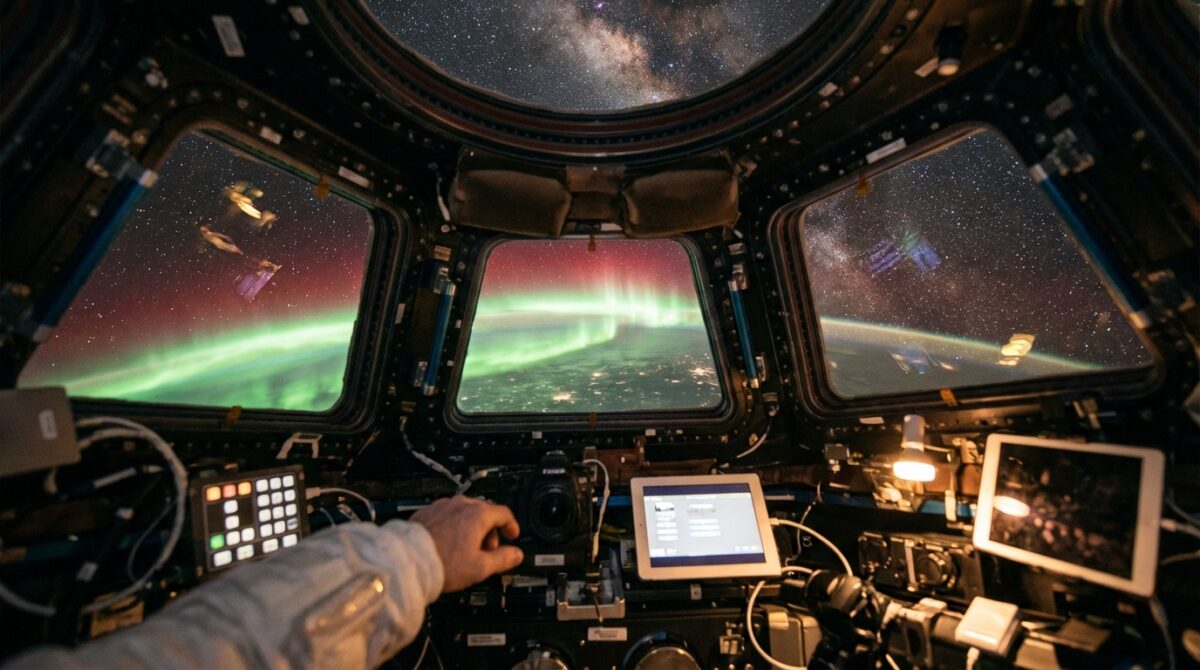
During one of the most intense bouts of solar activity in decades, a Russian cosmonaut pointed a camera at Earth and captured the aurora borealis as a living, moving curtain of light. The video was recorded from the International Space Station, turning a familiar spectacle of the night sky into a sweeping, planetary-scale performance.
The footage, shot by Roscosmos astronaut Sergey Kud-Sverchkov, shows the northern lights shimmering over Earth like a slow-motion ocean of green, threaded with rare waves of red. According to his post on Telegram, the display followed the strongest geomagnetic storm in roughly twenty years, strong enough to paint the upper atmosphere in deep crimson tones that usually stay invisible.
How the aurora looks from 400 kilometers above Earth
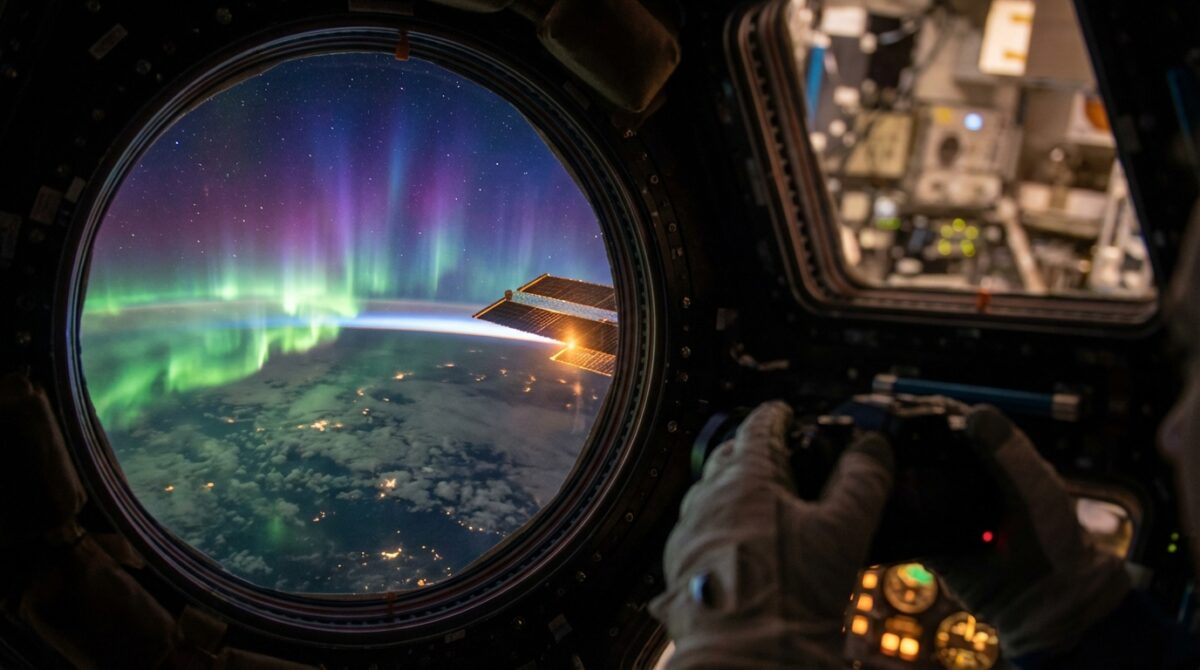
Seen from cities and dark rural locations, aurora arcs usually form bands near the horizon. From space, the geometry flips. Astronauts orbiting at about 400 kilometers altitude, roughly the height of the ISS, watch an entire oval of light wrapping the polar regions. Reports such as the AP coverage of the event describe the glow stretching thousands of kilometers, with Earth’s limb glowing green as if someone traced the edge of the planet with neon ink.
Astronomers Believe They’ve Observed a Rare Collision Between Two Planets
Unusual Chirping Signals from a Supernova Confirm the Long-Contested Magnetar Hypothesis
During this storm, Kud-Sverchkov wrote that there was “plenty of red glow” and that it felt like the station was “sailing inside that light.” That subjective description matches decades of astronaut accounts compiled in studies and features such as reports on aurora from 400 km altitude. From orbit, the aurora does not simply hang above you; it rises up like towers and sheets, sometimes climbing to 500–600 kilometers and engulfing the spacecraft’s path.
Charged particles, magnetic fields and atmospheric neon
Behind the beauty lies precise physics. The aurora borealis emerges when high-speed particles from the Sun, accelerated during eruptions and coronal mass ejections, stream outward in the solar wind. When a strong storm hits, these energetic particles funnel along Earth’s magnetic field lines into the polar regions, where they collide with atoms and molecules in the upper atmosphere.
Those collisions knock electrons into higher energy states. When the electrons fall back, they emit light. Green comes mainly from oxygen atoms around 100–150 kilometers altitude. Red appears higher up, from oxygen at roughly 200–300 kilometers, and is usually fainter. During the storm Kud-Sverchkov recorded, conditions boosted that high-altitude emission, producing extended red arcs visible in both his footage and other imagery, like the photographic coverage of the same event.
Why this northern lights video matters for science
At first glance, a minute-long video from the ISS looks like pure spectacle. Yet for earth observation teams and space weather researchers, these scenes help validate models of how geomagnetic storms evolve. Timing the passage of the station over the auroral oval lets scientists match visual structures with satellite instruments measuring particle flux, magnetic field changes and atmospheric density.
Institutions working on space weather forecasting rely on this cross-checking. Events like the one recorded here, also highlighted by outlets such as The Guardian’s science video report, contribute to a growing library of real storms. These sequences support models that help power-grid operators, aviation routes and satellite operators anticipate disturbances driven by solar activity.
Space exploration, cameras and citizen science from orbit
The International Space Station has become an orbital observatory as much as a laboratory. Interior windows, wide-angle cameras and stabilized mounts allow astronauts from multiple agencies to record cosmic phenomena in high resolution. Articles such as CNET’s “room with a view” feature show how crew members coordinate with ground teams to capture aurora when forecasts predict strong storms.
For enthusiasts on the ground, platforms resharing the clip, like social media posts of the cosmonaut’s recording or compilations such as the MSN space video, turn these scientific moments into shared experiences. A school class under a cloudy sky can still watch the northern lights unfold above the atmosphere, guided by an astronaut’s lens.
What the aurora reveals about Earth’s protective systems
Every burst of aurora borealis is a live demonstration of how Earth’s magnetic field and atmosphere shield the surface. When storms intensify, they inject extra energy into the upper atmosphere, causing satellites to experience more drag and radio signals to fluctuate. The glowing curtains seen in this space-based footage trace the exact regions where that energy enters.
Long-term earth observation of auroras, from both orbit and ground-based cameras, offers a natural monitor of how our planet responds to the Sun over the solar cycle. For navigation systems, communications networks and polar aviation, understanding those responses is not abstract. It informs how routes are planned, how satellites are designed and how missions are scheduled during periods of heightened solar activity.
From ISS window to your screen: a shared perspective
In the current era of space exploration, many missions emphasize engineering milestones: new launch vehicles, cargo ships or lunar landers. Yet the quiet act of a Russian cosmonaut filming the night sky from 400 kilometers up connects orbital hardware back to the human senses. The clip aligns with a growing catalog of impressions, from NASA astronauts to Roscosmos crews, that turn the planet itself into a subject of study and contemplation.
Several outlets, including international technology news sites and youth-focused explainers such as the BBC’s coverage of aurora filmed from space, now use this event as an entry point to discuss space weather. A single minute of light over Quebec or the North Atlantic becomes a teaching tool linking children, engineers and researchers to the same cosmic drama.
Key things this Russian ISS aurora video shows
For readers trying to decode what exactly appears in this sequence, several features stand out. They turn a beautiful clip into a compact lesson about how the Sun and Earth interact in real time.
- Extended red aurora: Sign of a strong storm energizing oxygen higher in the atmosphere than usual.
- Curved green band: The bright ring traces the auroral oval hugging Earth’s magnetic poles.
- Station sunrise: As the ISS moves into daylight, the aurora fades, revealing how sensitive it is to solar illumination.
- Star field beyond: Fixed stars behind the moving glow help distinguish Earth’s limb from the background cosmos.
- Dynamic waves: Subtle ripples in the light mark regions where charged particles vary in intensity and direction.
What caused the intense aurora seen in the cosmonaut’s video?
The display followed a powerful geomagnetic storm, triggered when a burst of charged particles from the Sun struck Earth’s magnetic field. Those particles were guided into the polar regions, where they collided with atoms and molecules in the upper atmosphere, producing the green and red light recorded from the International Space Station.
Why was there so much red light in this northern lights event?
Red aurora appears when energetic particles excite oxygen at higher altitudes, typically above 200 kilometers. During very strong storms, more energy reaches those layers, enhancing the red emission. The Russian cosmonaut’s description of a strong red glow matches a period when the storm intensity was among the highest seen in roughly two decades.
How high is the International Space Station when filming the aurora?
The ISS orbits at around 400 kilometers above Earth’s surface. From that height, astronauts look down on the entire auroral oval rather than up at arcs near the horizon. This vantage point lets them see the vertical structure of the aurora, including tall curtains and towers of light reaching toward the station.
Can aurora videos from space help scientific research?
Yes. Though they look like pure spectacle, time-stamped videos help researchers connect visual patterns with measurements from dedicated satellites and ground stations. By aligning what the cameras see with data on particle flows and magnetic fields, scientists refine models that predict space weather and its impact on satellites and power systems.
Where can I watch the aurora footage captured from the ISS?
Chickpeas Poised to Become the Moon’s First Cultivated Crop
Researchers Potentially Unveil a Novel Mineral Discovery on Mars
Major news outlets and space-focused platforms have shared the clip and related sequences. For instance, AP News, The Guardian and other science media offer edited versions, and you can also search YouTube for aurora borealis videos filmed from the International Space Station to see similar scenes from various missions.