Show summary Hide summary
- What lies concealed within Jupiter’s massive clouds
- Oxygen, water and the birth story of the gas giant
- From Great Red Spot to microphysics: what the model adds
- Limits, open questions and why caution still matters
- How this connects to exoplanets, policy and future missions
- How much oxygen does Jupiter likely contain compared to the Sun?
- Did the study directly measure water and oxygen below Jupiter’s clouds?
- Why does vertical mixing speed inside Jupiter matter?
- What does this research imply about where Jupiter formed?
- Can these modeling techniques help study exoplanets?
What now emerges from Jupiter’s turbulent bands is not just spectacle but substance: new simulations suggest the gas giant hides about one and a half times more oxygen than the Sun, locked beneath its towering clouds. That single number reshapes how scientists picture our early solar system and the hidden machinery inside the Solar System’s largest planet.
This leap comes from a study led by Jeehyun Yang at the University of Chicago, working with NASA’s Jet Propulsion Laboratory. Published in The Planetary Science Journal, the research combines chemistry and gas dynamics into the most detailed model yet of Jupiter’s atmosphere, without sending a probe into its crushing depths.
What lies concealed within Jupiter’s massive clouds
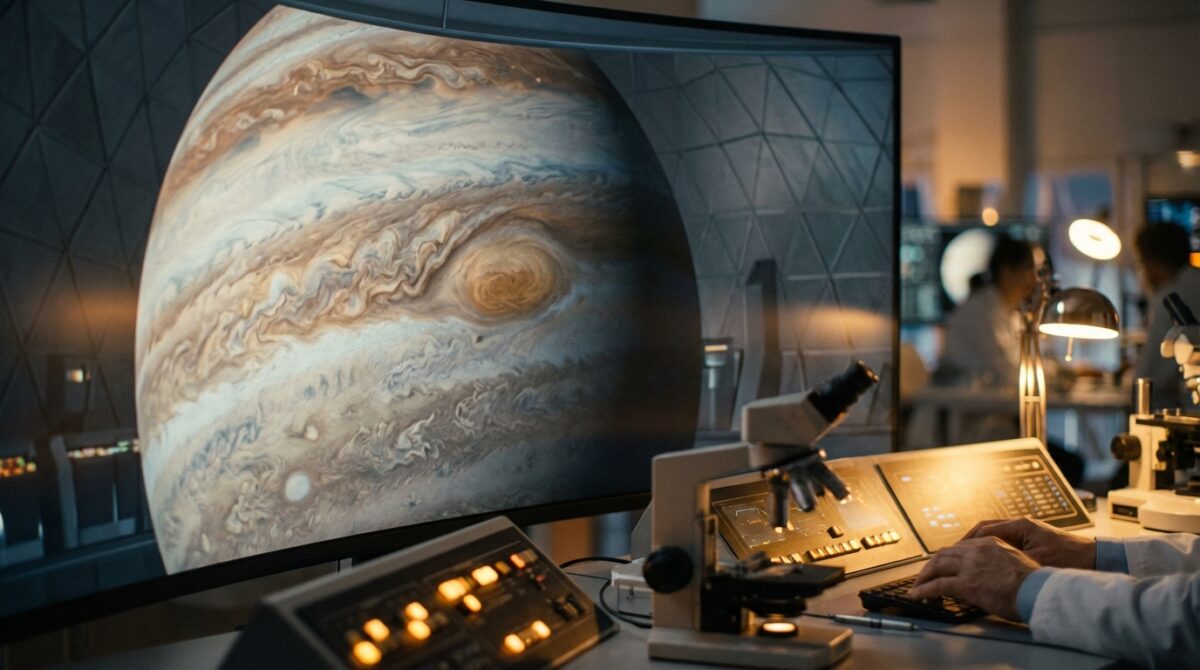
From Earth, Jupiter’s surface looks like a restless ocean of color. Bright zones and darker belts wrap the planet, sliced by storms including the famous Great Red Spot, a massive storm wider than Earth that has raged for more than three centuries. Yet beneath those bands, even NASA’s Galileo probe lost contact as it plunged into the dense gases, leaving the deeper layers effectively concealed.
Did a Black Hole Just Erupt? This ‘Impossible’ Particle Could Be the Key Evidence
Electrifying Dust Storms on Mars Transform the Red Planet’s Chemistry
For planetary science, the composition below the visible tops is a missing piece. Oxygen, mostly carried as water, records where and how the planet formed. Too little oxygen and Jupiter might have grown closer to the Sun; a richer supply suggests formation farther out, in an icy region. The new work offers a sharper, statistically grounded estimate of that hidden oxygen reservoir, narrowing a debate that has split researchers for years. Suni Williams bids farewell after 27 remarkable years at NASA
How scientists modeled Jupiter’s atmosphere without going there
To crack the mystery, Yang’s team built a model that follows both atmospheric chemistry and gas dynamics in one framework, tracking gases, droplets and clouds as they move and react over time. In one sentence, their method: they simulated how thousands of chemical reactions and vertical motions interact in Jupiter’s changing weather layers, then tuned the model until it matched spacecraft data.
Inputs came mainly from NASA’s Juno mission, which measures microwave emissions and composition, combined with earlier observations and lab data on reaction rates. Where previous models usually chose either detailed chemistry or detailed circulation, this study insisted on both, accepting heavy computation to reduce simplifications that previously blurred the oxygen picture.
Oxygen, water and the birth story of the gas giant
The headline result: Jupiter likely contains around 1.5 times the Sun’s oxygen abundance, with the model favoring this value over alternatives that suggested far drier conditions. Statistically, the preferred solutions cluster tightly around this higher oxygen scenario, though the authors acknowledge remaining uncertainty bands rather than claiming a single exact figure.
This matters because oxygen shapes planet formation pathways. Far from the Sun, water freezes into ice grains that growing worlds can more easily capture. A Jupiter loaded with water-rich material points toward formation in a colder zone followed by inward migration, supporting modern simulations of planetary movement. The finding also pushes back on earlier interpretations that proposed Jupiter might be surprisingly oxygen-poor.
Slower, stranger gas dynamics inside the turbulent atmosphere
Beyond composition, the model points to a slower, more layered interior circulation than many textbooks suggested. To match Juno and other constraints, vertical mixing in certain latitude bands had to be reduced by roughly 35 to 40 times compared with standard assumptions used in older chemistry-transport models.
That means a single molecule may take weeks, not hours, to cross a given layer, changing how quickly storms can dredge up materials from depth. For a mission planner or a data analyst comparing different studies, this slower circulation reshapes expectations about where key gases should appear and how long atmospheric “fingerprints” of big storms persist.
From Great Red Spot to microphysics: what the model adds
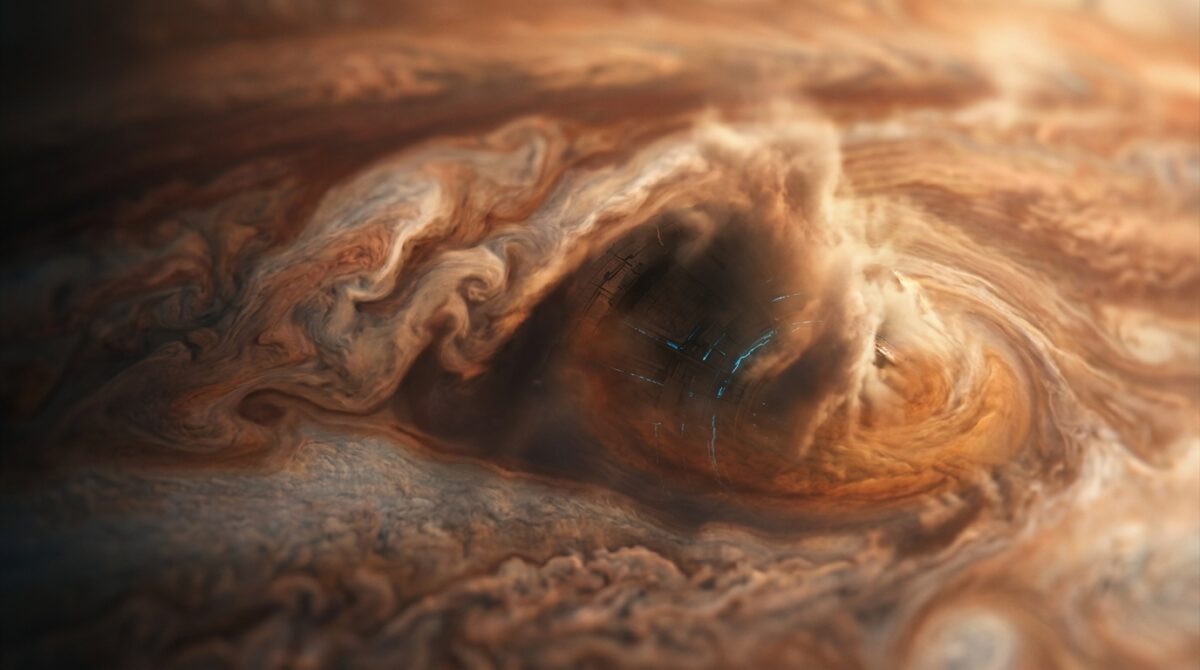
The new approach also reframes how features such as the Great Red Spot relate to the deeper atmosphere. While the study does not simulate each individual storm, its coupling of chemistry and dynamics clarifies how high-altitude clouds, ammonia snow and water-rich layers may interact around giant vortices. High-level hazes, for example, can block sunlight and change local heating, subtly feeding back on circulation patterns.
Citizen-science projects that map Jupiter’s storms in painstaking detail, such as work covered in recent analyses of amateur observations, now sit alongside this model as complementary tools. Together, time-lapse imagery and deep-interior simulations offer a more continuous picture from topmost clouds down into the hidden, hot layers.
Key takeaways for readers following Jupiter science
For enthusiasts like Lena, an engineer who spends nights imaging Jupiter with her backyard telescope, these results turn those striped views into a more physical story. Each band hints at processes the model quantifies, from condensation levels to mixing speeds and oxygen distribution.
To keep the big picture in mind, three points stand out:
- Jupiter’s oxygen is probably higher than the Sun’s, around 1.5 times, suggesting abundant water in its building blocks.
- Vertical mixing is far slower than older estimates, changing how researchers interpret trace-gas profiles.
- Chemistry and gas dynamics must be modeled together to avoid misleading conclusions about deep composition.
Limits, open questions and why caution still matters
Despite its sophistication, the model remains a simulation constrained by imperfect data. It focuses on specific latitude bands and depths, not the entire planet, and relies on reaction rates and cloud physics that, while state-of-the-art, still carry lab uncertainties. The authors explicitly frame their oxygen estimate as a probability-guided range, not a direct measurement.
This distinction avoids confusing correlation and causation. The agreement between the model and Juno-era observations supports the high-oxygen scenario but does not prove, in an absolute sense, that Jupiter must contain exactly that amount. Additional missions, improved microwave measurements and refined lab experiments on exotic gas mixtures will be needed to test and tighten these constraints. Spacecraft observes ‘magnetic avalanche’ sparking massive solar eruptions
How this connects to exoplanets, policy and future missions
For exoplanet researchers, the work offers a template: blend detailed chemistry with dynamics to interpret spectra of distant gas giant worlds that can never be probed directly. Similar models can help classify which planets likely formed beyond their systems’ ice lines and which could host temperate moons.
Space agencies and funding bodies weighing future missions to the outer planets can use these findings to refine instrument priorities. Studies such as the one summarized on Caltech’s overview of Jupiter water modeling or reports like recent inside-Jupiter analyses show a clear trend: combining multi-wavelength observations with advanced modeling unlocks more value from each mission dollar. Unlocking longevity: How cross-training could be your secret to a longer life
How much oxygen does Jupiter likely contain compared to the Sun?
The new University of Chicago and Jet Propulsion Laboratory model favors a Jupiter oxygen abundance of roughly one and a half times the Sun’s value. This estimate comes from simulations that best match spacecraft observations, but it remains a range with statistical uncertainty, not a single exact measurement.
Did the study directly measure water and oxygen below Jupiter’s clouds?
No, the study did not send instruments into the deep atmosphere. Instead, it used a combined chemistry and gas dynamics model constrained by data from missions such as Juno. By testing many scenarios, the researchers identified which oxygen levels are most consistent with the observed atmospheric signatures.
Why does vertical mixing speed inside Jupiter matter?
Vertical mixing controls how fast gases and aerosols move between hot deep layers and cooler upper regions. Slower mixing, as suggested by the new model, means chemical fingerprints of storms or deep composition persist differently than older models predicted, changing how scientists interpret atmospheric measurements.
What does this research imply about where Jupiter formed?
A higher oxygen content points toward formation in a colder, ice-rich region of the young solar system, followed by inward migration to its current orbit. However, the study cannot fully prove a single formation path; it adds weight to scenarios where Jupiter accreted significant icy material before moving inward.
Can these modeling techniques help study exoplanets?
Astronomers Unveil How Dying Stars Consume Their Giant Planetary Companions
Students Discover Ancient Star from the Dawn of the Universe Entering the Milky Way
Yes. The same approach—linking atmospheric chemistry with gas dynamics—can be adapted to giant exoplanets. By comparing simulated spectra with telescope data, scientists can better infer composition, circulation patterns, and formation histories for planets orbiting other stars.