Show summary Hide summary
Your sense of scale in space is about to be shaken. Scientists have spotted a massive asteroid, wider than seven football fields, spinning so fast that by older theories it should already have torn itself apart.
In a few frantic nights of observations, a new telescope in Chile revealed a class of space rocks whose fast rotation challenges everything astronomers thought they knew about how asteroids hold together.
Scientists stunned by a record-breaking asteroid rotation
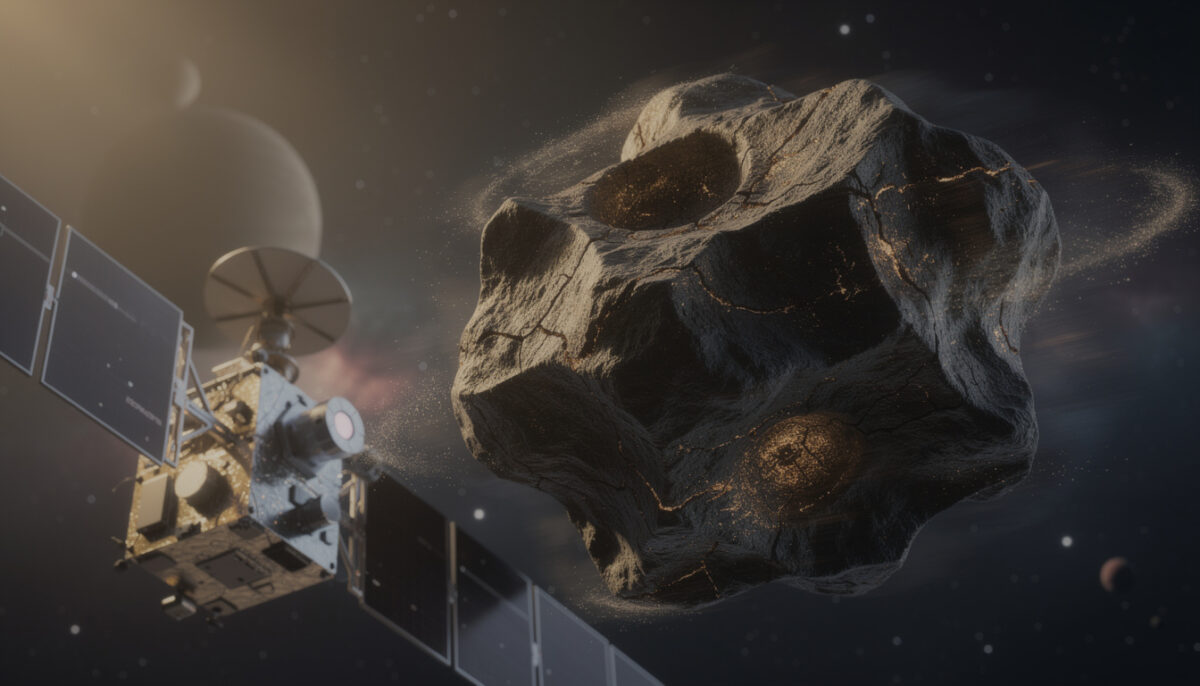
The star of this discovery is 2025 MN45, a newly catalogued celestial body in the inner asteroid belt. Its estimated diameter reaches about 710 metres, yet it completes a full rotation in roughly 1.9 minutes.
Private Firm to Touch Down on Asteroid Apophis During Its Close Earth Flyby
Hubble Space Telescope Captures Stunning Breakup of Comet C/2025 K1 (ATLAS) in Space
For years, astronomers assumed large asteroids could not spin faster than about 2.2 hours without disintegrating. That threshold comes from models of “rubble pile” objects, loose collections of rocks held together only by gravity. 2025 MN45 smashes that limit and forces a rethink of asteroid physics.
How the Vera C. Rubin Observatory made the discovery
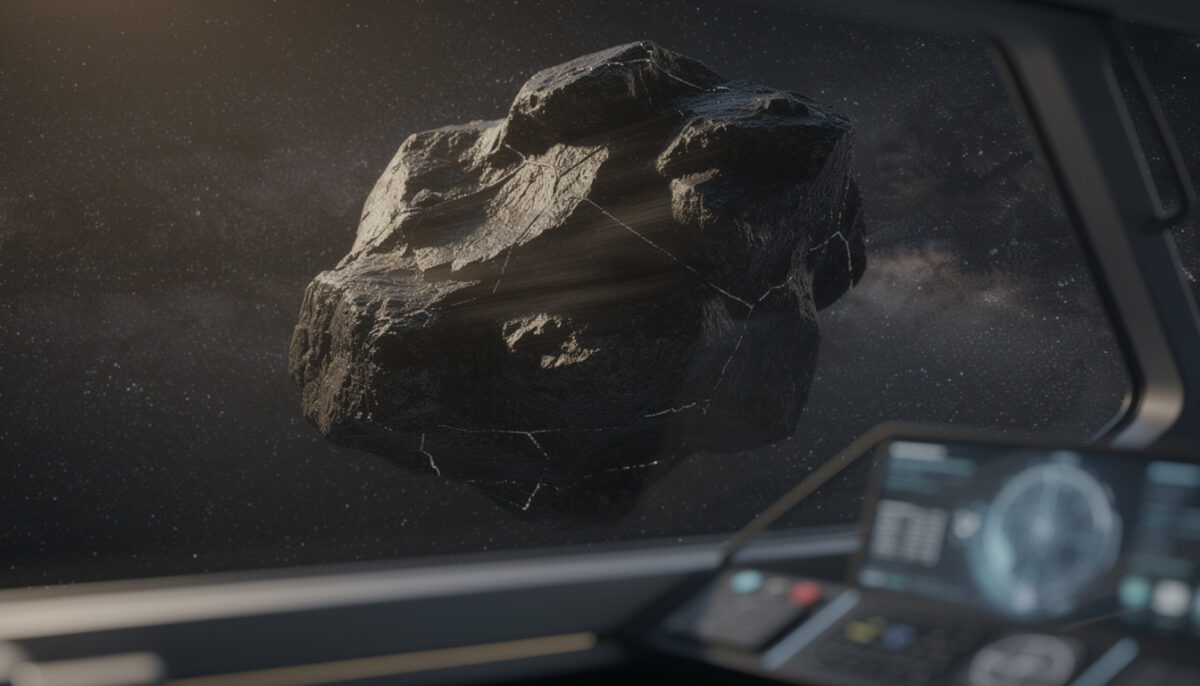
The breakthrough comes from the Vera C. Rubin Observatory in Chile, during its first nine nights of test observations in late April and early May 2025. Led by Dmitrii Vavilov at the University of Washington, the team analysed thousands of light curves from moving objects crossing the camera’s field.
By tracking subtle brightness variations, they measured how quickly each asteroid spins. Out of 76 objects with solid data, they flagged 19 super-fast rotators spinning once every 2.2 hours or faster, and then pushed further, hunting for even shorter periods that earlier software simply ignored.
Super-fast and ultra-fast rotators in the asteroid belt
Once the team relaxed their initial limits, they uncovered three ultra-fast rotators with periods around 3.8 minutes, 1.92 minutes and 1.88 minutes. 2025 MN45, the fastest of the trio, instantly set a record for any asteroid larger than 500 metres.
These objects sit among the countless rocks of the asteroid belt, but their behaviour makes them outliers. Where typical rubble piles lumber along, these bodies pirouette like spinning tops, raising questions about their formation and internal makeup.
Why 2025 MN45 must be made of stronger stuff
If 2025 MN45 were a loose agglomeration of small stones, the extraordinary speeds of its rotation would fling fragments away. Calculations show that even cohesive material such as compact clay would fail to withstand those centrifugal forces.
The logical conclusion is that 2025 MN45 is either one monolithic rock or contains a large fraction of solid metal. That hints at a violent past where collisions stripped away weaker layers, leaving behind a dense, highly resistant core able to survive such a blistering spin rate.
What this discovery changes for astronomy and space safety
For planetary scientist Laura, who uses Rubin data to model impact risks, 2025 MN45 is more than a curiosity. Strong, compact asteroids behave differently if they ever cross Earth’s orbit. They can penetrate deeper into the atmosphere and deliver more energy to the ground.
Researchers already study past giant impacts, such as the event that formed the vast Brazilian glass field described in this analysis of a gigantic asteroid strike. Ultra-fast, metal-rich impactors would leave yet another signature, forcing hazard models to adapt.
Revisiting impact risk in light of ultra-fast rotators
The Rubin results fold into a broader effort to assess how dangerous near-Earth objects might be. Strength, spin state and composition all influence the damage an incoming body can cause, beyond simple size and speed.
When teams update their simulations, they now need to account for monolithic, fast-rotating projectiles, complementing previous work on rubble piles and airburst events. For context on how risk is evaluated today, you can look at how concerned we should be about an asteroid impact, which outlines the main criteria used by monitoring agencies.
What Rubin’s next decade could reveal about spinning asteroids
The Vera C. Rubin Observatory will survey the southern sky for about ten years, revisiting the same regions night after night. That cadence is perfect for building a massive catalogue of asteroid light curves and rotation periods.
With each year of data, astronomers expect to find more massive asteroid outliers, map families of similar bodies and track how spin rates evolve after collisions or subtle forces such as the YORP effect. The sample of 76 measured rotators from 2025 is just the opening scene.
How you can follow and understand these space discoveries
If you enjoy spotting patterns in the sky yourself, simple backyard telescopes already let you time the rotation of some brighter asteroids by measuring changes in their brightness. Citizen scientists often contribute these measurements to professional databases.
To deepen your grasp of modern astronomy, resources that explain phenomena like the Lunar X and V can help you develop an eye for subtle light variations. That same skill underpins how Rubin and other observatories tease out spin from tiny flickers in a light curve.
Key takeaways from the fastest-spinning large asteroid
The saga of 2025 MN45 can be distilled into a few powerful lessons for anyone curious about space and astronomy:
- Limits can be broken: the old 2.2-hour rotation barrier for large rubble piles does not apply to all asteroids.
- Composition matters: a celestial body built from solid rock or metal can survive extraordinary speeds that would shatter weaker structures.
- New tools change the game: wide-field observatories like Rubin uncover behaviour no one thought to look for before.
- Risk models evolve: understanding fast rotation refines how agencies estimate potential impact damage.
- Curiosity drives progress: revisiting “impossible” scenarios is often how the biggest discovery stories begin.
As Rubin continues scanning the asteroid belt, each new anomaly adds another piece to the puzzle of how these spinning worlds form, survive and sometimes threaten planets like ours.
How fast does asteroid 2025 MN45 rotate?
Asteroid 2025 MN45, about 710 metres across, completes a full spin in roughly 1.9 minutes. That makes it the fastest-rotating asteroid ever observed above 500 metres in size, far beyond the traditional 2.2-hour limit proposed for rubble-pile objects.
Why does its fast rotation surprise scientists?
Previous models suggested that large asteroids made of loosely bound debris would fly apart if they rotated faster than about 2.2 hours per turn. 2025 MN45 spins around 70 times faster than that limit, indicating it must be a much stronger, more compact body.
What is an ultra-fast rotator asteroid?
Ultra-fast rotators are asteroids whose rotation periods are measured in minutes rather than hours. In Rubin data, three objects showed periods near 3.8, 1.92 and 1.88 minutes, including 2025 MN45, placing them in a distinct, rare class of extremely rapidly spinning bodies.
How was the rotation of 2025 MN45 measured?
Rocket Lab Successfully Deploys Eighth Synspective Radar Imaging Satellite to Enhance Earth Observation
Astronomers Uncover Cosmic Collision That Tore Apart a Nearby Galaxy
Astronomers analysed its light curve, recording how the asteroid’s brightness changed as it spun. Regular, repeating variations allowed them to calculate the rotation period with high confidence during Rubin Observatory’s early observation campaign in 2025.
Could 2025 MN45 pose a danger to Earth?
Current information places 2025 MN45 in the asteroid belt, not on a collision path with Earth. However, studying its strength and rotation helps refine impact risk models for any future objects of similar size and composition that might cross our planet’s orbit.