
Show summary Hide summary
- New evidence that lava tubes can host future Moon bases
- Why lunar lava tubes matter for human survival in space
- Inside the trio of robotic explorers and their autonomy
- What the results show, and what they do not yet prove
- Implications for planetary science, astrobiology and policy
- Why are lunar lava tubes good candidates for Moon bases?
- What did the Lanzarote field test actually prove?
- Does this guarantee robots will work the same way on the Moon?
- Who is leading this robotic exploration project?
- How does this research affect future human missions to Mars?
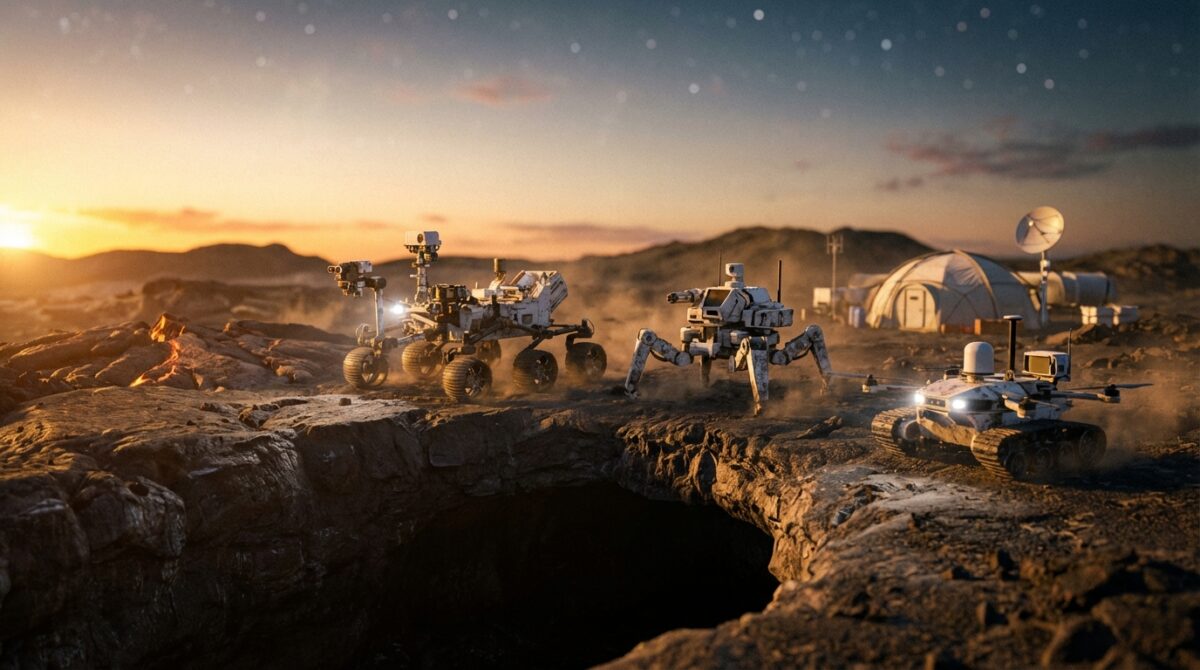
What if the safest place to live on the Moon is hidden deep underground? New research from a European team shows that Robotic Explorers can already enter volcanic caves, map them autonomously and simulate how future Moon Bases might be protected inside these Lunar Lava Tubes.
These results shift the discussion on Moon Colonization from “could we reach these caves?” to “how soon can robot teams start scouting them for real?”. The study gives space agencies a concrete roadmap, rather than a distant science-fiction vision, for turning underground tunnels into extraterrestrial habitats.
New evidence that lava tubes can host future Moon bases
The mission concept, developed by a consortium led by the German Research Center for Artificial Intelligence (DFKI) with key input from the Space Robotics Laboratory at the University of Malaga, has just been detailed in Science Robotics. The research shows that three complementary robots can autonomously survey, enter and map a cave, a capability long considered a missing link in Space Exploration strategies for the Moon and Mars.
Potential First Observation of a ‘Dirty Fireball’ Star Explosion Unveiled
Historic Artemis II Mission Launches Astronauts on Pioneering Journey to the Moon
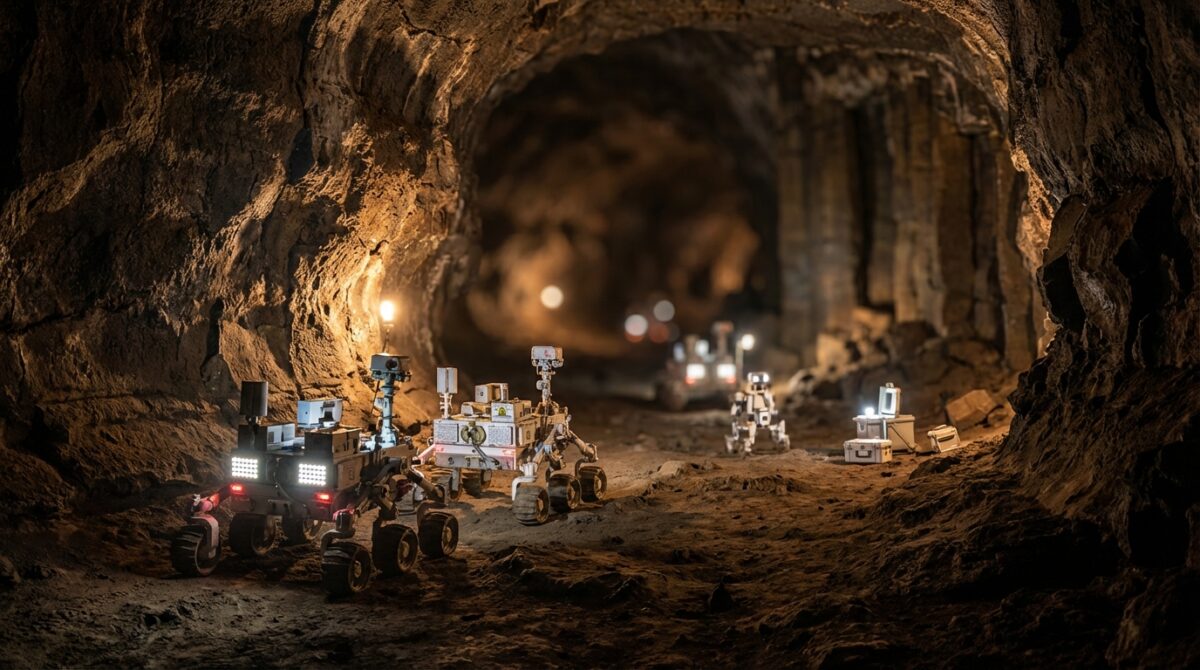
During a field campaign in February 2023 on the volcanic island of Lanzarote, Spain, the robots completed all key phases of the mission: scouting the entrance, dropping instruments, rappelling into the void, then building a detailed 3D model of the interior. For researchers in Planetary Science and Astrobiology, this is one of the clearest demonstrations so far that autonomous systems can handle the high-risk tasks humans should avoid during early Lunar Missions.
How the robotic mission works in four stages
The methodology is deliberately simple to describe, even if the engineering is demanding: a coordinated trio of robots divides the work into four progressive stages to reduce risk and maximise data. This approach mirrors how mountaineers build a route step by step before committing a full team to a dangerous ascent.
First, surface rovers create a shared map of the area around the lava tube entrance. Second, they release a sensorized payload cube into the opening to measure light, temperature and basic terrain properties. Third, a scout rover uses a rope to rappel down, much like a speleologist, and checks that the interior is navigable. Finally, once safety is confirmed, the robotic team continues deeper into the tunnel and generates a high-resolution 3D reconstruction.
Why lunar lava tubes matter for human survival in space
Lava tunnels on the Moon and Mars are gaining attention because they offer something surface habitats struggle to provide: natural protection. Thick rock overhead can block solar and cosmic radiation, limit temperature swings from boiling daytime heat to freezing nights, and shield against micrometeorite impacts that steadily erode exposed structures.
For mission planners thinking about Moon Bases, such shielding could dramatically reduce the mass needed for protective infrastructure. Studies discussed on platforms like SciTechDaily’s coverage of future Moon shelters highlight how underground sites may cut both risk and long-term cost. The new European study adds a missing operational piece: a validated way to actually survey these caves before building anything inside.
From Spanish caves to lunar missions
Lanzarote’s volcanic caves were chosen because they mimic, to a reasonable degree, the rough geometry and dark, dusty conditions expected in Lunar Lava Tubes. During the February 2023 tests, the robots had to cope with unstable rocks, steep slopes and no GPS signals, conditions similar to what they would face in real Lunar Missions.
The success of the trial, according to the authors writing in Science Robotics, supports the technical feasibility of using collaborative robot teams beyond Earth. While field tests on Earth cannot perfectly reproduce lunar gravity or dust behaviour, they allow researchers to validate autonomy, communication strategies and failure recovery – all critical before sending hardware hundreds of thousands of kilometres away.
Inside the trio of robotic explorers and their autonomy
The mission concept relies on three distinct but complementary roles. One robot focuses on wide-area surface mapping, another handles logistics and instrument deployment, and the third excels at agile movement and rappelling into the cave. Together, they form a small “team” that can reassign tasks if one unit struggles or fails.
Autonomy is central. Commands from Earth arrive with several seconds of delay on the Moon and much longer on Mars. The consortium, with major contributions from the University of Malaga, uses advanced path-planning algorithms and onboard decision-making so that robots can adapt to unexpected obstacles or partial data loss. Similar ideas appear in other international work on robot teams in caves, such as the trials discussed by Orbital Today’s coverage of lava cave missions.
The role of the University of Malaga and training future engineers
The Space Robotics Laboratory at the University of Malaga has built its reputation by developing algorithms that let rovers plan their own routes and manage limited energy and communication windows. Many of these techniques, originally created under European Space Agency contracts, now feed directly into autonomous cave exploration.
Students from the School of Industrial Engineering actively participate through internships and thesis projects. In practice, that means young engineers help tune navigation software, test hardware in simulated dust, or analyse data from Lanzarote field campaigns. This educational dimension matters: future Robotics experts who will design extraterrestrial habitats are already learning with real prototypes, not only with simulations.
What the results show, and what they do not yet prove
The field tests demonstrated that the four-phase strategy works from start to finish under realistic conditions. Robots successfully coordinated mapping, payload deployment, descent and subsurface 3D reconstruction. According to the authors, the probability of mission success in similar terrestrial caves is high, with uncertainties mainly linked to extreme terrain variations rather than software failures.
However, the results still stop short of proving that the same system will perform identically on the Moon or Mars. Differences in gravity, dust electrostatics and temperature cycles could introduce new failure modes. The research shows strong technical feasibility, not a guaranteed outcome, for future Space Exploration missions. Correlation between Earth test success and off-world performance is promising, but causation remains to be fully verified in situ.
- Terrestrial tests confirm that autonomous mapping of lava tubes is achievable with current technology.
- Radiation and impact protection from caves is inferred from physics and orbital imagery, not yet from human occupation.
- Mission timelines, long-term reliability and maintenance strategies for continuous robot use in space still need targeted studies.
Implications for planetary science, astrobiology and policy
For Planetary Science, detailed maps of lunar and Martian caves would refine models of past volcanic activity, crust formation and thermal evolution. In Astrobiology, subsurface voids on Mars are considered possible refuges where traces of past microbial life could be better preserved than on the harsh surface.
On the policy side, evidence that robot teams can safely inspect underground sites strengthens the case for including lava tube scouting in the early phases of large-scale Moon Colonization programs. Agencies and private companies can start to design staggered missions: first robotic surveys, then instrumented cubes and rovers, and later test modules for human-compatible extraterrestrial habitats. The new study makes that progression more concrete and budgetable.
Why are lunar lava tubes good candidates for Moon bases?
Lunar lava tubes provide natural shielding from radiation, micrometeorites and extreme temperature fluctuations. Building habitats inside these caves could reduce the need for heavy protective structures brought from Earth, making long-term missions more sustainable and safer for astronauts.
What did the Lanzarote field test actually prove?
The field campaign in Lanzarote showed that a coordinated team of three autonomous robots can map a cave entrance, deploy a sensor cube, rappel into the tube and generate a detailed 3D model of the interior. It demonstrated that the mission architecture is technically feasible under realistic terrestrial conditions.
Does this guarantee robots will work the same way on the Moon?
Not yet. The results indicate strong feasibility but do not fully capture lunar gravity, dust behaviour or thermal extremes. Additional testing in more controlled environments and, eventually, in situ missions will be needed before assuming identical performance on the Moon.
Who is leading this robotic exploration project?
A Groundbreaking New Theory Sheds Light on the Origins of the Big Bang
Webb Telescope Uncovers Enigmatic Explosion Challenging the Laws of Physics
The project is led by the German Research Center for Artificial Intelligence (DFKI) within a European consortium. The Space Robotics Laboratory at the University of Malaga and the Spanish company GMV are major contributors, especially in autonomy, navigation and mission design.
How does this research affect future human missions to Mars?
The same robotic strategy can be adapted to Martian lava tubes, which may also offer protected environments and potential astrobiological interest. Validating autonomous cave exploration on Earth and the Moon will inform the design of early robotic scouts for Martian subsurface missions.