

Show summary Hide summary
Your favorite Mars canyon might just be hiding a new mineral that rewrites parts of Martian history. Deep inside layered sulfates near Valles Marineris, Researchers potentially unveil a novel mineral discovery on Mars that ties together heat, water and oxygen in a single story of hidden activity.
Mars mineral discovery reshapes ancient water story
The new study in Nature Communications points to an uncommon ferric hydroxysulfate lurking inside layered deposits. This material appears as thin bands, roughly one meter thick, stacked with basaltic rocks on the Juventae Plateau and inside Aram Chaos.
For a geologist or Space Exploration fan, that layering is a gift. It shows that sulfate-rich pools once filled shallow depressions, then slowly evaporated, leaving hydrated ferrous sulfates that were later cooked by lava flows or volcanic ash. Each layer records a specific mix of water, heat and chemistry.
Cosmic Voids: The Invisible Forces Potentially Ripping the Universe Apart
A Peculiar Black Hole Type That Could Unlock Three Cosmic Enigmas at Once
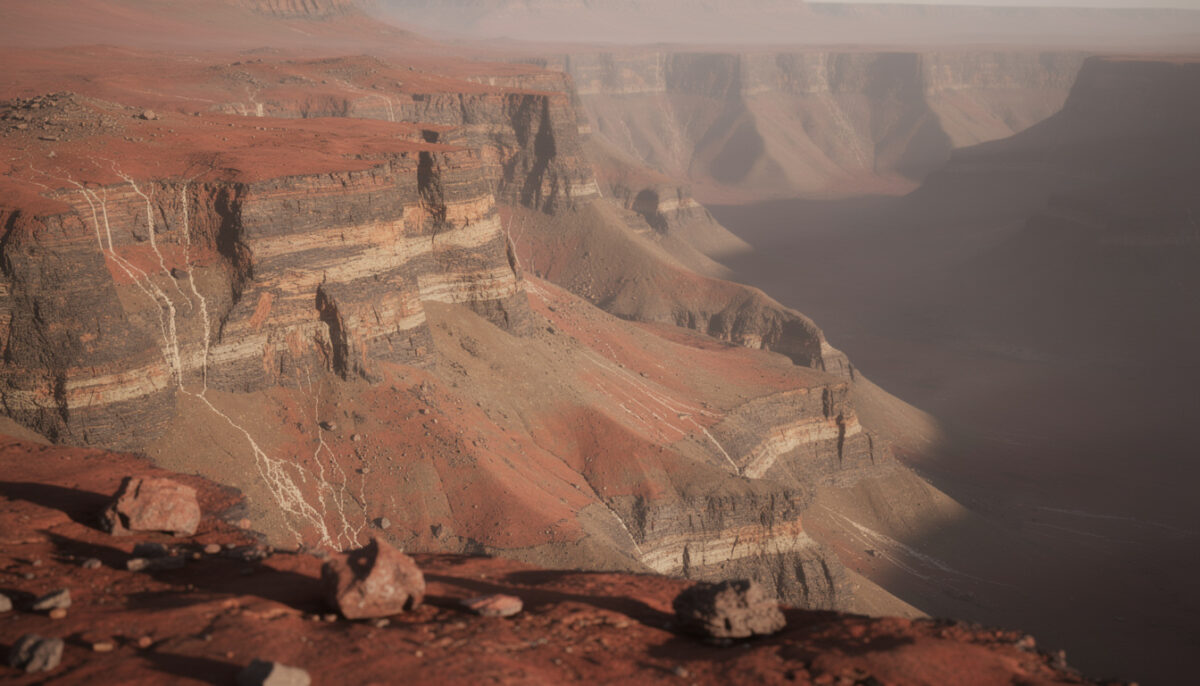
Why these Martian sulfates refused to match known spectra
For nearly twenty years, orbital spectrometers like CRISM recorded strange spectral bands over some sulfate-rich terrains. They did not fit the signatures of well-known minerals such as gypsum, hematite or standard Mg-Fe sulfates.
Dr. Janice Bishop’s team tackled this puzzle by pairing lab heating experiments with detailed mapping of Valles Marineris surroundings. Step by step, they recreated the Martian spectra in the lab, exposing hydrated iron sulfates to rising temperatures and oxygen until the same infrared “fingerprint” finally appeared.
Inside Juventae Plateau: volcanic heat meets ancient water
Imagine following a rover across the Juventae Plateau, skirting the cliffs above Juventae Chasma. Ancient channels cut across the basalt, frozen testimony of flowing water that once ran toward the giant canyon system.
In a small shallow depression, remote sensing reveals concentrated sulfates. Geologists reconstruct the scene: sulfate-rich ponds slowly dry out, leaving hydrated ferrous sulfates. Later, volcanic materials heat these layers, transforming their internal structure while preserving their delicate stratigraphy.
Four compositional units, one coherent geologic script
Co-author Dr. Catherine Weitz describes four main compositional units interbedded across the site: basaltic layers, hydrated ferrous sulfates, ferric hydroxysulfate, and overlying monohydrated sulfates. Their relative ages emerge from contact relationships and cross-cutting features.
That organization reveals a timeline: water-carved channels and basins first, sulfates laid down by evaporation next, then later volcanic or geothermal heating. For planetary Geology, this stacked record suggests activity extending into the Amazonian period, far younger than the earliest Martian epochs.
Aram Chaos and the power of catastrophic flooding
Travel mentally northeast of Valles Marineris and you reach Aram Chaos, a collapsed region inside an ancient impact crater. Many chaotic terrains formed when pressurized subsurface water burst out, triggered massive floods, and left behind disrupted blocks and thick sulfate beds.
In Aram Chaos, the team detects a vertical sequence: polyhydrated sulfates at the top, monohydrated layers below, and narrow bands of ferric hydroxysulfate at depth. That vertical order already hints at progressive heating and dehydration after deposition.
Temperature thresholds that build a new Martian mineral
Lab experiments track the evolution starting with rozenite (Fe²⁺SO₄·4H₂O). Heating drives off water and creates szomolnokite (Fe²⁺SO₄·H₂O). Once temperatures climb past roughly 100 °C, OH groups replace remaining water and ferric hydroxysulfate forms.
Polyhydrated sulfates begin changing around 50 °C, but only higher temperatures generate the new phase. That range exceeds typical surface conditions, implying localized geothermal sources beneath Aram Chaos. Similar logic underpins recent work on mysterious white rocks on Mars, where mineral textures also point to sustained subsurface heat and water exchanges.
Oxygen, dark reactions and astrobiology potential
The key chemical step connecting hydrated ferrous sulfates to ferric hydroxysulfate needs free oxygen gas. The governing reaction, 4 Fe²⁺SO₄·H₂O + O₂ → 4 Fe³⁺SO₄OH + 2H₂O, both oxidizes iron and generates water.
Mars has a thin CO₂-dominated atmosphere, yet its oxygen content is sufficient for slow but steady oxidation. Similar hidden redox chemistry appears on Earth’s seafloor, where scientists study “dark oxygen” production in abyssal environments, as detailed in this deep-sea oxygen research.
What this means for modern Space Exploration and life searches
For Astrobiology, the discovery opens three intriguing doors. First, it confirms that parts of Mars stayed chemically active more recently than many models suggested. Second, the combination of warm fluids, oxidants and sulfates offers energy gradients that microbes could once exploit.
Third, ferric hydroxysulfate might preserve fine-scale textures, much like the puzzling terrestrial fossils discussed in studies such as research on Earth’s bizarre fossils. Future rovers targeting these zones could examine layers millimeter by millimeter for biosignatures.
How to spot similar Martian minerals in future missions
For your own inner mission planner, this work offers a practical checklist when thinking about landing sites or orbital targets where Researchers could potentially unveil another novel mineral discovery on Mars. The same logic helps prioritize areas with active, complex geology.
Look for combinations of water history, volcanic activity and spectral oddities. Ferric hydroxysulfate appears rare today, but additional deposits may lie buried beneath thicker monohydrated layers, waiting for erosion or drilling to bring them within reach.
- Ancient water pathways: channels, chaos terrains, collapsed basins connected to major canyons.
- Evidence of heating: lava flows, ash deposits, or tectonic fractures near sulfate layers.
- Layered sulfates: clear vertical stacks of polyhydrated, monohydrated and iron-rich phases.
- Unusual spectra: bands that do not match standard Martian sulfate libraries.
- Amazonian surfaces: younger terrains where recent geothermal activity is more plausible.
What exactly is the new mineral found on Mars?
The study identifies an uncommon ferric hydroxysulfate, an iron sulfate where OH replaces water in the crystal structure. Its infrared spectrum differs from known Martian sulfates, and it appears confined to thin layers within sulfate-rich deposits near Valles Marineris, especially Aram Chaos and the Juventae Plateau.
How did scientists detect ferric hydroxysulfate from orbit?
Researchers combined spectra from the CRISM instrument with controlled laboratory heating experiments on hydrated iron sulfates. When they reproduced the same heating and oxidation steps in the lab, the resulting mineral showed the same spectral bands as the puzzling Martian layers, allowing a confident identification.
Why does this discovery matter for Mars geology?
Ferric hydroxysulfate forms only above about 100 °C and in the presence of oxygen. Its presence implies localized geothermal or volcanic heat acting on sulfate deposits after they formed. That means parts of the Martian crust remained thermally and chemically active relatively late in the planet’s history.
What does this mean for the possibility of past life on Mars?
The combination of liquid water, oxidants and sustained heat creates habitable niches where microbes could potentially survive. While ferric hydroxysulfate itself is not evidence of life, it signals environments that might have offered energy sources and preservation conditions for biosignatures within layered sulfate deposits.
Could this mineral also exist on Earth?
Assessing the Real Risk: How Concerned Should We Be About an Asteroid Impacting Earth?
Subsurface Oceans on Icy Moons Could Be Boiling Beneath Their Frozen Crusts
The material likely has a unique crystal structure and strong thermal stability, consistent with a new mineral species. To gain official status, scientists must identify the same phase in terrestrial rocks. Ongoing fieldwork in sulfate-rich volcanic and evaporitic settings aims to locate an Earth analogue.