

Show summary Hide summary
- Dirty Fireball: when a star explosion gets “contaminated”
- How this stellar phenomenon rewrites massive star deaths
- What makes EP241113a so convincing for astronomy
- Limits, open questions and the road ahead
- What is a Dirty Fireball in astrophysics?
- How is EP241113a different from a normal gamma-ray burst?
- Why does this discovery matter for understanding supernovae?
- How do astronomers confirm a Dirty Fireball candidate?
- Which instruments are best suited to find more events like this?
- FAQ
- How does a dirty fireball supernova differ from a classic supernova?
- Why were dirty fireball supernovae so difficult to spot until now?
- What could the confirmed observation of a dirty fireball supernova mean for astronomy?
- What causes the jets in a dirty fireball supernova to slow down?
- Can we expect more dirty fireball supernovae discoveries in the future?
Your usual picture of a dying star probably ends in a classic supernova. Now imagine a star explosion so throttled with heavy matter that its jet glows in X-rays instead of gamma rays. That is the Dirty Fireball scenario astronomers may have finally caught in action.
The event, tagged EP241113a, could be the first solid detection of this long-hypothesized type of dirty fireball supernova. It reshapes how your club of astronomy-obsessed friends can think about giant stars, black holes, and the hidden side of cosmic blasts.
Dirty Fireball: when a star explosion gets “contaminated”
Picture a massive star at the end of its life, deep in a distant galaxy. As its core collapses, the outer layers fall inward and a compact object, often a black hole, takes over. A narrow jet of ultra-energetic particles punches through the star and, in the cleanest cases, triggers a spectacular Gamma-Ray Burst, the brightest cosmic explosion your detectors can see. For more on supernova precursors, see radio waves unveil the secrets leading up to a star’s cataclysmic explosion.
Historic Artemis II Mission Launches Astronauts on Pioneering Journey to the Moon
A Groundbreaking New Theory Sheds Light on the Origins of the Big Bang
In a Dirty Fireball, that jet does not stay pristine. Heavy particles, such as protons and neutrons from the stellar envelope, get dragged along. This extra load slows the jet, robs it of the extreme speeds needed for classic gamma emission, and shifts the flash down to the X-ray band. The theory has hovered in astrophysics since the 1990s, but convincing observational evidence had been missing.
A cosmic event caught by the Einstein Probe
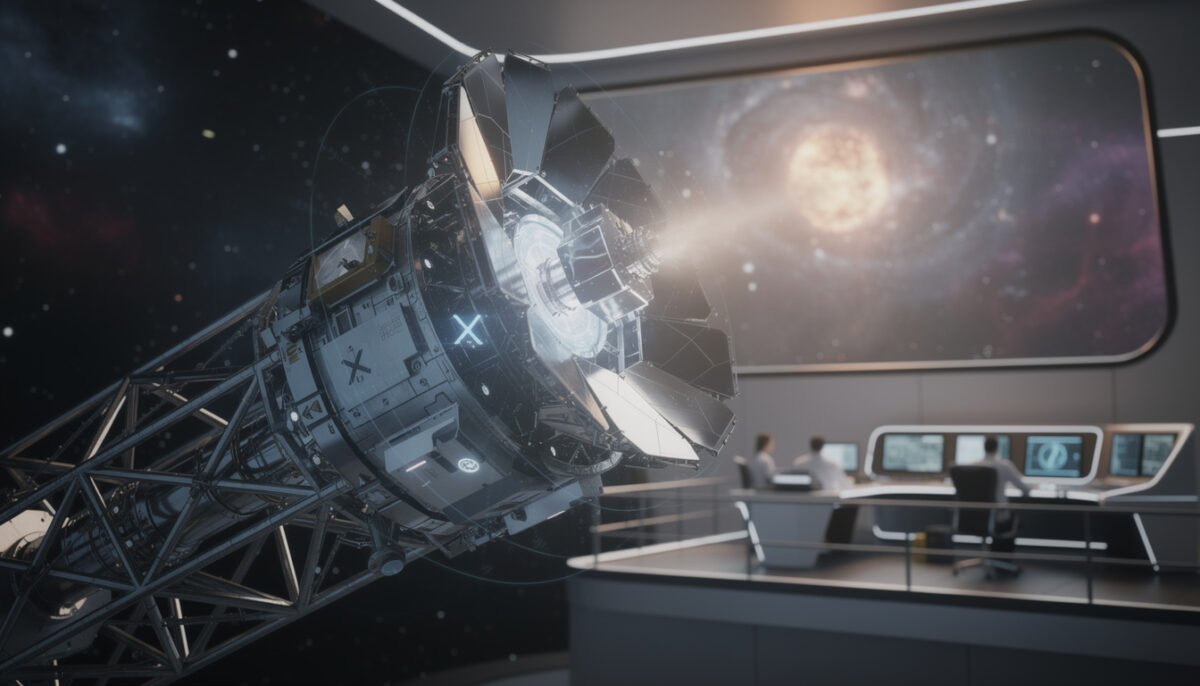
Enter the new Chinese space observatory Einstein Probe, designed to hunt fast X-ray transients over a wide field of view. During a routine scan, its instruments spotted EP241113a: a short, intense flash from a galaxy roughly 9 billion light-years away. The burst packed an energy budget comparable to known Gamma-Ray Burst events, yet the signal appeared only in soft X-rays, not in high-energy gamma rays.
The flare faded into a multi-hour afterglow, then into a slow decline, just like a standard GRB afterglow. That combination of GRB-like energy, X-ray spectrum, and temporal behavior is exactly what Dirty Fireball models predicted. Publications such as recent soft X-ray analyses detail how well EP241113a matches these expectations.
How this stellar phenomenon rewrites massive star deaths
For Li, a fictional PhD student following this discovery from a university control room, EP241113a is more than a pretty light curve. It suggests that what you typically call a supernova or a GRB might just be two points on a broader continuum of stellar phenomena. In one extreme, you find clean, ultra-relativistic jets creating classic gamma flashes. On the other, you get choked jets, side glows, and possibly events without any jet at all. This concept echoes ideas discussed in something massive lies.
Researchers like Xiang-Yu Wang and collaborators argue that if the distance estimate to the host galaxy holds, then the explosion must be as energetic as a normal GRB but heavily baryon-loaded. That supports earlier modeling efforts compiled in resources such as dedicated Dirty Fireball studies, where theorists explored how jet contamination shapes observable spectra and light curves.
From observational bias to hidden population
EP241113a also exposes a selection bias in your view of the high-energy universe. Space telescopes tuned to gamma rays naturally pick up the cleanest, brightest jets. Slower, X-ray–only outflows slide under the radar. With new soft X-ray missions, the picture flips: you finally access this veiled family of cosmic events that sit between classic GRBs and ordinary supernovae.
Astrophysicists like Gavin Lamb have argued that there might be a whole ladder of explosions, from powerful jetted blasts down to almost jet-free collapses. In that context, EP241113a becomes a test case showing how instrumentation, not just theory, has limited your catalogue of space observations so far. For a related look at cosmic collisions, see how a planetary collision observed unveiled a new kind of cosmic event.
What makes EP241113a so convincing for astronomy
Astronomers dissected EP241113a using several criteria. The timing profile shows an abrupt rise, then a gradual decline compatible with jet afterglow physics. The spectrum is too soft for a canonical GRB, yet too energetic for a routine supernova. The multi-hour glow suggests an expanding jet slowing in the interstellar medium, exactly what GRB afterglow codes reproduce.
Independent work, available in sources like popular science reports and dedicated academic articles, converges on the same idea: this event does not fit neatly into existing boxes. For Li and your fellow enthusiasts, that tension between categories is where new physics often hides.
Limits, open questions and the road ahead
Not everyone signs off on the Dirty Fireball label yet. Some teams stress that the redshift of the host galaxy must be nailed down with higher precision. If the distance were smaller, the energetics would look less extreme, and alternative scenarios, such as unusual magnetar flares, might compete. That healthy skepticism keeps follow-up campaigns sharp.
New facilities coming online will multiply such finds. Faster alerts, coordinated ground telescopes, and better spectral coverage will let astronomers map when a collapsing star produces a clean GRB, a Dirty Fireball, or a more ordinary stellar explosion. Each improved dataset brings you closer to a coherent map of how massive stars end their lives across cosmic time.
- Dirty Fireball: jet loaded with heavy particles, shining mainly in X-rays.
- Classic GRB: ultra-relativistic, clean jet visible in gamma rays.
- Choked jet event: jet fails to break out, leaving a dimmer, asymmetric supernova.
- Standard core-collapse: no strong jet, optical supernova dominates.
What is a Dirty Fireball in astrophysics?
A Dirty Fireball is a type of star explosion where the relativistic jet is loaded with heavy particles from the collapsing star. This contamination slows the jet so much that it radiates mainly in X-rays instead of gamma rays, creating a GRB-like afterglow without a standard gamma-ray burst.
How is EP241113a different from a normal gamma-ray burst?
EP241113a releases an energy budget comparable to many gamma-ray bursts, but the signal was detected only in soft X-rays. Its light curve and afterglow resemble a GRB, yet the spectrum is too soft to match classical gamma-ray events, which is why researchers suspect a Dirty Fireball scenario.
Why does this discovery matter for understanding supernovae?
The event suggests that star explosions may form a continuum, from clean gamma-ray bursts to heavily loaded, slower jets and ordinary supernovae. Identifying Dirty Fireballs helps connect those outcomes and clarifies how black holes and neutron stars are born from collapsing massive stars.
How do astronomers confirm a Dirty Fireball candidate?
They combine distance measurements to estimate total energy, detailed X-ray and optical spectra, and the timing of the afterglow. If the event is highly energetic, jet-like, yet lacks a gamma-ray flash, and models reproduce the data with heavy baryon loading, it becomes a strong Dirty Fireball candidate.
Which instruments are best suited to find more events like this?
Wide-field X-ray missions such as the Einstein Probe are ideal to catch short, bright X-ray flashes. Rapid follow-up with optical, radio and sometimes gamma-ray observatories then tracks the afterglow, building the full multi-wavelength picture of these rare cosmic explosions.
FAQ
How does a dirty fireball supernova differ from a classic supernova?
A dirty fireball supernova involves jets from a collapsing star that are mixed with heavy particles, causing them to emit in X-rays instead of stronger gamma rays typical of classic supernovae. This difference points to a more ‘contaminated’ and slower jet.
Why were dirty fireball supernovae so difficult to spot until now?
Dirty fireball supernovae are tricky to detect because their X-ray signals are fainter and less dramatic than the gamma-ray bursts from traditional supernovae. This makes them much easier to miss with standard detection methods.
What could the confirmed observation of a dirty fireball supernova mean for astronomy?
If truly confirmed, the observation could change our understanding of how massive stars die and the many ways their explosions can manifest. It also opens up new possibilities for studying the formation of black holes and stellar jets.
What causes the jets in a dirty fireball supernova to slow down?
Webb Telescope Uncovers Enigmatic Explosion Challenging the Laws of Physics
Artemis 2 Commander Reid Wiseman’s Singular Focus: Preparing for a Historic Journey to the Moon
The jet becomes loaded with heavy particles like protons and neutrons from the star’s envelope, which slows it down and prevents it from reaching the extreme speeds needed to create gamma-ray bursts.
Can we expect more dirty fireball supernovae discoveries in the future?
Yes, as X-ray observation techniques improve and astronomers become more aware of what to look for, finding additional dirty fireball supernovae should become increasingly likely.