
Show summary Hide summary
- Artemis II rocket rollout and what we now know
- How the Artemis II Moon mission will actually work
- Beyond Artemis II: broader NASA gains under new policy
- What this Moon launch means for future exploration
- Policy implications, limits, and what remains uncertain
- How this affects you and the broader scientific landscape
- What is the main goal of NASA’s Artemis II mission?
- How does national policy influence NASA’s Moon launch plans?
- Will Artemis II land astronauts on the Moon?
- What other missions is NASA working on besides Artemis II?
- When are astronauts expected to return to the lunar surface?
What does a nation’s space policy look like when a crewed lunar journey moves from distant dream to scheduled launch window? With NASA’s Artemis II Moon mission now standing on the pad and a clear political mandate behind it, the United States is treating a flight around the Moon as the opening move in a wider strategy of long-term space exploration, scientific research, and technological power.
Across human spaceflight, science missions, aeronautics, and deep-space technology, NASA reports measurable gains aligned with President Donald J. Trump’s second term agenda. Those gains are not only shaping the upcoming space mission around the Moon; they also reflect how national policy and funding are reshaping the agency’s everyday choices.
Artemis II rocket rollout and what we now know
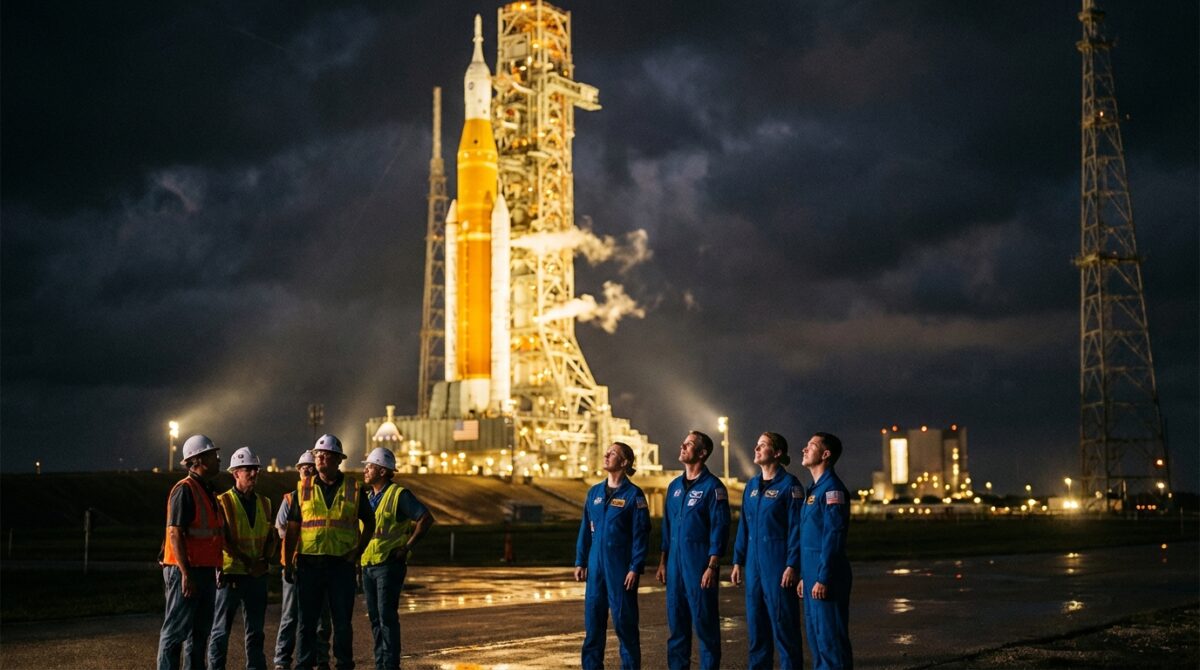
The most visible symbol of this shift is the Artemis II rocket, a Space Launch System (SLS) stack with the Orion spacecraft now at Launch Pad 39B. According to detailed rollout coverage, engineers completed the move from the Vehicle Assembly Building in mid-January, clearing the way for full fueling and countdown tests.
Astronomers Believe They’ve Observed a Rare Collision Between Two Planets
Unusual Chirping Signals from a Supernova Confirm the Long-Contested Magnetar Hypothesis
NASA’s own mission blog describes how this first crewed Artemis flight will send four astronauts on a roughly ten‑day trip into distant retrograde orbit around the Moon and back to Earth. As outlined in NASA’s rollout update, teams are rehearsing every step needed for a launch no earlier than early February, subject to test results and weather.
From policy vision to pad-ready spacecraft
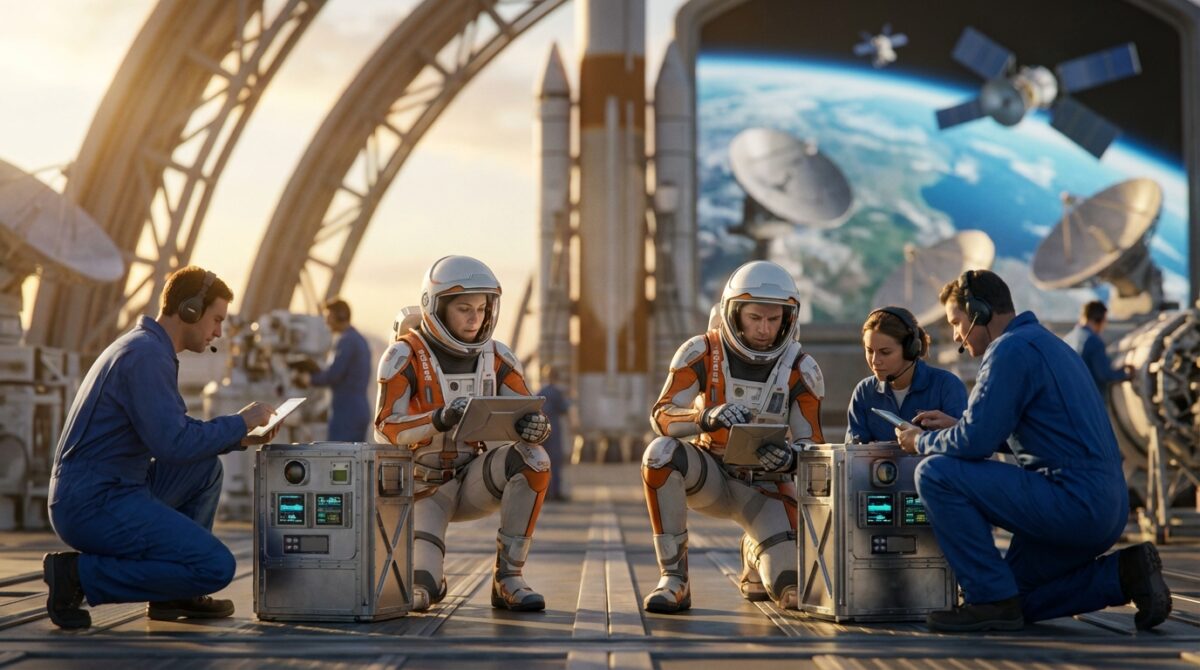
Behind the hardware on the pad sits a broader political and financial context. Since taking office as the 47th president, Trump has defined a national space policy that emphasizes U.S. leadership, rapid progress in space exploration, and close coordination with allies. NASA leaders link that direction, along with funding increases through the Working Families Tax Cut Act, to the pace now seen at Kennedy Space Center.
Administrator Jared Isaacman has described this as the clearest executive guidance since the Apollo era. In public remarks summarizing the first year of this term, he argued that clear priorities and funding have allowed NASA to “move faster and think bigger,” especially in readying the first deep-space space mission by American astronauts in more than half a century.
How the Artemis II Moon mission will actually work
Methodologically, Artemis II is a test flight with people on board. In one line, the mission will fly four astronauts around the Moon in Orion, specifically to validate life support, communications, navigation, and operational procedures that must work before anyone attempts a lunar landing.
Coverage from outlets such as CNN’s mission overview and ABC News analysis explains that Artemis II will: launch atop the SLS, perform an initial Earth orbit checkout, execute a translunar injection burn, enter a distant orbit around the Moon, and then return for a high‑speed re‑entry to test Orion’s heat shield under realistic conditions.
Key systems and tests during the lunar journey
During this lunar journey, Orion’s environmental control system will be run continuously with a full crew to monitor air, water, and temperature performance in deep space. Communications links will be checked as the spacecraft passes behind the Moon, relying on NASA’s Deep Space Network. Navigation sensors must demonstrate that the vehicle can autonomously determine its position and execute course corrections.
NASA’s mission page on final steps for the first crewed Artemis flight highlights another goal: validating day‑to‑day procedures, from sleeping schedules to emergency drills. None of these tests can absolutely guarantee safety on later missions, yet engineers treat them as statistically reducing risk before committing to a landing.
Beyond Artemis II: broader NASA gains under new policy
Artemis II may dominate headlines, but NASA’s internal reports outline a wider pattern of activity during the first year of this second term. Agency data indicate two completed human spaceflight missions and fifteen science launches in that period, alongside a successful flight of a new experimental X‑plane in aeronautics research.
These missions span Earth observation, planetary defense, and astrophysics. One example often cited by analysts is the ramp‑up to operating the Nancy Grace Roman Space Telescope, which will probe dark energy and exoplanets. Explorations of extreme environments, from deep‑sea chemistry such as “dark oxygen” production to exoplanet atmospheres, are increasingly viewed as part of a single research arc connecting oceans and outer space.
Human spaceflight, Space Force, and international norms
The current momentum also builds on decisions made in Trump’s first term. Those years saw the creation of the U.S. Space Force, the launch of the Artemis campaign, and the introduction of the Artemis Accords. These voluntary principles, now signed by about sixty nations, aim to guide responsible behavior around the Moon and beyond.
At the same time, NASA and partners restored routine crewed launches to orbit from U.S. soil after the shuttle program. Today, scheduling is tight: as coverage of NASA’s juggling act shows, managers must coordinate a crewed lunar flight while also rotating astronauts to the space station using commercial vehicles.
What this Moon launch means for future exploration
Looking ahead, NASA officials expect American crews to return to the Moon’s surface by 2028 and to begin building a semi‑permanent presence, supported by a lunar base and the Gateway outpost. Artemis II is framed as the rehearsal that must succeed before that infrastructure can be safely used.
In parallel, work continues on nuclear power and propulsion intended for deep‑space missions. Such systems could enable faster trips to Mars, changing the trade‑offs that mission planners face between cargo mass, crew health, and travel time. This trend echoes long careers such as that of Suni Williams, recently profiled in a piece on her 27 years at NASA, showing how individual expertise accumulates across multiple vehicle generations.
Policy implications, limits, and what remains uncertain
All these advances sit within clear limits. A successful Artemis II launch would demonstrate that policy support and funding can correlate with faster progress, yet it would not prove causation by itself. Technical readiness, industrial capacity, and international cooperation also affect outcomes, sometimes more than legislation.
Risks remain for the rocket, the spacecraft, and the crew. Rollout updates from outlets such as Space.com’s live coverage and reporting from USA Today on the rollout timeline emphasize that hardware must still clear fueling tests, static fires, and final reviews. Launch dates therefore remain “no earlier than” targets, not guarantees.
How this affects you and the broader scientific landscape
For readers, the relevance of a crewed loop around the Moon lies in both inspiration and infrastructure. A successful space mission can drive investment in STEM education, prompt new commercial services in orbit, and shape debates about how public funds should support research. It also strengthens satellite networks and Earth‑monitoring tools that underpin weather forecasts, climate data, and even agriculture.
Research summaries such as those on ScienceDaily’s space exploration feed show a similar pattern: orbital and deep‑space missions frequently yield spin‑off technologies that later appear in medicine, energy, or communications. Artemis II fits that pattern by pushing life‑support, materials, and navigation systems into harsh conditions that may reveal both weaknesses and new ideas.
- Artemis II tests deep‑space life support and navigation with a human crew.
- National policy and the Working Families Tax Cut Act provide targeted funding.
- Fifteen recent science missions expand Earth and planetary knowledge.
- Future plans include a lunar base and advanced nuclear propulsion for Mars.
What is the main goal of NASA’s Artemis II mission?
Artemis II is designed as a crewed test flight of the Space Launch System rocket and Orion spacecraft. Four astronauts will travel around the Moon and back, validating life support, communications, navigation, and operational procedures needed before any attempt to land on the lunar surface.
How does national policy influence NASA’s Moon launch plans?
Under President Donald J. Trump’s second term, a formal National Space Policy and funding through the Working Families Tax Cut Act have given NASA clearer priorities and resources. Agency leaders say this support correlates with faster progress on Artemis, though many technical and industrial factors also play important roles.
Will Artemis II land astronauts on the Moon?
No. Artemis II will not land on the Moon. The mission will send the crew into a distant orbit around the Moon and then return them to Earth. Its purpose is to test systems and procedures in deep space, preparing for later Artemis missions that aim to land astronauts on the lunar surface.
What other missions is NASA working on besides Artemis II?
Chickpeas Poised to Become the Moon’s First Cultivated Crop
Researchers Potentially Unveil a Novel Mineral Discovery on Mars
During the first year of this presidential term, NASA completed two other human spaceflight missions, launched about fifteen science missions, and flew a new X-plane for aeronautics research. The agency is also preparing the Nancy Grace Roman Space Telescope and advancing nuclear power and propulsion technologies for future deep-space exploration.
When are astronauts expected to return to the lunar surface?
NASA planning documents, combined with statements from agency leadership, indicate a target of around 2028 for American astronauts to return to the Moon’s surface. That schedule depends on the outcomes of Artemis II and subsequent missions, along with continued technical progress and stable funding.