
Show summary Hide summary
- Mars white rocks and what we now know about ancient rain
- Methodology: Matching Martian clays with Earth’s tropical geology
- Detailed results: Ancient weather and a wetter Mars
- Implications for habitability, climate models and future missions
- Limits of the study and what remains unknown
- What do the white rocks on Mars actually tell us about water?
- Does kaolinite prove that Mars had tropical rainforests?
- How reliable is the comparison between Earth and Mars clays?
- Could the white rocks have formed without rainfall, for example by underground hot water?
- Why are these findings important for future space exploration?
What if the clearest water evidence for ancient Mars did not come from a massive canyon or dried-up riverbed, but from scattered, mysterious white rocks no bigger than paving stones? New research suggests these pale fragments record millions of years of rainfall on a world that is now cold and dry.
These results sharpen what scientists know about Mars climate history. They indicate that parts of the planet likely experienced long-lasting, humid conditions, closer to Earth’s tropical regions than to the frozen desert usually imagined.
Mars white rocks and what we now know about ancient rain
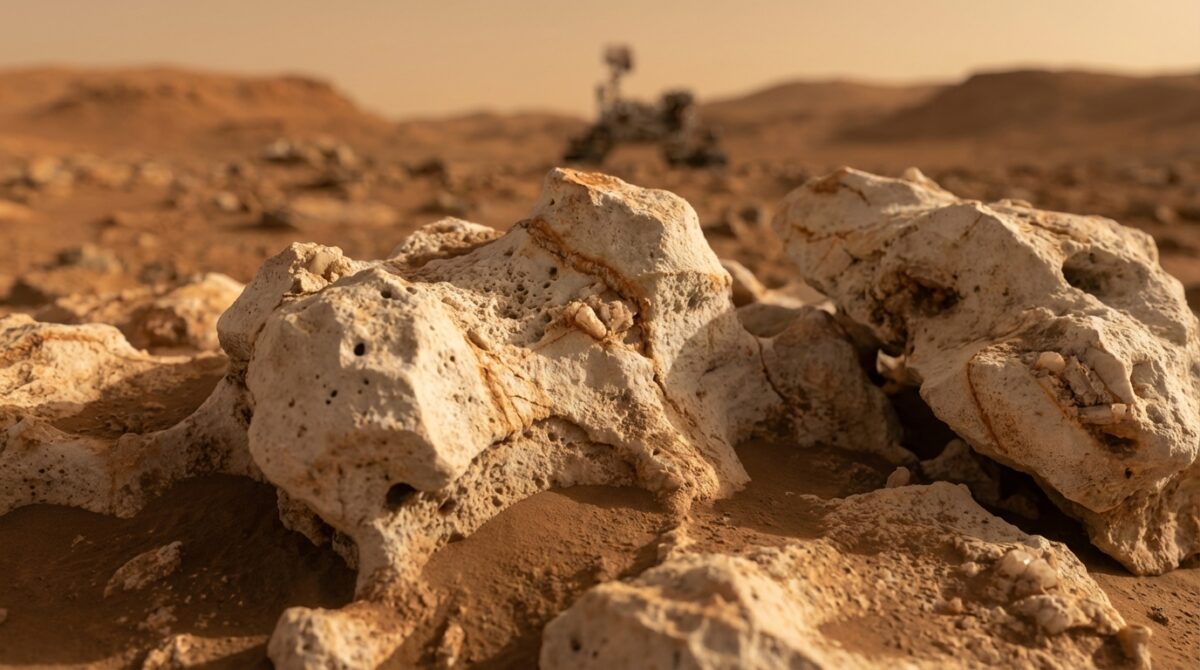
The pale stones, spotted by NASA’s Perseverance rover in Jezero crater, have been identified as kaolinite, a white, aluminum-rich clay. On Earth, this mineral almost always forms when intense, warm rainfall leaches rocks for extremely long periods. The new study, led by Adrian Broz at Purdue University and published in Communications Earth & Environment, argues that similar processes likely occurred on Mars.
Potential First Observation of a ‘Dirty Fireball’ Star Explosion Unveiled
Historic Artemis II Mission Launches Astronauts on Pioneering Journey to the Moon
According to the team, the chemical fingerprint of these Martian clays aligns best with formation under cool-to-warm, surface-level weathering driven by rain, rather than by hot underground fluids. This does not prove that Mars once hosted rainforest-like ecosystems, yet it strengthens the case for a sustained, wet phase that could have supported habitable environments.

How rover instruments decoded the mysterious white rocks
Perseverance has been roaming Jezero crater since 2021, a site chosen because orbital data suggested it once hosted a lake roughly twice the size of Lake Tahoe. Along its path, the rover has repeatedly encountered white rocks that stand out sharply against the red dust. These pieces range from small pebbles to boulders, scattered rather than concentrated in a single outcrop.
To investigate, mission scientists used the rover’s SuperCam and Mastcam-Z instruments. SuperCam fired laser pulses at the rocks and read the emitted light to determine chemical composition, while Mastcam-Z provided detailed color imaging and context. The resulting spectra pointed consistently to kaolinite, a mineral rarely seen on Mars at ground level, although detected in larger deposits from orbit.
Methodology: Matching Martian clays with Earth’s tropical geology
To interpret what kaolinite means for planetary science, Broz and colleagues compared the Martian data with terrestrial analogs. In a single, focused approach, they matched the rover’s chemical readings against rocks from long-studied sites near San Diego, California, and in South Africa, where kaolinite forms under well-understood climatic conditions.
On Earth, this clay appears in two main contexts: surface weathering under heavy rain at moderate temperatures, and hydrothermal alteration driven by hot fluids at depth. Each pathway leaves a different chemical signature. By analysing data from three Earth locations and comparing them statistically with Perseverance’s measurements, the researchers inferred that the Martian samples most closely resembled clays formed by long-term rainfall.
For readers who follow other coverage, these findings connect with reports such as white rocks on Mars pointing to ancient rainfall and analyses suggesting that white Mars rocks suggest eons of rain. The new peer-reviewed study provides the detailed geochemical backbone behind those stories.
Key statistics, timeframes and confidence levels
While Mars carries no direct “date stamp” for each pebble, kaolinite formation on Earth typically demands millions of years of sustained water flow. The Purdue-led team applies that reasoning cautiously to Mars: the rocks likely experienced prolonged exposure to liquid water, not a brief episode of flooding.
Although the paper does not assign a precise probability to rainfall being the only explanation, the authors argue that hydrothermal scenarios are strongly disfavoured by the geochemical ratios measured. In scientific language, rainfall-driven weathering is the most consistent hypothesis with current data, but not the only one that can exist in principle.
Detailed results: Ancient weather and a wetter Mars
For a fictional planetary scientist like Dr. Laila Ortega, who studies climate history across planets, these white rocks function as a time capsule. Their composition points toward a past when Mars had a thicker atmosphere and stable surface water capable of supporting intense chemical weathering. Such conditions require not only sporadic rain, but repeatedly humid seasons over long intervals.
This picture contrasts with earlier models where Mars was dominated by ice and short-lived melt events. Instead, the kaolinite supports scenarios where parts of the planet resembled a cool, cloudy version of tropical highlands on Earth, with frequent storms and slowly evolving geology.
A geological mystery inside Jezero crater
A key puzzle remains: Where did these white rocks come from? In the stretches already examined, Perseverance has not found a clear parent formation. The fragments are scattered along the rover’s route, as if transported from elsewhere. Possible origins include delivery by the ancient river that built Jezero’s delta, or ejection by a distant impact that sprayed debris into the crater.
Orbital instruments have mapped large kaolinite-rich deposits in other Martian regions, potentially representing that missing source. Until the rover reaches such outcrops, these small fragments are the only on-the-ground samples of this type, forcing scientists to piece together the story from limited but highly suggestive clues.
- Kaolinite composition: white, aluminum-rich clay formed by intense leaching.
- Rock sizes: from pebble-scale fragments to meter-class boulders.
- Environment implied: long-lived, humid, rainfall-driven weathering at or near the surface.
- Unresolved questions: original source outcrop, exact duration of wet periods, and timing within Mars’ early history.
Implications for habitability, climate models and future missions
The discovery matters because all known life needs water. If Mars once sustained stable, rain-fed landscapes for millions of years, then at least some environments on the planet could have supported microbial ecosystems. Kaolinite-rich rocks preserve chemical traces of such environments, making them prime targets for future sample return missions.
For climate modellers, the findings pressure-test scenarios of early Mars. Any successful model must now reproduce not only lakes and rivers, but conditions that sustain strong chemical weathering. That implies adequate atmospheric pressure, greenhouse gases, and a long-lived hydrological cycle, not merely brief warm spurts.
Limits of the study and what remains unknown
Despite the excitement, researchers stress that these results do not prove that Mars once hosted lush jungles or complex life. The study is based on a modest number of scattered rocks in a single crater, observed remotely rather than brought into a laboratory. Correlation between kaolinite and rainfall on Earth is strong, yet Mars may include processes not fully captured by terrestrial analogs.
There is also uncertainty about timing: did this ancient weather occur early in the planet’s history, or was it part of a later, regional wet episode? Future rover traverses and eventual sample return will be needed to refine the chronology and determine whether these humid conditions were global or patchy.
What do the white rocks on Mars actually tell us about water?
The white rocks identified as kaolinite indicate that liquid water interacted with Martian rocks for very long periods. On Earth, such clays form where rainwater repeatedly washes through soils and sediments, stripping out many elements. This strongly suggests that parts of Mars once hosted sustained surface water, rather than only brief floods or melting events.
Does kaolinite prove that Mars had tropical rainforests?
No. Kaolinite is linked to warm, humid conditions on Earth, often in tropical regions, but the mineral itself does not specify vegetation or complex ecosystems. It indicates long-term rainfall and chemical weathering. Mars could have had cooler, cloudy, wet climates that still produce similar clays without resembling Earth’s jungles.
How reliable is the comparison between Earth and Mars clays?
The comparison is scientifically robust but not absolute. Researchers matched Martian chemical signatures from Perseverance with well-characterized kaolinite samples from California and South Africa. The best fit points to rainfall-driven weathering, while hydrothermal explanations are less consistent with the data. However, differences in gravity, atmosphere, and chemistry mean that some uncertainty always remains.
Could the white rocks have formed without rainfall, for example by underground hot water?
A Groundbreaking New Theory Sheds Light on the Origins of the Big Bang
Webb Telescope Uncovers Enigmatic Explosion Challenging the Laws of Physics
Hydrothermal processes can create kaolinite on Earth, but they leave distinct chemical patterns. The study tested this possibility using data from three Earth sites and found that the Martian rocks do not match typical hydrothermal signatures. While unknown Martian processes cannot be ruled out entirely, rainfall-driven surface weathering currently provides the most coherent explanation.
Why are these findings important for future space exploration?
Understanding when and where Mars had long-lived water helps mission planners choose landing sites and sampling targets that are most likely to preserve signs of past life. Regions linked to kaolinite and similar clays may become priority destinations for rovers, orbiters, and sample-return missions, guiding the next decades of Mars exploration strategy.