Show summary Hide summary
- Hubble’s lucky shot of a rare comet breakup
- What makes Comet C/2025 K1 so intriguing for astronomy
- The delayed brightening mystery of the comet fragmentation
- Why this comet breakup matters for future space exploration
- A new benchmark for high‑resolution space imagery
- How close was Comet C/2025 K1 (ATLAS) to the sun when it fragmented?
- Why is Hubble’s observation of this comet breakup considered so rare?
- Did the breakup of Comet C/2025 K1 pose any danger to Earth?
- What can space missions learn from the K1 fragmentation?
- Where can detailed scientific results about K1’s breakup be found?
Picture the Hubble Space Telescope turning toward a routine target, only to catch a comet c/2025 k1 breakup literally ripping itself apart at that exact moment. Your favorite space fan will replay this cosmic slow‑motion crash in their head for days.
Hubble’s lucky shot of a rare comet breakup
The story starts with a problem. A research team had secured precious Hubble time to study a comet, then technical constraints made their original target unusable. They pivoted to Comet C/2025 K1, discovered a few months earlier by the ATLAS survey, and crossed their fingers.
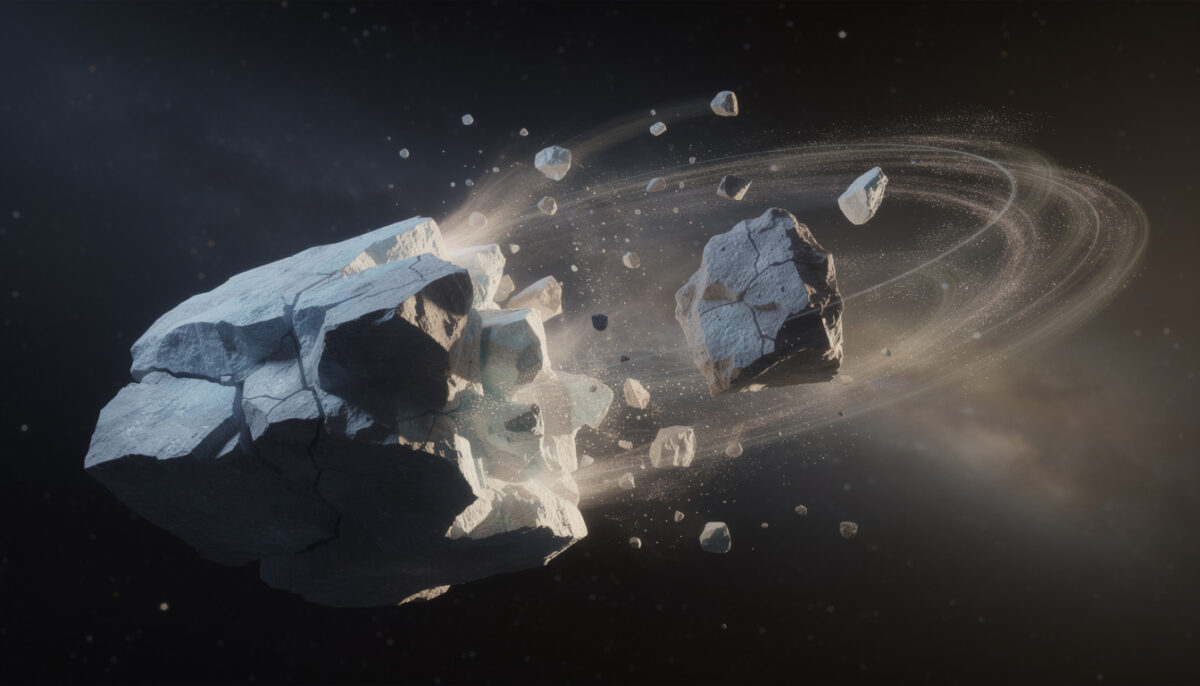
When Hubble’s instruments locked onto the new object in early November 2025, the data stunned the team. The telescope was not looking at a single icy body, but at a remarkable comet breakup already underway. In the images, K1’s nucleus had fractured into at least four pieces, each wrapped in its own blurry coma of gas and dust.
Blue Origin Enters the Competition for Orbital Data Centers
Astronomers Initially Overlook Gigantic Space Explosion—Equivalent to a Billion Suns—Until Detecting Its Echo
A three‑day time‑lapse of destruction in space
Hubble followed Comet C/2025 K1 for three consecutive days, November 8, 9, and 10. Using the Space Telescope Imaging Spectrograph, astronomers obtained a detailed sequence of space imagery showing the fragments drifting apart. One piece appeared to split again during the campaign, proving the disintegration was still unfolding.
Researchers estimate the breakup started roughly a week before the first exposure, just after K1 had swung through perihelion, its closest point to the sun. You can dive deeper into this serendipitous space observation in this detailed report from Space.com: Hubble Space Telescope accidentally witnesses comet C/2025 K1 breaking apart.
What makes Comet C/2025 K1 so intriguing for astronomy
K1 is not a short‑period visitor like Halley’s Comet. It is a long-period object from the distant Oort Cloud, a reservoir of icy bodies on the edge of the solar system. These relics preserve material that has barely changed since the planets formed billions of years ago.
Before fragmenting, K1’s nucleus was slightly larger than average, with an estimated diameter of around eight kilometers. For planetary scientists, watching such a “dirty snowball” crumble live offers a rare shortcut into understanding how fragile comet interiors really are.
From frozen relic to fragile rubble pile
Like many comets, K1 was likely a porous mix of ice, dust, and rock, held together weakly. As sunlight heated its surface, ices vaporized and created jets that acted like tiny thrusters. Combined with rotation and gravitational stress near the sun, those forces probably pushed internal fractures beyond their limit.
This is where K1 becomes a case study that astronomy textbooks will cite for years. By measuring how quickly the fragments separated, scientists can estimate the internal strength of the nucleus and refine models of comet evolution and survival.
The delayed brightening mystery of the comet fragmentation
There was a twist. Ground-based observers expected K1 to brighten immediately when it broke apart, as fresh ice should reflect more sunlight. Yet the comet’s light curve did not spike right away. The visible outbursts came later, puzzling anyone following this celestial event.
A growing consensus suggests the comet’s glow comes mostly from sunlight bouncing off dust, not bare ice. Newly exposed surfaces may first need to accumulate a thin dust layer or build up heat under the crust before blasting out a visible cloud of particles, creating the delayed brightening detected in space exploration data.
What Hubble’s timing tells us about comet surfaces
Never before had the Hubble Space Telescope caught a disintegrating comet this soon after the initial failure. Usually, telescopes arrive weeks after the main event. This time, K1 was observed only days into its collapse, giving researchers a rare handle on the timing of dust-layer formation.
As one scientist described in NASA’s mission report on the unexpected breakup, the delay between fragmentation and brightening might be the clock that tracks how quickly a new dusty shell forms and then gets blown away. That insight will feed straight into future models of how comet activity starts and stops.
Why this comet breakup matters for future space exploration
For someone passionate about missions like Rosetta or future sample-return projects, K1 offers a realistic warning. Any spacecraft approaching a long-period comet must assume the target could fall apart mid-mission, changing its mass, jets, and hazard profile in days.
The K1 event also sharpens the way engineers and scientists think about impact risks. Fragmenting comets behave differently from intact ones, and their debris fields spread dramatically. Cases like Shoemaker‑Levy 9 and now K1 help refine how trajectory models handle broken nuclei.
A new benchmark for high‑resolution space imagery
The sequence on K1 sets a new reference for space imagery of active comets. Combining Hubble’s resolution with ground-based follow-up and data from surveys like ATLAS builds a multi-scale picture: wide-field discovery, precision tracking, and close-up structural analysis.
For fans of space observation, the K1 dataset is a perfect example of how chance, technology, and a quick change of plan can expose a hidden side of the solar system in just a few orbits of a telescope.
- Timeline: Discovered in May 2025, perihelion in late 2025, breakup observed days later by Hubble.
- Origin: Long‑period comet from the Oort Cloud, carrying ancient solar system material.
- Breakup pattern: At least four large fragments, one of which split again under observation.
- Instruments: Hubble’s Space Telescope Imaging Spectrograph captured the evolving fragments in high detail.
- Key insight: Delay between fragmentation and brightening reshapes models of comet surface activity.
How close was Comet C/2025 K1 (ATLAS) to the sun when it fragmented?
The breakup appears to have started shortly after K1 passed perihelion, its closest point to the sun. Estimates place the onset of fragmentation roughly a week before Hubble’s first images in early November 2025, when solar heating and gravitational stress were near their peak.
Why is Hubble’s observation of this comet breakup considered so rare?
Comet fragmentation is unpredictable and usually detected after the main event, when the debris is already dispersed. In the case of Comet C/2025 K1, Hubble captured the object only days into the disintegration, providing an unusually early and detailed view of the process that astronomers almost never get.
Did the breakup of Comet C/2025 K1 pose any danger to Earth?
No. K1 was located about 400 million kilometers from Earth during the breakup, far beyond any direct threat. The fragments continued on a trajectory out of the solar system, turning the event into a scientific opportunity rather than a hazard for our planet.
What can space missions learn from the K1 fragmentation?
Scientists Discover a Massive Asteroid Rotating at Extraordinary Speeds
Private Firm to Touch Down on Asteroid Apophis During Its Close Earth Flyby
The K1 case highlights how quickly a comet nucleus can lose structural integrity after perihelion. Future missions targeting comets must account for the possibility of rapid internal failure, changing jets and fragment paths in a matter of days, which affects navigation, safety, and instrument planning.
Where can detailed scientific results about K1’s breakup be found?
The results were published in the journal Icarus and summarized in several expert outlets. For readers wanting a technical overview of the astronomy behind the event, sources like EarthSky and NASA’s mission pages provide accessible explanations of the comet fragmentation and Hubble’s data.