Show summary Hide summary
- Giant magnet concept redefining planetary defense
- Testing NOVA on asteroid 2024 YR4 in simulations
- How the magnetic shield compares to other space safety ideas
- What this strategy changes for future asteroid missions
- Key potential benefits of magnetic asteroid deflection
- How does a giant magnet move an asteroid without touching it?
- Would magnetic asteroid deflection replace kinetic impact missions?
- How long would NOVA need to protect Earth from a small asteroid?
- What happens to the captured asteroid fragments?
- Is the NOVA magnetic shield concept technically realistic?
- FAQ
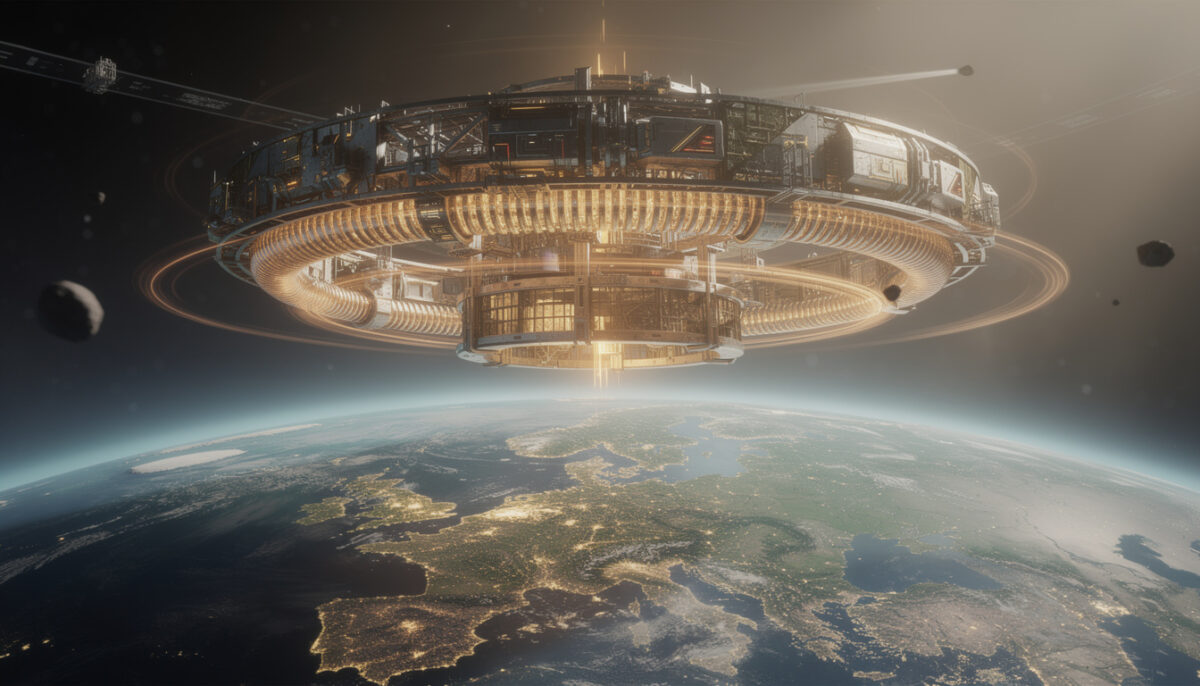
Imagine adjusting the course of a killer asteroid not with nukes or battering rams, but with a giant magnet quietly peeling it apart in space. This new idea of magnetic asteroid deflection promises earth protection without debris clouds or last‑minute panic.
Giant magnet concept redefining planetary defense
Planetary scientist Gunther Kletetschka and his team propose a fresh angle for planetary defense: non-contact orbital velocity adjustment, or NOVA. Instead of smashing into a rock, the mission would fly a powerful magnetic shield beside it and let physics do the work.
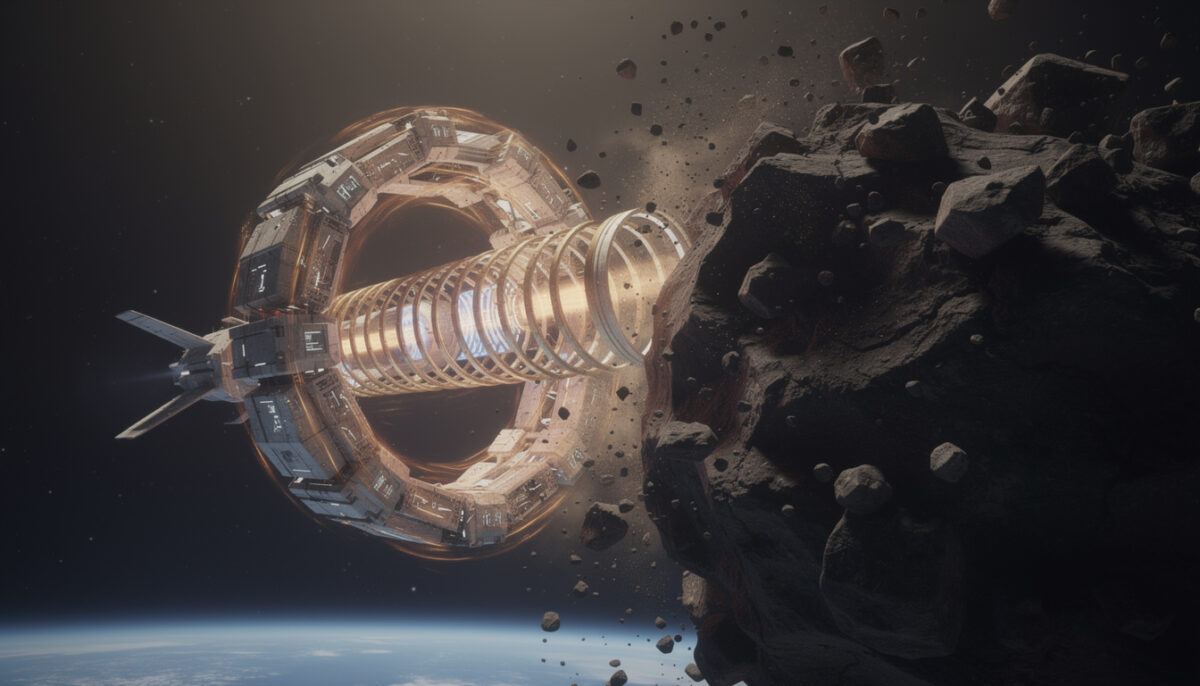
The NOVA spacecraft is designed as a 20‑meter superconducting coil, powered by a compact nuclear fission reactor. Precision thrusters keep it just 10 to 15 meters from the target, close enough for the magnet to tug on iron-rich material inside hazardous asteroids. The goal is space safety with zero explosive force.
Christina Koch Gears Up to Make History as the First Woman to Orbit the Moon on Artemis 2: A Unique Honor and Duty
Astrophotographer Snaps Breathtaking Image of the Antennae Galaxies Colliding in the Depths of Space
From rubble pile to controllable second asteroid
Most near‑Earth objects are not single monolithic boulders. They resemble floating gravel heaps, loose “rubble piles” held together by weak gravity and zero tensile strength. Hitting that kind of object hard, as with a kinetic impactor, risks shattering it into many pieces.
Kletetschka compares this to trying to push one small boat inside a swarm of boats. A strong impact may disperse the whole fleet. With NOVA, the space technology works differently: the magnet gently extracts metallic fragments, capturing them in a magnetic trap at the center of the coil. Each captured rock increases both spacecraft mass and magnetic field, making subsequent fragments easier to pull away. Step by step, the asteroid shrinks while the spacecraft becomes a second, controllable mini‑asteroid.
Testing NOVA on asteroid 2024 YR4 in simulations
To move from concept to numbers, the team focused on asteroid 2024 YR4. Early orbital data briefly raised concerns about a possible impact around 2032, before refined measurements showed a safe flyby. With a size under 70 meters, this body offered a realistic test case for the magnet approach.
Using NOVA calculations, Kletetschka estimated that fully redirecting 2024 YR4 would demand at least 170 days of continuous magnetic operations. That timeframe fits within typical warning scenarios for small objects. For comparison, NASA’s kinetic strategies, evaluated in documents like recent planetary defense assessments, rely heavily on rapid, high‑energy strikes rather than slow, continuous steering.
Why a gentle pull can beat a violent push
Traditional kinetic impactors transfer momentum in a single event. That works well if the asteroid is cohesive, but for rubble piles, the shock can fragment the body. Multiple fragments on intersecting trajectories create a complex asteroid impact scenario that becomes harder to manage.
With NOVA, force is applied gradually and locally to small pieces. The asteroid’s overall orbit changes as mass is siphoned away and relocated to the magnetic trap. Mission controllers gain two benefits at once: less mass heading toward Earth and a magnetically bound “companion” object whose trajectory is fully controllable.
How the magnetic shield compares to other space safety ideas
The NOVA concept sits within a broader wave of ideas using magnetic fields for earth protection. Researchers exploring solar‑flare risks have already outlined plans for large-scale space shields, such as the studies discussed by the Harvard-Smithsonian team and detailed in sources like reports on a giant magnetic shield against solar storms.
Those projects imagine enormous loops of conductive wire positioned between Earth and the Sun to deflect charged particles. NOVA shrinks that architecture down to asteroid scale. Where solar-flare shields defend satellites and power grids, the NOVA giant magnet directly reshapes the orbit of a single dangerous rock.
Limits, uncertainties and what still needs proving
NOVA remains untested in space, and Kletetschka highlights several open questions. First, the method depends on enough iron within the target asteroid. Spectral comparisons with known objects suggest this is likely for many bodies, yet not guaranteed for all. Second, flying a massive coil within 15 meters of a tumbling rock for months stretches current navigation capabilities.
Another challenge is engineering a superconducting system that remains stable in deep space while coupled to a nuclear reactor. Mission designers must also show that the extracted fragments stay trapped, avoiding unintended debris clouds. Despite these hurdles, the clear advantage is that NOVA carries almost no risk of making the threat worse. For more context on magnetic anomalies in space, see Apollo Moon Rocks Reveal New Insights Into Lunar Magnetic Mysteries.
What this strategy changes for future asteroid missions
For mission planners like the fictional aerospace startup “Orion Shield,” a NOVA-type craft could complement impactors and gravity tractors. A company already preparing Apophis‑related operations, as described in analyses of private missions planning to touch down on asteroid Apophis, might someday bolt a magnetic coil onto its spacecraft.
Combined approaches create a richer playbook: early NOVA operations to “soft-shape” a rubble pile, followed by kinetic nudges if needed. This diversified strategy reduces the probability that any single failure mode leads to an asteroid impact on Earth and raises the overall reliability of planetary defense campaigns. Explore similar innovative strategies in NASA Revamps Its Artemis Program for an Ambitious New Era of Moon Exploration.
Key potential benefits of magnetic asteroid deflection
From a strategic standpoint, the NOVA approach introduces several advantages for long‑term space safety planning. Each benefit targets a weakness of current methods while leveraging mature physical principles.
- No explosive fragmentation: Gentle extraction limits the chance of breaking one threat into many uncontrolled fragments.
- Controllable second mass: The spacecraft plus captured rocks act as a guided mini‑asteroid under human control.
- Scalable force: As the trap gains mass, the magnetic pull strengthens naturally, improving asteroid deflection efficiency over time.
- Reusable architecture: A robust coil and power system could, in theory, operate on multiple small targets during its lifetime.
- Synergy with other tools: NOVA can be combined with kinetic impactors, gravity tractors, or laser ablation for complex threats.
For a public increasingly aware of impact risk, as discussed in reviews examining how worried we should be about asteroids hitting Earth, the idea of a controllable magnetic “tow truck” offers a tangible, engineering‑driven answer.
How does a giant magnet move an asteroid without touching it?
The NOVA spacecraft carries a powerful superconducting coil that generates a strong magnetic field. When it flies very close to an iron-rich rubble pile asteroid, this field pulls out metallic fragments. As these fragments are trapped at the center of the coil, the asteroid’s mass distribution and orbit slowly change, providing gentle, continuous deflection without any physical impact.
Would magnetic asteroid deflection replace kinetic impact missions?
Current studies see NOVA as an additional option, not a replacement. Kinetic impactors work well for cohesive targets or when time is short. Magnetic deflection is better suited to smaller, rubble pile objects and missions with months or years of lead time. A robust planetary defense strategy would likely combine both methods, choosing the right tool for each threat.
How long would NOVA need to protect Earth from a small asteroid?
For the test case asteroid 2024 YR4, simulations suggest roughly 170 days of nonstop operations to achieve a full orbital deflection. The exact duration depends on object size, composition, initial trajectory, and how early the mission starts. Starting earlier gives mission designers more time and allows them to use weaker, safer forces.
What happens to the captured asteroid fragments?
Extracted fragments remain confined in a magnetic trap at the center of the coil, effectively merging with the spacecraft. This turns the vehicle into a more massive, magnetized object that can be steered deliberately. Mission control would then place this combined body into a safe orbit, away from Earth and other sensitive targets.
Is the NOVA magnetic shield concept technically realistic?
The basic physics of magnetic attraction and orbital mechanics is well understood, and superconducting magnets already operate in laboratories and some space experiments. The challenges lie in scaling the coil to 20 meters, powering it with a space-rated nuclear reactor, and maintaining precise navigation for months near a tumbling asteroid. These are demanding engineering tasks, yet consistent with long-term space technology development paths.
FAQ
What is magnetic asteroid deflection?
Magnetic asteroid deflection is a proposed method of altering the path of an asteroid using a powerful magnet instead of impact or explosion. This technique aims to gently redirect iron-rich asteroids without creating debris.
How does magnetic asteroid deflection protect Earth from asteroids?
Magnetic asteroid deflection works by deploying a spacecraft with a superconducting magnet near a hazardous asteroid. The magnetic field interacts with the asteroid’s iron content, gradually altering its course away from Earth.
Is magnetic asteroid deflection safer than traditional methods?
Yes, magnetic asteroid deflection is considered safer because it avoids breaking the asteroid into potentially dangerous fragments. This non-contact approach uses magnetic forces for a controlled, gradual change in trajectory.
Can magnetic asteroid deflection work on all types of asteroids?
Astronomers Unravel Half-Century Enigma Behind Intense X-Ray Emissions from a Visible Star
Project Hail Mary Turns Reality: 45 Exoplanets Identified as Potential Homes for Alien Life
Magnetic asteroid deflection is most effective on asteroids that contain significant metallic, especially iron-rich, material. It may not be suitable for rocky or carbonaceous asteroids with low metal content.
Who proposed the concept of magnetic asteroid deflection?
Planetary scientist Gunther Kletetschka and his team introduced the idea of magnetic asteroid deflection, proposing the use of a large superconducting magnet for planetary defence.