
Show summary Hide summary
- Chickpeas as the first crop of lunar cultivation
- Vermicompost and fungi: the hidden allies of moon agriculture
- What the experiment revealed about space farming limits
- Are moon-grown chickpeas ready for astronauts’ plates?
- From lab experiment to sustainable space food strategy
- Why are chickpeas promising for moon agriculture?
- What role do worms play in lunar cultivation systems?
- How do mycorrhizal fungi help protect space-grown crops?
- Are chickpeas grown in simulated moon dirt safe to eat yet?
- How could this research influence future moon colonies?
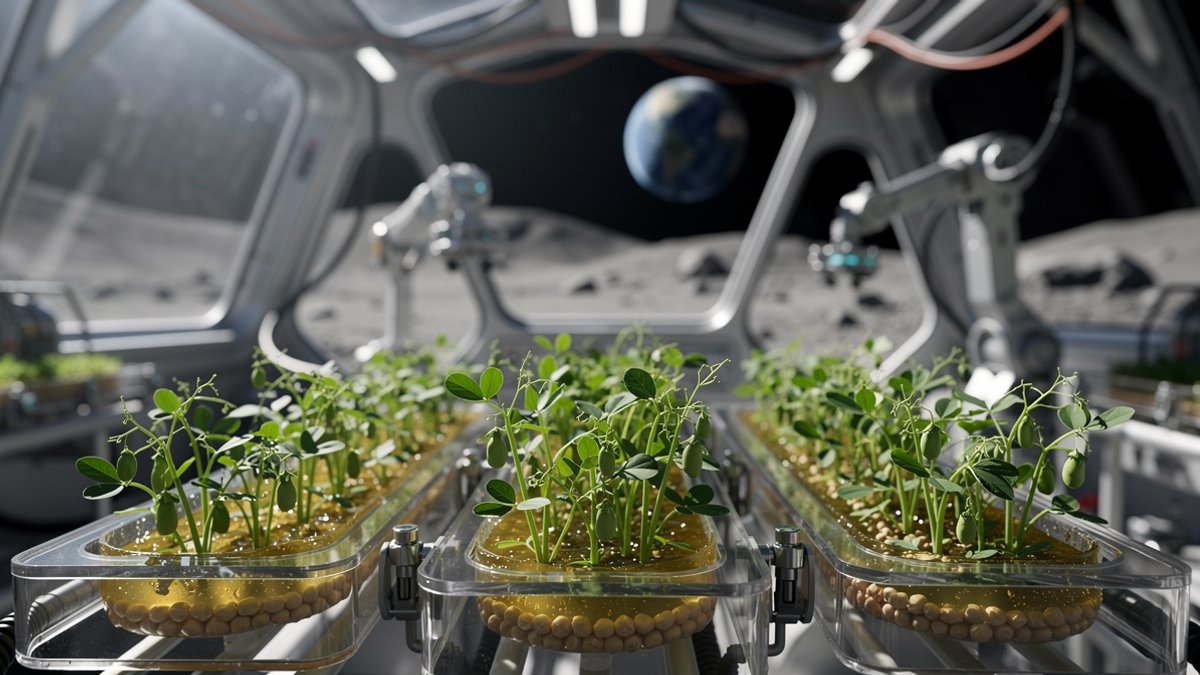
Imagine a future moon colony where fresh hummus is on the menu. That scenario just moved closer to reality: scientists have grown chickpeas in “moon dirt” for the first time, opening a new chapter for moon agriculture chickpeas and long‑term space missions.
Chickpeas as the first crop of lunar cultivation
When NASA prepares Artemis crews for extended stays on the lunar surface, the question becomes very concrete: what will astronauts eat once stored rations run low? Recent work led by the University of Texas at Austin points toward chickpeas as a realistic first crop for lunar cultivation and sustainable space food.
Researchers from UT Austin and Texas A&M chose a compact, resilient chickpea variety called “Myles.” The plants did not grow in regular soil but in a regolith simulant, a material created to mimic the dusty surface gathered during Apollo. This result, detailed by UT scientists and echoed in outlets such as Scientists Successfully Harvest Chickpeas From ‘Moon Dirt’, marks a turning point for applied astrobotany.
Researchers Potentially Unveil a Novel Mineral Discovery on Mars
Cosmic Voids: The Invisible Forces Potentially Ripping the Universe Apart
From sterile regolith to living space farming media
Lunar regolith looks like sand but behaves more like powdered glass. It lacks organic matter and microscopic life that support crops on Earth. Its grains can contain heavy metals, a problem for any attempt at space farming. Yet regolith still offers minerals that roots can exploit once the material is biologically upgraded.
To bridge this gap, the team used a simulant supplied by Exolith Labs, then turned to biology instead of chemistry. Their goal was clear: transform hostile dust into a living substrate capable of supporting chickpeas without importing tons of soil from Earth, a key requirement for realistic extraterrestrial farming scenarios.
Vermicompost and fungi: the hidden allies of moon agriculture
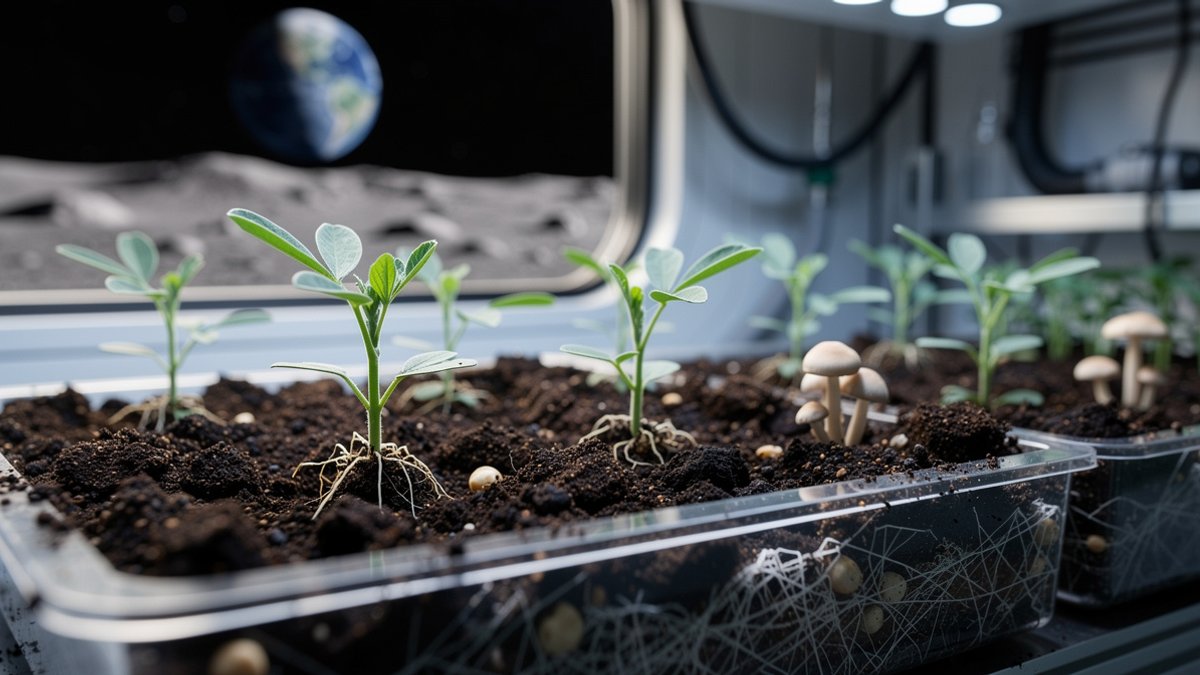
Lead researcher Sara Santos and her colleagues mixed the simulated “moon dirt” with vermicompost, a nutrient-rich compost produced by red wiggler worms. These worms digest organic waste and leave behind a dark, crumbly material loaded with nutrients and microorganisms that support plant health and root development.
On a future moon colony, the same worms could recycle food scraps, cotton fabric, and hygiene products into fertile substrate. This approach closes resource loops instead of relying on constant resupply. It also aligns with Earth‑based research showing that high quality organic matter can improve resilience, even indirectly benefiting aspects like sleep quality through better diets, as explored in work on high‑fiber nutrition.
Mycorrhizal coating: protecting crops from toxic metals
Before sowing, the team coated chickpea seeds with arbuscular mycorrhizae fungi. These microscopic partners colonize plant roots, helping them absorb phosphorus and other key elements while limiting the uptake of damaging metals present in the regolith simulant.
Results showed that inoculated plants not only grew better but also lived longer in harsh mixtures. The fungi successfully established themselves inside the artificial soil, suggesting that a single introduction could sustain whole generations of crops inside a lunar greenhouse, a powerful tool for long‑term moon agriculture chickpeas infrastructures.
What the experiment revealed about space farming limits
The researchers planted chickpeas in several blends of regolith simulant and vermicompost, gradually increasing the proportion of “moon dirt.” Plants thrived in mixes containing up to 75% simulated lunar soil. Beyond that threshold, stress symptoms appeared, and life cycles shortened dramatically.
This 75% limit now acts as a practical design parameter for future space farming systems. Engineers planning pressurized greenhouses on the Moon can combine local regolith with imported organic matter and worm‑generated compost, staying within a safe window for chickpea health and yield.
A concrete roadmap for extraterrestrial farming systems
The chickpea trial outlines how a closed‑loop agricultural module could work inside a moon base. Nothing stays “waste” for long, and every stream is reused to support extraterrestrial farming:
- Food scraps and plant residues are fed to compost worms.
- Worms convert this waste into vermicompost rich in microbes.
- Regolith is blended with vermicompost to create a living substrate.
- Seeds coated with symbiotic fungi are planted in this substrate.
- Crops yield food and new seeds for the next planting cycle.
By following this loop, a lunar outpost reduces dependence on cargo flights while maintaining a steady source of fresh protein, fiber, and calories for crews orbiting far from Earth.
Are moon-grown chickpeas ready for astronauts’ plates?
Despite the excitement, researchers remain cautious about serving these chickpeas directly to astronauts. The main unknown is their food safety: do the plants accumulate heavy metals from the regolith simulant, or does the fungal shield keep concentrations low enough for long‑term consumption?
Doctoral researcher Jessica Atkin, first author of the Scientific Reports study, now focuses on nutrient profiles and potential contaminants. Comparable analyses, discussed in outlets like SciTechDaily’s coverage of chickpea growth in moon dirt, aim to verify protein content, mineral balance, and the performance of successive plant generations under repeated lunar‑style cultivation.
From lab experiment to sustainable space food strategy
The project began with self‑funding by Santos and Atkin before gaining a NASA FINESST grant, a sign that agencies view crop innovation as a strategic piece of upcoming missions. Future work will compare chickpeas with other candidates such as lentils or leafy greens for mixed diets.
For mission planners, the objective is clear: design a robust, diversified menu where chickpeas provide protein, complex carbohydrates, and a familiar taste. In the long view, this experiment lays technical and psychological foundations for crews who may spend months or years relying on sustainable space food grown in their own lunar greenhouses.
Why are chickpeas promising for moon agriculture?
Chickpeas combine several advantages for moon agriculture: they are compact, relatively drought tolerant, and offer high protein and fiber content. The ‘Myles’ variety used in the experiment grows in a limited volume, which suits cramped habitats. Its nutritional density makes it attractive for long missions where every cultivated plant must justify its space and resource usage.
What role do worms play in lunar cultivation systems?
Red wiggler worms transform organic waste such as food scraps and worn textiles into vermicompost. This compost adds nutrients and living microorganisms to sterile lunar regolith simulant. In a lunar habitat, worm‑based recycling would reduce waste, limit the need for imported fertilizers, and create a continuous supply of fertile substrate for new plantings.
How do mycorrhizal fungi help protect space-grown crops?
Arbuscular mycorrhizal fungi attach to roots and extend their reach into the surrounding substrate. They improve access to phosphorus and trace elements while limiting the uptake of harmful metals. In the chickpea experiment, plants inoculated with these fungi survived longer and handled higher proportions of regolith, making them vital allies for future extraterrestrial farming.
Are chickpeas grown in simulated moon dirt safe to eat yet?
A Peculiar Black Hole Type That Could Unlock Three Cosmic Enigmas at Once
Assessing the Real Risk: How Concerned Should We Be About an Asteroid Impacting Earth?
Safety has not been fully confirmed. Researchers still need to measure whether metals from the regolith simulant build up in edible seeds and whether nutrient profiles match or surpass Earth‑grown chickpeas. Only after detailed chemical analyses and multi‑generation tests will these crops be cleared as a reliable food source for astronauts.
How could this research influence future moon colonies?
Demonstrating that chickpeas can grow and produce seeds in regolith simulant offers a template for closed‑loop agriculture on the Moon. Future moon colonies could rely on a mix of local regolith, worm compost, and beneficial fungi to grow multiple crops. This reduces resupply needs, improves crew autonomy, and turns agriculture into a core technology for long‑duration lunar presence.