Show summary Hide summary
- How stellar evolution turns suns into planet eaters
- Missing hot giants around dying stars: the smoking gun
- Tidal interactions: the quiet force that drags planets inward
- What this cosmic phenomenon hints about Earth’s future
- How astronomers confirm these doomed planetary companions
- Key takeaways on dying stars and devoured planets
- FAQ
- What happens to planets that are too close to a dying star?
- How do astronomers detect evidence of planetary engulfment by dying stars?
- Could planetary engulfment by dying stars happen in our Solar System?
- What are the consequences of planetary engulfment for the star itself?
- Are all giant planets around old stars at risk of being engulfed?
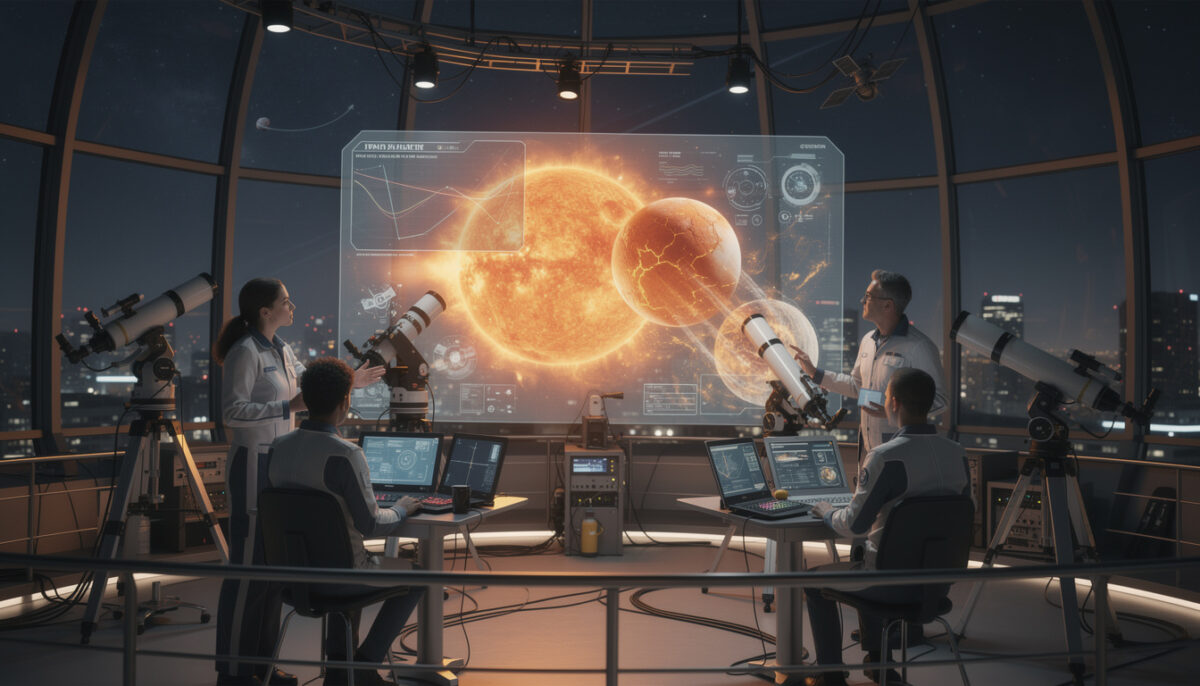
Your favorite hot Jupiter, orbiting tight around its star, might be living on borrowed time. New research in Astronomy shows how dying stars quietly erase their closest planetary companions, offering a distant preview of the Sun’s final act and Earth’s long‑term prospects.
How stellar evolution turns suns into planet eaters
Every Sun-like star follows a long arc of stellar evolution. During the calm “main sequence” phase, hydrogen fusion in the core keeps the star stable and its planets comfortably in orbit, as in our current Solar System. Learn more about star system mysteries similar to this in something massive lies beneath Jupiter’s clouds.
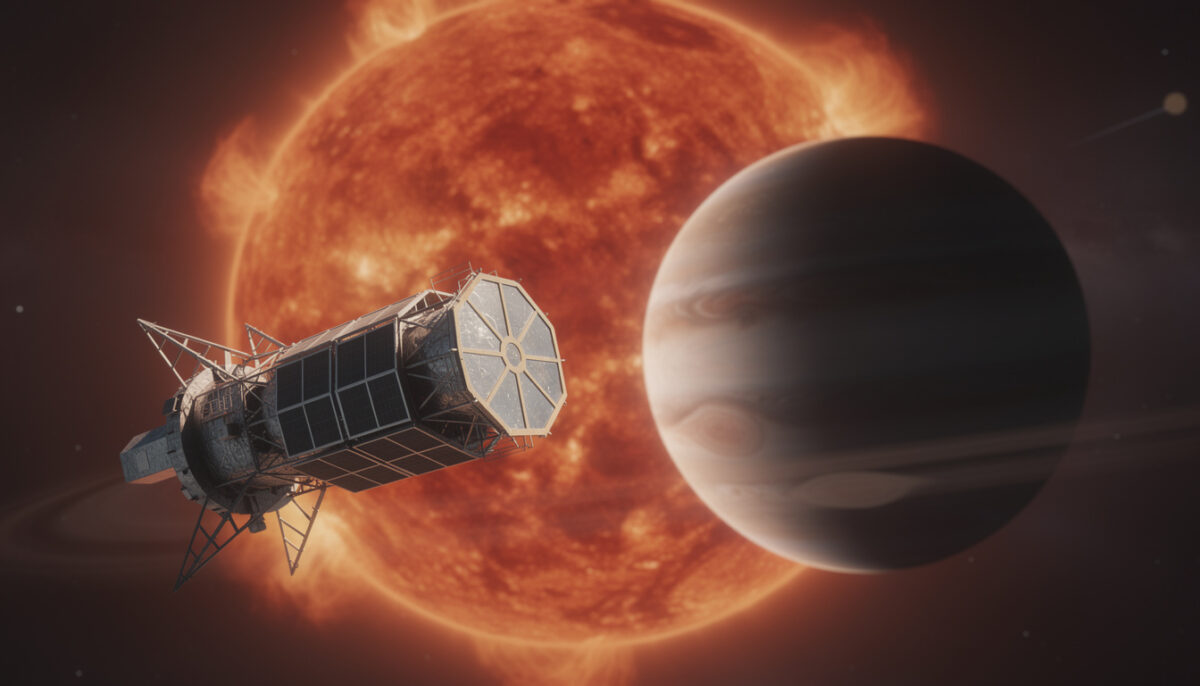
When hydrogen runs low, the balance breaks. The star cools, swells, and enters the red giant stage. Its radius grows dozens of times, while its outer layers become loosely bound. This inflation is the trigger that makes star consumption of nearby exoplanets not just possible, but highly efficient.
Students Discover Ancient Star from the Dawn of the Universe Entering the Milky Way
How a Minuscule Claw in a 500-Million-Year-Old Fossil Revolutionized Our Understanding of Spider Origins
What half a million stars reveal about planetary engulfment
In the latest study, a team from UCL and the University of Warwick sifted through light curves for nearly half a million post–main sequence stars. They used NASA’s TESS telescope to hunt for the tiny, periodic dips in brightness produced when a planet crosses in front of its star.
Starting from more than 15,000 signals, strict vetting left just 130 giant planets and planet candidates on tight orbits of up to 12 days. Among them, 48 were already confirmed, 49 were known candidates, and 33 emerged as fresh discoveries, expanding the catalog of doomed worlds.
Missing hot giants around dying stars: the smoking gun
When the team compared different stages of stellar ageing, a striking pattern appeared. Younger post–main sequence stars still hosted close-in giants at about 0.35%, a rate comparable to unevolved stars on the main sequence.
For fully developed red giants, the number plummeted to around 0.11%. That sharp drop suggests a widespread wave of planetary engulfment by dying stars: as stars swell, many of their nearest giant worlds simply vanish, likely torn apart or swallowed.
From statistics to a timeline of destruction
The analysis indicates that once a star leaves the main sequence, close giants can be lost within just a few hundred thousand years. That is short compared with the billions of years of earlier stable life.
This large-scale pattern matches individual events where telescopes have caught a star’s brightness outburst and dusty afterglow, interpreted as direct star consumption of a planet, similar to the dramatic cases discussed in recent observational reports. For more detail on explosive cosmic events, see how radio waves unveil the secrets leading up to stellar explosions.
Tidal interactions: the quiet force that drags planets inward
What physically drives these giants into their host? The key lies in tidal interactions. A close planet raises tides on its star, and the star raises tides on the planet, linking their spins and orbits through gravity.
As the star expands into a red giant, its outer layers become easier to distort. The tidal bulges lag slightly, robbing the planet of orbital energy. Over time, this drag slows the planet and shrinks its orbit, tightening the spiral toward planetary consumption.
From gentle tug to catastrophic plunge
Once the orbit contracts enough, heating and friction ramp up. Some worlds may break apart into streams of gas and dust before impact, while others plunge intact beneath the stellar surface.
These processes leave observable fingerprints. Infrared excesses, odd chemical signatures, and sudden brightening events help astronomers link population-scale statistics with spectacular single events, such as the planetary demise scenarios compared in recent planet‑eating giant analyses.
What this cosmic phenomenon hints about Earth’s future
To make this less abstract, imagine Leena, a grad student building models for the Sun’s future. Her simulations show that in roughly five billion years, our star will follow the same route, swelling into a red giant and transforming the inner Solar System. More on how our Sun’s journey relates to its galactic neighbors is explored in our Sun possibly fled the Milky Way’s core.
Mercury and Venus sit in the highest danger zone. Current models suggest they will almost certainly be engulfed. Earth’s orbit may expand slightly as the Sun loses mass, leaving a slim window where the planet survives but becomes utterly uninhabitable.
How safe is Earth compared with hot Jupiters?
The TESS study focused on giant planets hugging their stars far more tightly than Earth hugs the Sun. Those worlds face a far more rapid and certain fate as soon as stellar evolution accelerates.
Earth orbits farther out, so direct engulfment is less likely in many models. Yet the Sun’s brighter, bloated phase will bake the surface, strip oceans, and tear at the atmosphere, echoing the long‑term scenarios discussed in modern end‑of‑Earth projections.
How astronomers confirm these doomed planetary companions
Finding a dip in starlight is only the first step. To prove an object is truly a planet and not a small star or brown dwarf, researchers must measure its mass as well as its radius.
They track tiny wobbles in the host star’s spectrum as the object orbits. Combining the wobble with the transit depth reveals whether the companion is a genuine giant planet or something heavier, crucial for mapping which bodies are most vulnerable to planetary engulfment by dying stars.
What this means for future observations of dying stars
With each newly confirmed system, models of Astrophysics grow sharper and more predictive. Comparing engulfment rates across different star masses, metallicities, and ages will refine timelines for when consumption peaks.
Upcoming observations, building on exotic transients already spotted by facilities that also chase “dirty fireball” explosions or rare collisions like those described in planet–planet impact studies, will tie population trends to dramatic individual events. For another example of dramatic cosmic impacts, see how astronomers believe they’ve observed a rare collision between two planets.
Key takeaways on dying stars and devoured planets
For a quick overview, keep these points in mind when thinking about dying stars and their planetary companions:
- Red giants host far fewer close-in giant exoplanets than less evolved stars, pointing to large-scale planetary loss.
- Tidal interactions intensify as stars expand, draining orbital energy from nearby planets and shrinking their paths.
- Engulfment can unfold within hundreds of thousands of years after a star leaves the main sequence.
- Our Sun will follow this path, likely destroying Mercury and Venus and radically transforming Earth’s environment.
- Future telescopes will connect statistics to fireworks by capturing more real-time events of planetary consumption.
How common is planetary engulfment around red giants?
Current surveys suggest that close-in giant planets become much rarer as stars evolve into red giants. While about 0.35% of younger post–main sequence stars host such planets, only around 0.11% of more evolved red giants do, implying that many of their nearby planets have already been engulfed or destroyed.
Could Earth be swallowed when the Sun becomes a red giant?
Most models indicate that Mercury and Venus will almost certainly be engulfed. Earth sits farther out, so it may escape direct consumption as the Sun loses mass and its gravitational pull weakens. However, the intense heat and radiation will likely strip oceans and atmosphere, making Earth uninhabitable even if the planet’s rock survives.
What kind of planets are most at risk around dying stars?
The highest risk falls on giant exoplanets on very tight orbits—hot Jupiters and similar worlds with periods of days rather than years. Their proximity means tidal forces are strong, causing rapid orbital decay once the star begins to expand, whereas distant planets experience weaker interactions and may endure far longer.
How do astronomers know a star has swallowed a planet?
Evidence comes from several clues: an unexpected lack of close-in planets around older stars, sudden brightening events, dusty outbursts, and chemical signatures in stellar atmospheres that hint at recent ingestion of planetary material. Population statistics from missions like TESS strengthen the case by showing consistent patterns across thousands of stars.
Why does studying planetary engulfment matter for astronomy?
Understanding how and when planets are destroyed refines models of stellar evolution, planetary system lifetimes, and the long-term habitability of worlds. It also helps interpret strange transients and enriches the broader picture of cosmic phenomena, from exoplanet demographics to the final stages of sun-like stars across the Galaxy.
FAQ
What happens to planets that are too close to a dying star?
Planets in close orbits can be swallowed as the star expands into a red giant. This process, known as planetary engulfment by dying stars, often destroys or significantly alters these planets.
How do astronomers detect evidence of planetary engulfment by dying stars?
Astronomers look for changes in a star’s brightness, unusual chemical signatures, and the absence of expected exoplanets around old stars. These clues help confirm planetary engulfment by dying stars has taken place.
Could planetary engulfment by dying stars happen in our Solar System?
Yes, when the Sun eventually enters its red giant phase, it may engulf Mercury, Venus, and possibly Earth. This fate is expected to occur billions of years from now.
What are the consequences of planetary engulfment for the star itself?
Landspace Conducts Test of 220-Ton Methane Engine Paving the Way for Next-Gen Heavy-Lift Rockets
Colorado Startup Lux Aeterna Secures $10 Million to Pioneer Reusable Satellite Technology Shaping the Future Space Economy
Engulfed planets can affect the dying star by transferring momentum, spinning it up, or enriching its outer layers with heavy elements. These interactions provide valuable information about stellar evolution.
Are all giant planets around old stars at risk of being engulfed?
Only giant planets orbiting within a few astronomical units are at high risk of planetary engulfment by dying stars. Those farther out usually survive the red giant phase unscathed.