
Show summary Hide summary
A brief, violent twist in a distant radio signal has done what years of careful observing had failed to achieve: it has exposed the Elusive Companion hiding beside a source of Fast Radio Bursts. For the first time, astronomers can say with high confidence that at least some of these cosmic flashes arise in binary star systems, not from isolated stars alone.
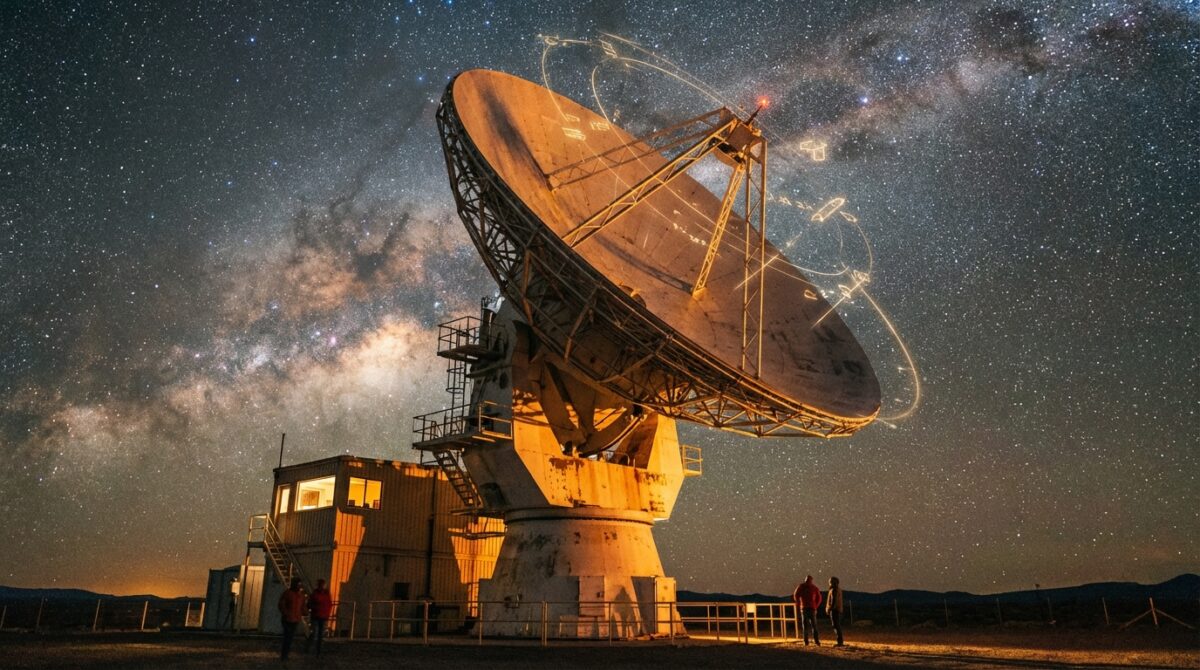
This shift in understanding comes from an international team led by researchers at the Department of Physics at The University of Hong Kong (HKU), working with major Chinese observatories. Their work, published in Science, uses nearly 20 months of monitoring with China’s Five-hundred-meter Aperture Spherical Telescope (FAST) to track a repeating FRB about 2.5 billion light‑years away.
How a sudden signal flare changed fast radio burst theory
The key finding is deceptively simple: a Sudden Signal Flare in the polarization of the radio waves revealed a dense, magnetized cloud crossing our line of sight. The timing and behaviour of this flare match what would be expected from a coronal mass ejection (CME) launched by a nearby star orbiting the FRB source.
Potential First Observation of a ‘Dirty Fireball’ Star Explosion Unveiled
Historic Artemis II Mission Launches Astronauts on Pioneering Journey to the Moon

In a single sentence, the methodology is this: astronomers used long-term, high-sensitivity Radio Astronomy observations to monitor how the polarization of a repeating FRB changed over time, then matched those changes to models of plasma from an orbiting companion. The event was not a single lucky snapshot, but the outcome of systematic watching and patient data analysis.
The object behind the bursts: a magnetar in a pair
The team’s interpretation, led by HKU astrophysicist Professor Bing Zhang, is that the FRB comes from a magnetar—a type of Neutron Star with an extreme magnetic field—locked in orbit with a Sun‑like star. The companion sometimes hurls out CMEs, flooding the region with magnetized plasma. When that plasma cloud drifts across the line of sight between Earth and the magnetar, the FRB’s polarization suddenly changes.
According to the analysis, the properties of the plasma clump inferred from the data are consistent with stellar eruptions seen in our own Solar System. The difference is scale and distance: this event happened billions of light‑years away, yet its fingerprint is readable through the FRB’s behaviour.
The astronomy campaign behind the discovery
The story began with FRB 220529A, a repeating fast radio burst targeted by the FAST FRB Key Science Program co-led by Professor Zhang. From mid‑2022 onward, the team collected data over roughly 17–20 months, treating the object almost like a patient in long-term medical observation rather than a one‑off event in Astrophysics.
FRB 220529A initially appeared ordinary among repeaters: bright, brief, highly polarized radio flashes. Then, near the end of 2023, the signal did something entirely unexpected. The value that tracks how much the polarization angle twists—called the rotation measure (RM)—suddenly spiked by more than a factor of 100, then slid back to its previous level within about two weeks.
What is an RM flare and why it matters
This extreme yet short‑lived event, named an “RM flare”, is the central evidence. In normal conditions, an FRB’s RM changes slowly or remains relatively stable. A rapid surge followed by a symmetric decline indicates that an extra blob of magnetized plasma briefly entered the path of the radio waves.
Lead author Dr. Ye Li from Purple Mountain Observatory and the University of Science and Technology of China quantified the spike: an abrupt RM increase by more than one hundred times the earlier baseline, measured with high signal‑to‑noise. The probability of such a pattern arising from random noise is extremely low, reinforcing that a genuine physical structure crossed the line of sight.
Binary origin of fast radio bursts: what we now know
The team then compared the inferred plasma properties to known Cosmic Phenomena such as CMEs seen on the Sun. Co‑first author Professor Yuanpei Yang of Yunnan University showed that a CME‑like ejection from a companion star provides a self‑consistent solution: the density, magnetic field strength, and spatial scale all line up with the observations.
This interpretation strongly suggests that at least some repeating Fast Radio Bursts occur in binary systems. The FRB source is likely a magnetar, and the companion is a relatively normal star capable of energetic eruptions. While the companion is far too faint and distant to be imaged directly, its presence is “seen” through the imprint it leaves on the Transient Signals from the magnetar.
How this fits with other fast radio burst studies
The result connects with a growing body of work using both single‑dish telescopes and interferometers to locate FRBs and study their environments. Studies like those from MIT on localizing an individual burst’s host galaxy, described in recent MIT reports on fast radio bursts, had already hinted that dense, complex surroundings were involved.
Reports on the “China Sky Eye”, including coverage such as analyses of China’s Sky Eye solving a cosmic mystery, had suggested that binary models might be necessary. The new Science paper supplies the clearest observational signature so far, turning a theoretical possibility into well‑supported evidence.
Implications for radio astronomy and cosmic environments
For Astronomy more broadly, this study provides a new way to use FRBs as probes of distant plasma. Instead of only asking “what causes the bursts?”, researchers can ask “what does the changing signal reveal about the environment?”. The RM flare acts like an X‑ray contrast dye injected into a binary system billions of light‑years away.
For Radio Astronomy, the work suggests a practical strategy: monitor repeating FRBs over long periods, searching for polarization flares that betray companions, stellar winds, or even circumstellar disks. If multiple sources show similar behaviour, astronomers could start to map how common binary systems are among FRB hosts and how those systems evolve.
Why this matters for your picture of the universe
For readers used to hearing about Pulsars in the context of regular radio beacons, FRBs represent a more extreme, sporadic cousin. Knowing that at least some of these eruptions come from magnetars in binaries hints at a continuum of behaviour: from stable pulsar emissions to chaotic magnetar flares shaped by nearby stars.
This nuance matters whenever FRBs are used as tools, for example to measure the distribution of matter between galaxies. If an FRB’s immediate environment is shaped by a binary companion, that local contribution must be separated from the larger‑scale signal. The new results do not diminish FRBs’ promise as cosmological probes; they refine how those probes must be calibrated.
- Energy scale: a single FRB burst can outshine an entire galaxy in radio waves for a few milliseconds.
- Timescale: the observed RM flare lasted about two weeks, contrasting with millisecond bursts.
- Distance: FRB 220529A lies roughly 2.5 billion light‑years away, yet small‑scale plasma structures remain detectable.
- System type: evidence points to a magnetar plus Sun‑like star, not an isolated neutron star.
- Observation window: nearly 20 months of monitoring were required to catch the brief flare.
Limitations, open questions and next research steps
Despite the strength of the evidence, this work does not prove that all FRBs come from binary systems. The authors explicitly focus on repeating sources, where long‑term monitoring is possible. One‑off bursts, which form the majority of the catalogued population, may have very different origins.
The interpretation also relies on models of CMEs and magnetized plasma that are well tested in nearby stars but extrapolated to far more energetic environments. While the observed RM changes fit a CME‑like event, other dense plasma structures cannot yet be ruled out completely. The link between magnetars, binaries and repetition rate remains a working hypothesis, not a universally accepted law.
What astronomers will look for next
The international collaboration—spanning HKU, Purple Mountain Observatory, Yunnan University, the National Astronomical Observatories of the Chinese Academy of Sciences and others—plans to extend monitoring to a larger sample of repeaters. If similar RM flares are found in multiple sources, confidence in a binary‑driven scenario will grow substantially.
Other observatories, including interferometric arrays, may try to spatially resolve nebulae or supernova remnants around repeating FRBs, complementing the polarization approach. Parallel efforts described in outlets such as detailed analyses of binary‑origin FRBs underline how rapidly this field is moving. For now, the sudden flare from FRB 220529A stands as a textbook example of how a tiny twist in a distant signal can transform the story of a whole class of cosmic objects.
What exactly is a fast radio burst?
A fast radio burst (FRB) is a brief, intense pulse of radio waves lasting only milliseconds, originating from distant galaxies. Each burst can emit as much radio energy as an entire galaxy during that short moment. Many FRBs have been detected only once, while a smaller subset repeat over time.
How did astronomers infer the presence of a companion star?
Astronomers monitored the polarization of the FRB’s radio waves and detected an RM flare, a sudden hundred‑fold jump in rotation measure followed by a rapid decline over about two weeks. This pattern matches a dense, magnetized plasma cloud, likely from a coronal mass ejection launched by a nearby companion star crossing the line of sight.
Does this discovery mean all FRBs come from binary systems?
No. The study provides strong evidence that at least some repeating FRBs are produced by magnetars in binary systems with companion stars. However, many FRBs are non‑repeating, and their origins may differ. The findings support a broader framework but do not establish a single cause for every FRB observed.
How reliable are the results from the FAST telescope?
A Groundbreaking New Theory Sheds Light on the Origins of the Big Bang
Webb Telescope Uncovers Enigmatic Explosion Challenging the Laws of Physics
FAST offers exceptionally high sensitivity, allowing precise measurements of FRB properties over long periods. The RM flare in FRB 220529A was tracked across months of data, with changes far exceeding measurement uncertainties. While every observation has limits, the signal’s strength and coherence across epochs make the result highly robust.
Why are magnetars important in fast radio burst research?
Magnetars are neutron stars with extraordinarily strong magnetic fields, capable of releasing huge amounts of energy in short bursts. Their extreme environments make them natural candidates for powering FRBs. The new study strengthens the link between magnetars and repeating FRBs, especially when those magnetars interact with material from a companion star in a binary system.