
Show summary Hide summary
- Oval dance before collision: what astronomers really saw
- A new way to weigh a black hole and neutron star
- Where can such eccentric mergers be born in space?
- Why this oval dance matters for the next decade of astrophysics
- Key takeaways to share with another space fan
- What makes this black hole–neutron star merger so different?
- How did scientists detect the oval orbit if they cannot see the system directly?
- Why did earlier studies misjudge the masses of the black hole and neutron star?
- What does this event tell us about where such systems form?
- How will this discovery affect future astrophysics research?
Imagine watching a Black Hole and a Neutron Star locked in an off‑beat cosmic waltz, looping on an Oval Dance instead of a neat circle, before a violent Collision. That is exactly what astronomers just uncovered in real gravitational wave data.
For anyone following Astrophysics, this discovery reshapes how your Universe forges some of its most extreme couples.
Oval dance before collision: what astronomers really saw
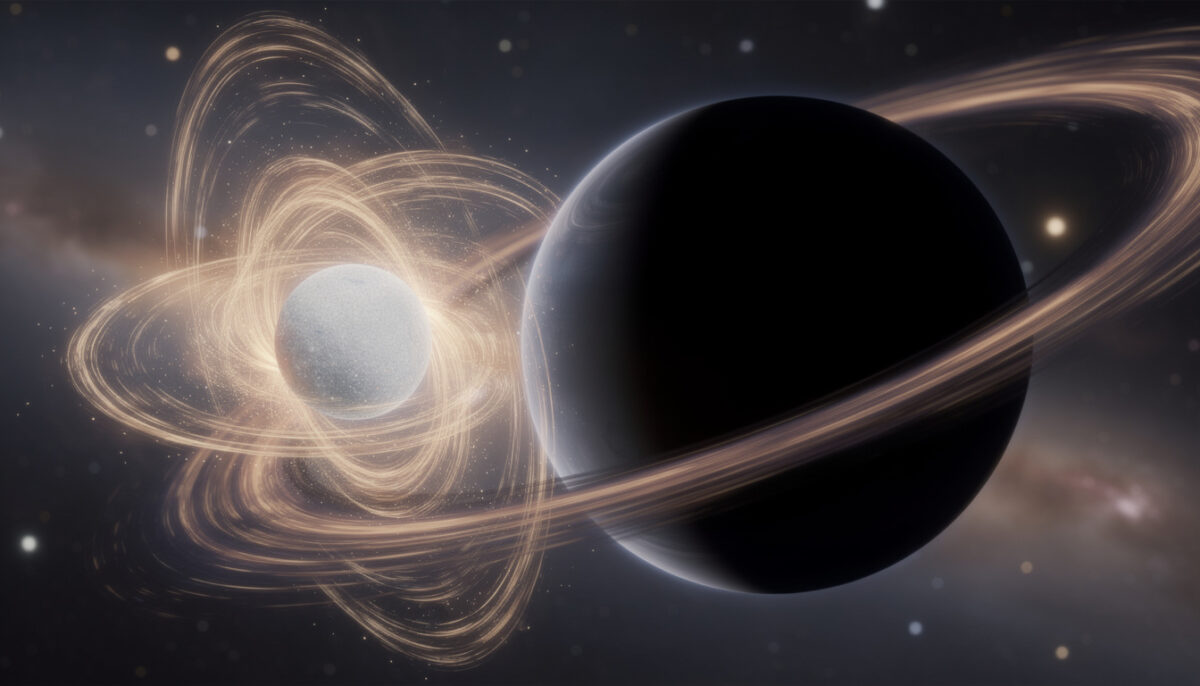
The story begins with the event nicknamed GW200105, a distant Stellar Merger where a black hole swallowed a neutron star. Previous studies treated their path as circular, as most models of a compact Binary System predict. A new analysis, however, shows the orbit was still clearly stretched just before impact.
Astronomers Believe They’ve Observed a Rare Collision Between Two Planets
Unusual Chirping Signals from a Supernova Confirm the Long-Contested Magnetar Hypothesis
That elongated trajectory means the pair did not calmly spiral together over billions of years in isolation. Instead, their last laps looked like a distorted racetrack, strongly hinting at past encounters with other stars disturbing the system and locking in this odd configuration.
Gravitational waves expose the eccentric orbit
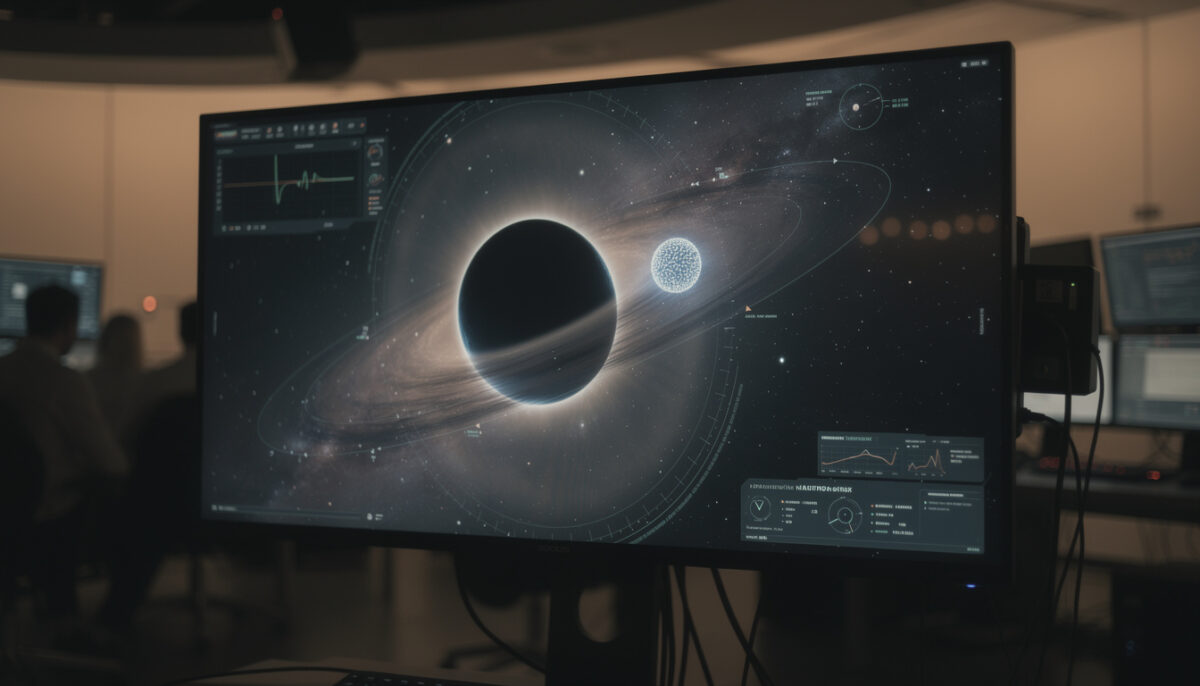
How can anyone know the shape of an orbit when no telescope can resolve such tiny systems? The answer lies in the ripples in spacetime themselves: Gravitational Waves. Detectors from the LIGO and Virgo collaborations recorded the subtle stretching and squeezing of space produced by the merger, like a cosmic seismograph.
Researchers from the University of Birmingham, Universidad Autónoma de Madrid, and the Max Planck Institute for Gravitational Physics developed a refined model that lets them read two key signatures from the signal: the degree of orbital stretch (eccentricity) and potential spin wobbling (precession). Measuring both together in a neutron star–black hole event had never been achieved before.
A new way to weigh a black hole and neutron star
Once the team accounted for the oval orbit, the masses of the two objects shifted. Earlier circular assumptions had made the black hole seem lighter and the neutron star heavier. The revised analysis shows the final merged object weighs about 13 times the Sun, aligning better with typical stellar black holes.
This may sound like a technical detail, yet your understanding of how massive stars live and die hangs on those numbers. Accurately weighing these extreme bodies refines models of supernova explosions and helps track which stars end up as neutron stars and which collapse directly into black holes.
Bayesian detective work against thousands of models
To reach those conclusions, the team ran an extensive Bayesian comparison. They pitted thousands of theoretical waveforms against the actual data, letting statistics decide which scenario fit best. The result: a nearly circular orbit is ruled out at 99.5% confidence, a blow for the “perfect-circle” expectation.
Interestingly, they found no strong sign of precession in GW200105. That points to an eccentric orbit likely locked in during the system’s formation, not twisted later by spinning components. The signal reads more like a relic of a messy astrophysical environment than a choreographed two-body dance.
Where can such eccentric mergers be born in space?
To picture the birthplace, think of Maya, a fictional researcher working on dense star clusters. In her simulations, hundreds of massive stars crowd together, each with its own gravity tugging at neighbors. Close encounters constantly reshuffle who orbits whom, sometimes throwing a Black Hole and Neutron Star into a tight, skewed embrace.
An environment like a globular cluster or a galactic nucleus naturally produces the kind of chaotic interactions that can leave a compact pair on a highly eccentric track. GW200105 fits that pattern far better than the quiet life of a binary that evolves alone from two massive stars in a peaceful corner of a galaxy. For more on star cluster-related cosmic phenomena, see our article on how Titan and Saturn’s rings were born.
What this means for future space phenomena studies
Until recently, many models assumed a dominant formation route: two massive stars form together, lose energy via radiation and stellar winds, and end as a compact, nearly circular Binary System. The oval orbit observed here breaks that simplicity. Multiple routes are clearly at play, some governed by crowd dynamics in dense clusters.
For your view of Space Phenomena, that means mergers detected by gravitational waves are not a uniform family. Each event could carry fingerprints of its birthplace, whether a calm stellar neighborhood or a gravitationally turbulent region near a galactic center.
Why this oval dance matters for the next decade of astrophysics
As detectors grow more sensitive through the 2030s, catalogues of compact mergers will swell. Systems like GW200105 show that eccentric mergers are not just theoretical curiosities. They are real, measurable, and packed with information about environments hidden from conventional telescopes, especially near an Event Horizon.
For someone passionate about high-energy astrophysics, this is the equivalent of discovering that not all earthquakes happen on the same kind of fault. Every detection becomes a probe of cosmic geography, mapping where dense stellar regions thrive and how many neutron stars and black holes inhabit them.
Key takeaways to share with another space fan
Summing up this discovery makes a handy checklist for your next discussion with a fellow enthusiast:
- A black hole–neutron star pair in GW200105 merged from a clearly eccentric orbit, not a near-perfect circle.
- The merger produced a black hole around 13 solar masses, after correcting earlier mass estimates.
- Statistical analysis rules out a circular orbit at about 99.5% confidence.
- No strong precession hints at formation in a crowded stellar environment, not a quiet isolated binary.
- This supports multiple formation channels for compact mergers, reshaping how you interpret future gravitational wave events.
Seen this way, that strange Oval Dance before Collision is more than a curiosity; it is a precise clue about how your Universe builds and reshapes its most extreme objects.
What makes this black hole–neutron star merger so different?
Unlike most known compact binaries, this system was still on a significantly eccentric, oval-shaped orbit just before merging. Gravitational Waves from event GW200105 show a stretched trajectory rather than the nearly circular path standard models predict, revealing a far more chaotic formation history.
How did scientists detect the oval orbit if they cannot see the system directly?
Researchers used the detailed shape of the gravitational wave signal recorded by LIGO and Virgo. By comparing thousands of theoretical waveforms to the data with Bayesian methods, they measured orbital eccentricity and ruled out a circular orbit with very high confidence.
Why did earlier studies misjudge the masses of the black hole and neutron star?
Earlier analyses assumed the Binary System had a circular orbit. That simplification distorted how the signal was interpreted, making the black hole appear lighter and the neutron star heavier. Once eccentricity was included, the final Black Hole mass settled near 13 times the Sun. To better understand mass measurements in cosmic events, read more about the Apollo Moon Rocks revealing new insights.
What does this event tell us about where such systems form?
Chickpeas Poised to Become the Moon’s First Cultivated Crop
Researchers Potentially Unveil a Novel Mineral Discovery on Mars
The eccentric orbit strongly suggests formation in dense stellar environments, such as clusters or galactic centers, where many stars interact gravitationally. Random close encounters there can pair a Black Hole and Neutron Star and leave them on an oval trajectory before their final Stellar Merger.
How will this discovery affect future astrophysics research?
It shows that multiple formation paths produce compact mergers, not just one quiet evolutionary route. Future gravitational wave detections will increasingly be used to distinguish these channels, map extreme environments, and refine models of Space Phenomena near an Event Horizon and beyond.