Show summary Hide summary
- Toxic metals in bananas: what the study now reveals
- From mining disaster to environmental pollution of crops
- Detailed results: where the toxic metals accumulate
- Hidden health risks: lead, cadmium and long-term exposure
- How this study was conducted and why it matters
- Real-world impact on farmers, consumers and policy
- Connecting Brazil’s case to global food contamination debates
- Are bananas in all parts of Brazil contaminated with toxic metals?
- Why are young children more at risk from contaminated bananas?
- Does this study prove that the mining disaster causes specific diseases?
- Can washing or peeling bananas remove heavy metals from the pulp?
- What can authorities do to protect public health after such mining disasters?
What if the bananas on a child’s plate carried toxic metals from a distant mining catastrophe? New research in Brazil now shows that young children eating bananas grown near the Doce River estuary may face a measurable health risk from heavy metals lingering in the soil a decade after the Fundão dam collapse.
This finding sharply reframes the legacy of the 2015 Mariana disaster: it is no longer only a story of mud-filled rivers, but of food contamination quietly entering household kitchens and school snacks.
Toxic metals in bananas: what the study now reveals
Researchers from the University of São Paulo (USP), the Federal University of Espírito Santo (UFES), and the University of Santiago de Compostela investigated crops grown in Linhares, at the Doce River estuary, where iron-ore tailings arrived after the Fundão dam failure in 2015.
Gravitational Wave Detection Validates Einstein Again
Revealing the ancient secrets of the Greenland shark
The work, published in the journal Environmental Geochemistry and Health, concludes that bananas from contaminated plots could pose a non-carcinogenic risk to children under six, mainly due to lead and cadmium, while estimated risk for adults remains below international safety thresholds.
How scientists traced metals from mine waste to fruit
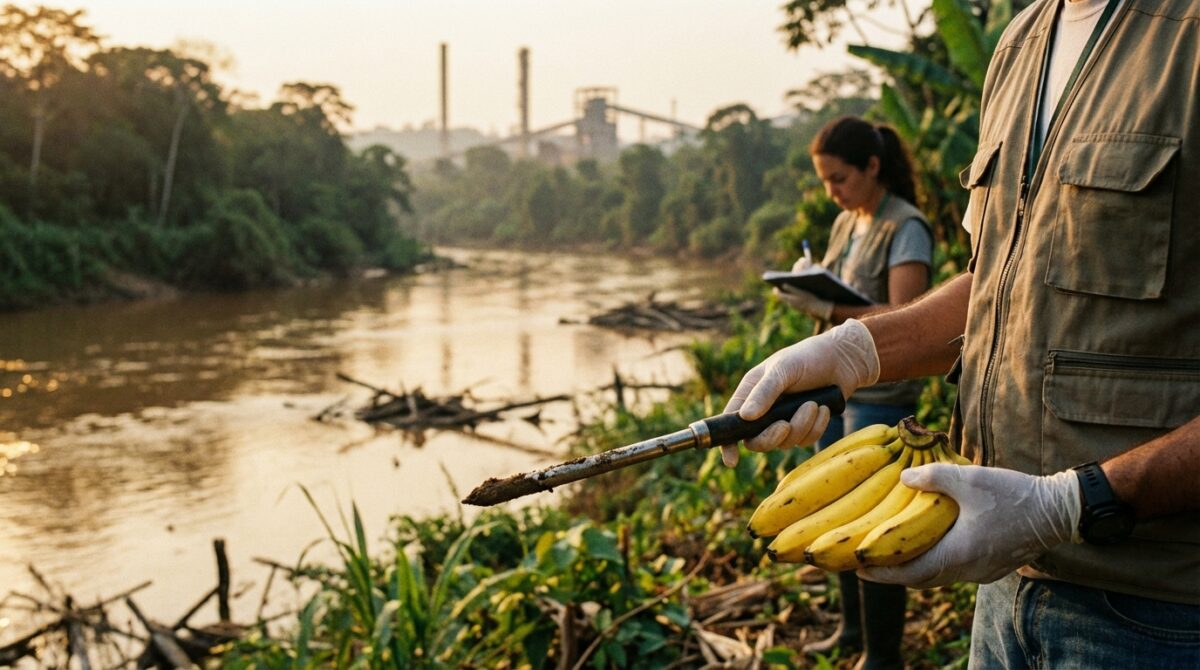
The team led by soil scientist Amanda Duim and agronomist Tiago Osório used a straightforward yet rigorous approach: compare the levels of potentially toxic elements in soil with those in different plant parts, then estimate human exposure using standard health-risk formulas.
By looking specifically at cadmium, chromium, copper, nickel and lead—all linked to the iron oxides in tailings—they could track how far the mining waste had travelled from river sediment into roots, stems, leaves and finally into edible pulp.
From mining disaster to environmental pollution of crops
In November 2015, the collapse of the Fundão tailings dam in Mariana released millions of cubic meters of mining sludge that moved down the Doce River. For riverside farmers like the fictional João in Linhares, the mud initially meant flooded fields; today, it means slow, invisible environmental pollution of the soil where his bananas and cassava grow.
Researchers started sampling only seven days after the failure. Over the years, their data showed that iron-rich mud settled into floodplains, locking heavy metals to iron oxides in the soil. The new study asks a sharper question: are these metals making their way into fruit and into human bodies? Scientists unveil hidden geometry to further explore this phenomenon.
Bananas, cassava and cocoa under the microscope
The investigation covered three key foods: bananas, cassava rhizomes and cocoa pulp, all grown on land periodically influenced by Doce River flooding in Linhares. Farmers in the region rely on these crops both for income and for daily meals, which makes any agricultural impact immediately social and economic.
To quantify contamination, plants were washed, weighed fresh, dried, then ground by part—roots, stems, leaves and peeled fruit. The “plant powder” was dissolved in acid, and metal concentrations were calculated in milligrams per kilogram of dry biomass, then compared with reference values from FAO and other agencies.
Detailed results: where the toxic metals accumulate
The pattern that emerged was uneven but worrying. In bananas and cassava, most elements—except chromium—tended to concentrate below ground, in roots and tubers. That might sound reassuring, yet some metals still reached the pulp eaten by families in Linhares.
Cocoa showed a different profile: stems, leaves and fruits accumulated higher levels, and in cocoa pulp the concentrations of copper and lead exceeded limits recommended by the Food and Agriculture Organization of the United Nations.
Key numbers and risk indices for children and adults
The health-risk assessment relied on three metrics: the risk quotient (RQ), the risk index (RI) and the total risk index (TRI). These compare estimated daily intake from food against reference doses considered tolerable over a lifetime.
For most metals and foods, the TRI stayed below 1 for adults, which suggests no significant non-carcinogenic risk at current exposure estimates. However, for children under six eating bananas from contaminated areas, the TRI exceeded 1, driven mainly by lead, with cadmium also surpassing FAO guidelines.
What the statistics say in practice
The team used local consumption data from the Brazilian Institute of Geography and Statistics, factoring in body weight, exposure duration and the time needed for harmful effects to develop. Reference doses included approximately 0.05 mg/kg for cadmium in fruits and 0.8–2.3 mg/kg for lead, among others.
While exact confidence intervals were not detailed in public summaries, the methodology follows international standards used in public health and environmental toxicology, which usually work with conservative assumptions. That means the risk for children is unlikely to be overstated and may, if anything, underestimate high-consumption households.
Hidden health risks: lead, cadmium and long-term exposure
Lead stands out as the main concern in these toxic metals profiles. Even at low doses, long-term exposure during early childhood can alter brain development, reducing IQ and contributing to attention problems and behavioral changes.
Cadmium, another key contaminant detected in bananas, is associated with kidney damage and cardiovascular strain when accumulated over decades. Shorter exposure can trigger gastrointestinal symptoms, while inhalation in other contexts is linked to lung issues.
Non-carcinogenic and carcinogenic risks over a lifetime
The TRI focuses on non-carcinogenic effects. Yet the research team, including health scientist Tamires Cherubin, also underlines a potential carcinogenic risk if exposure continues over an entire lifespan, roughly 75 years in Brazil.
Certain metals can damage DNA directly or indirectly, potentially raising the likelihood of cancers affecting the central nervous system, digestive tract and blood-forming tissues. Here the link is probabilistic, not deterministic: not every exposed child will develop cancer, but population risk may rise if the contamination persists and is not managed.
How this study was conducted and why it matters
The scientific value of Duim’s doctoral work lies in the clear chain it traces: from mining disaster, to tailings in river water, to soil, to plant tissues, and finally to estimated human intake. Few previous studies connected all these steps with such detail in the Doce River basin.
The thesis has already led to seven international articles and earned major academic awards in 2025, including the USP Thesis Award in Sustainability and the Capes Thesis Award. Funding from FAPESP supported the long-term field and lab work needed to follow the contamination over several years.
What we still do not know
Several uncertainties remain. The sampling represents specific locations and time windows in Linhares; conditions may differ in other stretches of the Doce River or in dry versus wet years. Metal uptake can vary sharply between banana varieties and farming practices.
Correlation between high iron oxide content in soil and metals in plants is strong, but small-scale variations in pH, organic matter and root microbiota can alter absorption. Future work needs to refine which agricultural practices reduce transfer to fruit most effectively.
Real-world impact on farmers, consumers and policy
For families like João’s, the message is not to abandon bananas altogether, but to treat fruit sourced from known impact zones with caution, especially for young children. Health agencies may recommend diversifying fruit intake and monitoring produce origin in school feeding programs.
At policy level, the study strengthens demands for long-term monitoring of environmental pollution from tailings, not only in water and fish but across the entire food web. Regulators can use the risk indices to target soil remediation, crop substitution or irrigation changes in the most affected areas.
Practical measures to reduce exposure
While full cleanup of mine waste is a generational challenge, some immediate measures can reduce exposure for local residents. For households and authorities, the following actions can meaningfully lower risk without disrupting food security overnight:
- Prioritise bananas and cassava from non-impacted plots when supplying school meals and hospitals.
- Rotate crops towards species that tend to retain metals in non-edible parts, as identified in Duim’s broader research on native plants.
- Increase soil testing for lead and cadmium in smallholder farms along the Doce River floodplain.
- Support remediation trials, such as planting metal-accumulating native trees on the most contaminated riverbanks.
- Communicate risks clearly to parents and farmers, avoiding panic but explaining why young children face higher vulnerability.
These strategies illustrate how science-based recommendations can translate into everyday decisions, from municipal procurement rules to what parents serve at breakfast.
Connecting Brazil’s case to global food contamination debates
The Doce River story echoes other global concerns about food contamination by industrial waste. International outlets have already highlighted these findings, with detailed reporting on toxic elements found in bananas from the Mariana region and analyses of heavy metals in cassava and cocoa in tailings-affected soils.
In parallel, other research fronts look at different contaminants, from PFAS in drinking water to air pollutants near coal plants. New treatment technologies, such as those described in toxic metals found in bananas, show how engineering can help cut exposure before it reaches crops or taps.
Are bananas in all parts of Brazil contaminated with toxic metals?
No. The study focuses on bananas grown in areas influenced by tailings from the Fundão dam collapse near the Doce River estuary in Linhares. Bananas from regions not affected by the mining catastrophe are not covered by this research and are not assumed to carry the same heavy metal profile. Local origin and farming conditions strongly influence contamination levels.
Why are young children more at risk from contaminated bananas?
Children have lower body weight and developing organs, so a similar intake of lead or cadmium represents a higher dose per kilogram compared to adults. Their brains and nervous systems are still maturing, which increases sensitivity to toxic metals. The study’s risk indices showed total risk values above 1 for children eating bananas from impacted areas, while adult values stayed below that threshold.
Does this study prove that the mining disaster causes specific diseases?
The research shows a plausible pathway from mining waste to higher metal intake, and it estimates health risk using established toxicological models. However, it does not track individual patients or diagnose illnesses. The results indicate increased probability of non-carcinogenic and possibly carcinogenic effects over time, but they do not establish direct cause-and-effect for any single person.
Can washing or peeling bananas remove heavy metals from the pulp?
Peeling and washing help remove surface residues and soil, but they cannot eliminate metals that have been absorbed and stored inside the fruit tissue. The study analysed peeled banana pulp and still found lead and cadmium above recommended values in some samples. Reducing exposure must therefore focus on soil conditions, crop choice and sourcing, not on kitchen washing alone.
What can authorities do to protect public health after such mining disasters?
Discovery of New Fossils Could Resolve the Enigma of Sail-Backed Spinosaurs
Explore Five Breathtaking Shots in Photography Awards
Authorities can map contamination hotspots, monitor crops and water, and issue targeted consumption guidelines, especially for young children and pregnant women. They can also fund soil remediation, support crop diversification, and enforce stricter environmental rules on mining operations. Long-term surveillance and transparent communication help communities adapt while limiting public health impacts.