
Show summary Hide summary
- What this spider pearl necklace really revealed
- A tiny arachnid host and half‑millimeter parasites
- Life cycle: From pearl necklace to soil predator
- What this means for biology, ecology and hidden diversity
- Methodology, numbers and how confident we can be
- Why this strange pearl necklace matters beyond arachnid fans
- Where to explore more on spider parasites
- Are the pearl necklace parasites dangerous to humans?
- Does the parasite kill the spider host?
- How common are spider-parasitic mites in Brazil?
- Can similar living pearl necklaces appear on other animals?
- Why do scientists keep emphasizing museum collections in this discovery?
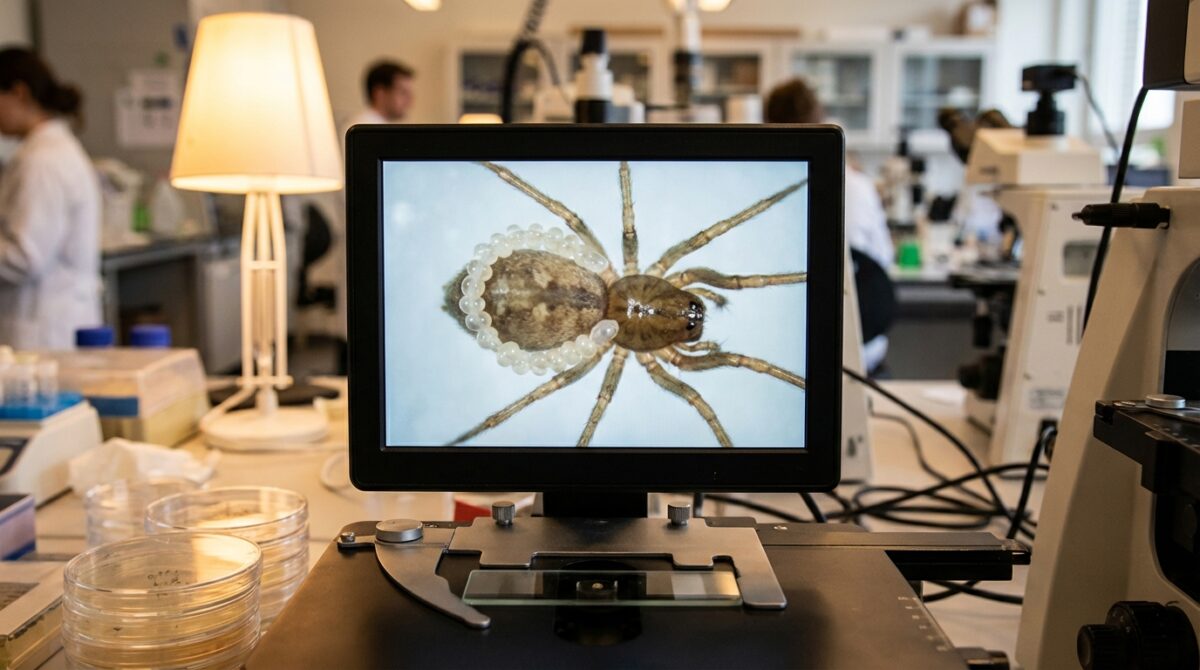
A spider just a few millimeters long appeared to be wearing a perfect pearl necklace. Under the microscope, every “pearl” twitched. What looked like jewelry was in fact a chain of living parasites, revealing an overlooked chapter of spider biology and parasite ecology in Brazil.
This chance observation has now delivered the first record of a particular mite family parasitizing spiders in the country, and only the second spider-parasitic mite species formally described there.
What this spider pearl necklace really revealed
Researchers at the Butantan Institute in São Paulo were sorting preserved spiders and scorpions when one tiny arachnid stood out. Around its abdomen ran a row of pale beads, aligned so neatly that they resembled a miniature piece of jewelry.
Assessing the Real Risks: How Concerned Should We Be About an AI Apocalypse?
Unexpected Fossil Finds Rewrite the Timeline of Complex Animal Evolution
Unsure whether this structure was part of the spider or something attached to it, the team consulted mite specialist Ricardo Bassini‑Silva, curator of the institute’s Acarological Collection. He quickly recognized the beads as larval mites, transforming a curious specimen into a significant record of parasitism in South American invertebrates.

How scientists identified a new parasite species
To test the hypothesis that these were unknown mites, the team used a straightforward but powerful approach: detailed morphological analysis under light and scanning microscopy, comparing every structure to known species. This single sentence summary hides hours of careful measurement and illustration.
The work, supported by the São Paulo Research Foundation (FAPESP) and published in the International Journal of Acarology, confirmed a new species in the genus Araneothrombium. The species was named Araneothrombium brasiliensis, expanding the known range of a group first described in Costa Rica in 2017 and hinting that such parasites are more widespread across neotropical ecosystems than records currently suggest.
A tiny arachnid host and half‑millimeter parasites
Each mite larva measures around 500 micrometers, about half a millimeter. On a spider only a few millimeters long, this makes the larval chain visually striking, which explains why the “necklace” caught researchers’ attention even on old specimens.
The larvae were all engorged, evidence that they had already fed extensively. They were attached to juvenile spiders from three different families, suggesting that this parasite does not specialize on a single spider lineage and that younger hosts, like many young animals, may be more exposed to infection and predation.
Why the parasites choose a spider’s weak point
Araneothrombium brasiliensis feeds on spider lymph, the fluid circulating through some arthropod bodies. To access it, larvae concentrate on the pedicel, the narrow bridge linking the cephalothorax to the abdomen.
Most of the spider is armored with rigid chitin, but the pedicel is relatively thin and flexible. According to Bassini‑Silva, that makes it the ideal entry point for the mites’ mouthparts, turning a structural necessity for the spider into a vulnerability that parasites exploit.
Life cycle: From pearl necklace to soil predator
The team has so far identified only the larval stage of this mite. This is common in this group: larvae latch onto hosts, while older stages disappear from view because they live freely in soil or leaf litter, hunting small insects or even other mites.
This shift from parasite to predator complicates tracking their full life cycle. Adults no longer rely on a spider host, so they are rarely collected together with the arachnids that reveal their existence. As a result, much of the known diversity in this group is based solely on larvae.
What the location in Brazil tells us about ecology
The parasitized spiders came from Pinheiral, in the state of Rio de Janeiro, near caves and rocky grottos. This landscape mirrors the environment where Brazil’s first known spider‑parasitic mite, Charletonia rocciai, was originally described in 1979.
A 2022 study revisited Charletonia rocciai, expanding knowledge about its anatomy, biology, and hosts, including some insects. That earlier species and Araneothrombium brasiliensis together suggest that transitional zones around caves may harbor specialized parasite–host interactions that are still under‑documented.
What this means for biology, ecology and hidden diversity
For biologists, this “pearl necklace” illustrates how little is yet known about symbiosis and parasitism in arthropods. According to Bassini‑Silva, Brazil hosts more than 3,000 described spider species, but only two spider-parasitic mites have been formally catalogued so far. The gap between these numbers points to a large, hidden diversity.
The discovery also highlights the value of museum and zoological collections. The spider that carried these larvae had been stored for years. The mites only became visible once researchers started examining specimens in detail, a reminder that preserved collections are active research infrastructures rather than static archives.
From a single spider to broader scientific questions
Consider a fictional environmental consultant, Ana, hired to survey invertebrate diversity around a new infrastructure project near Rio de Janeiro. Her team collects spiders for identification, much like the Butantan group did. If Ana’s samples are archived in a collection, future researchers might one day discover new parasites on them, long after the field campaign ended.
This scenario shows how long‑term sampling and collaborations with consultancies can indirectly feed academic research. The Butantan team expects similar partnerships to yield more specimens and potentially more parasite species, refining maps of host–parasite relationships in tropical ecosystems.
Methodology, numbers and how confident we can be
The description of Araneothrombium brasiliensis rests on a limited number of specimens, all derived from preserved spiders collected in a single Brazilian region. Detailed morphometrics, comparison with reference material, and established taxonomic criteria support the classification, which is standard practice in acarology.
Although the original article reports qualitative rather than statistical results, the confidence in species status comes from clear, repeatable morphological distinctions from related mites described since 2017. Still, the small sample and spatial restriction mean that conclusions about its full distribution or host range remain tentative rather than definitive.
Limits, open questions and why causation matters
The current data show that the mite larvae feed on juvenile spiders and can grow substantially while attached, but they do not yet show how often infestations kill or weaken hosts. Any claim that these parasites regulate spider populations would therefore go beyond available evidence.
At this stage, researchers can talk about association and damage to individual spiders, not about broad ecosystem-level causation. Key uncertainties include how larvae locate hosts, whether they also exploit insects in this region, and how climate or habitat change might influence infestation rates.
Why this strange pearl necklace matters beyond arachnid fans
For readers who are not specialists in mites, this case still carries several practical insights. It shows how small, overlooked details—a row of dots on a museum specimen—can reframe understanding of biodiversity and species interactions in a region.
It also underlines how parasite discovery intersects with broader issues, from environmental assessment to conservation. Better knowledge of parasite–host networks helps ecologists gauge ecosystem resilience and detect subtle impacts of land use change on less visible organisms.
Where to explore more on spider parasites
Several recent reports have discussed this discovery and related work on spider‑associated parasites. For an accessible overview of the first observation of a spider wearing what looked like jewelry, see this piece on scientists finding a spider with a pearl necklace made of parasites. A complementary angle on the same topic appears in a feature about a newly discovered parasite that resembles a string of pearls around a spider’s neck.
Together with the formal description in the International Journal of Acarology, these resources help place Araneothrombium brasiliensis within a wider conversation about parasite diversity, tropical ecology, and how collections continue to feed new discoveries well into the 2020s.
- Spider hosts reveal hidden parasite diversity in museum drawers.
- Pearl necklace-like formations can signal complex life cycles, not decoration.
- Living parasites may shift from host-dependent larvae to free-living predators.
- Arachnid weak points such as the pedicel can be key entry sites for parasites.
- Ecology of caves and grottos appears to favor specialized host–parasite interactions.
Are the pearl necklace parasites dangerous to humans?
Current evidence indicates that Araneothrombium brasiliensis targets small arachnid hosts, mainly juvenile spiders. There is no indication that these mites infest humans or larger vertebrates. Their mouthparts and life cycle are adapted to tiny invertebrate hosts, and they are mostly encountered by specialists studying preserved material or soil organisms.
Does the parasite kill the spider host?
The larvae feed on spider lymph through the pedicel and can become engorged, which clearly stresses the host. However, existing observations do not yet quantify mortality. Some spiders may survive infestations, while others could be weakened or die. Larger datasets would be required to measure survival rates and distinguish mild from lethal infections.
How common are spider-parasitic mites in Brazil?
Only two species, Araneothrombium brasiliensis and Charletonia rocciai, have been formally described so far, despite Brazil having thousands of spider species. This contrast suggests that many more parasite species exist but remain undescribed, either because they are rare, easily overlooked, or hidden in unscreened museum collections.
Can similar living pearl necklaces appear on other animals?
Stanford Researchers Develop Shape-Shifting Material Mimicking Octopus Color and Texture Changes
Groundbreaking Fiber Optic Breakthrough Enables Simultaneous Streaming of 50 Million Movies
Yes. Related mites and other parasites can attach to different invertebrates, including some insects. Charletonia rocciai, for example, has been found on spiders and at least two insect orders. Chains or clusters of small organisms on a host’s body often signal parasitism rather than structural body parts.
Why do scientists keep emphasizing museum collections in this discovery?
The spider hosting Araneothrombium brasiliensis had been preserved for years before anyone noticed the mites. This case shows that collections function as time capsules, storing biological interactions that can be studied decades later. As researchers revisit old material with new questions and tools, they continue to reveal species and relationships that field surveys alone would miss.