
Show summary Hide summary
Glancing at the clock before a meeting feels trivial, yet that small gesture hides a dizzying possibility: the time your watch displays might not exist in any fundamental way. A bold new hypothesis suggests that what feels like the steady flow of seconds could be an illusion generated by quantum physics – and researchers are now sketching real experiments to test it.
Time as an illusion in modern physics and space-time
Everyday perception treats time as a river, carrying events from past to future. In physics, that picture falls apart. Einstein’s general relativity welds space and time into a single space-time fabric where past, present and future can coexist, more like a block of film frames than a streaming video.
Relativity already shows that clocks on GPS satellites tick differently from those on Earth, a correction that space agencies like NASA and ESA must apply so navigation works on your phone. Quantum theory goes further and largely sidelines time, treating it as something added “by hand” rather than a quantity directly measured like energy or position. This mismatch fuels ideas explored in analyses such as is time just an illusion and pushes theorists toward radical rethinks of reality.
Assessing the Real Risks: How Concerned Should We Be About an AI Apocalypse?
Unexpected Fossil Finds Rewrite the Timeline of Complex Animal Evolution
The Page–Wootters hypothesis and a timeless universe
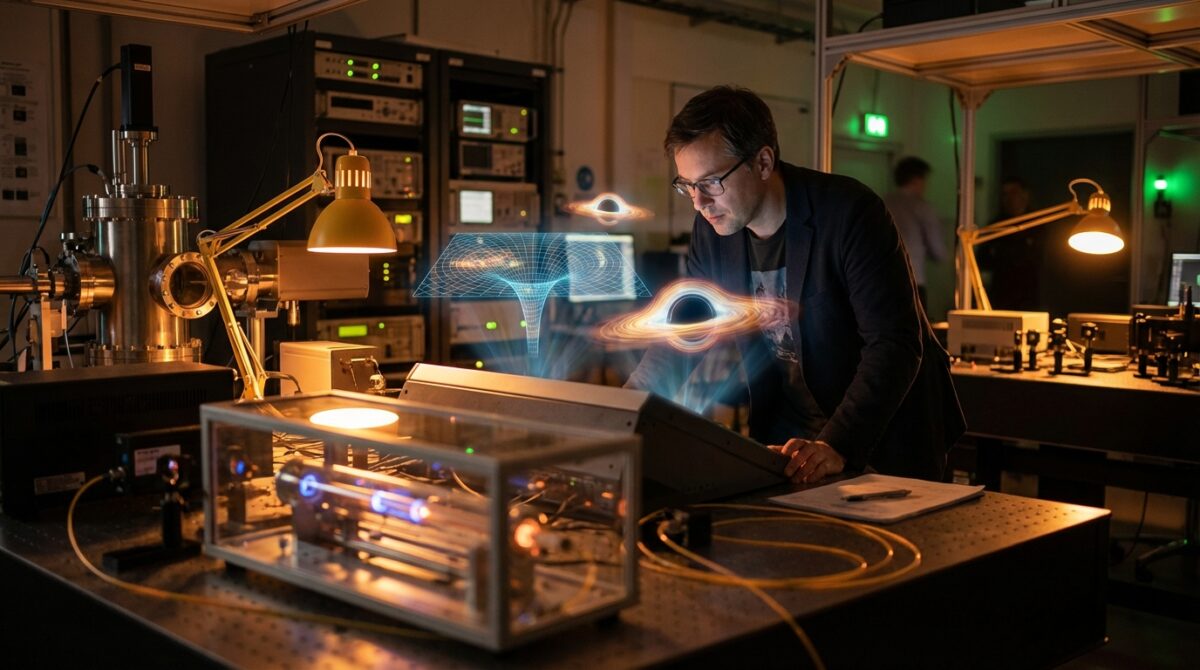
In the early 1980s, physicists Don Page and William Wootters proposed that the universe, viewed as a whole, might be completely timeless. They imagined everything – particles, fields, galaxies – encoded in a single giant quantum wave function, static and complete. No ticking, no flowing, just a frozen mathematical object.
To rescue the experience of change, they sliced this wave function into two parts. One part plays the role of “the world” – all the stuff we observe. The other part acts as an internal clock. Crucially, these two halves are quantum-entangled, meaning their properties are tightly correlated. Through that entanglement, observers inside the universe perceive sequences of events, even though the global state does not evolve. Time, in this picture, is a relational illusion arising from quantum linkage, not a fundamental stage on which reality unfolds.
From philosophical speculation to experimental demonstration
For decades, the Page–Wootters mechanism stayed in the realm of philosophy of physics: elegant, provocative and experimentally out of reach. That is starting to change. Advances in quantum technologies – especially ultra-precise atomic clocks – now offer ways to probe whether this relational view of time matches what laboratory systems actually do.
Recent theoretical work has modelled tiny magnets entangled with a quantum “spring”. To an outside observer, the combined system sits in a fixed energy state, apparently static. Yet relative to the internal clock built from those magnets, the spring appears to oscillate, producing a sequence that looks like ordinary dynamics. Even more striking, the usual equations of motion in physics emerge from this setup. That turns a once abstract hypothesis into a candidate for concrete demonstration.
How quantum clocks rewrite our perception of time
To investigate whether time is emergent, teams working on quantum devices first needed to redefine what a clock really is. Historically, humanity has used everything from sundials to incense mazes to track change. Modern metrology labs now push atomic clocks to such accuracy that they would lose less than a second over the age of the universe.
Physicists studying minimal clocks made of just a few atoms uncovered a striking trade-off. The more precise and frequent the ticks, the more entropy – a measure of disorder and irreversibility – the clock produces as heat. A clock, even a microscopic one, behaves less like a passive dial and more like a tiny thermal engine. This links timekeeping directly to thermodynamics and supports ideas explored in work such as logical challenges to our understanding of reality.
Black holes as cosmic clocks and the role of consciousness
As experiments sharpen, theorists are also asking what could serve as the ultimate Page–Wootters clock within the cosmos. Some argue that black holes fit the bill. They isolate themselves behind an event horizon, yet still exchange quantum information with the outside via Hawking radiation. That combination – seclusion plus subtle entanglement – resembles the requirements for an almost ideal internal timekeeper.
If black holes function as such clocks, their radiation should carry a thermodynamic “signature” of timekeeping. Researchers are now analysing how entropy and correlations spread in theoretical black hole models to see whether their behaviour mirrors that of engineered quantum clocks. The same mathematics used to safeguard satellite navigation or plan deep-space missions for agencies like JAXA and commercial players such as SpaceX could, unexpectedly, reveal how the universe itself tracks change.
Why the illusion of time matters on Earth
Ideas about time being an illusion can feel remote from daily life, yet they already shape technologies people rely on. Relativistic corrections to time are wired into every GPS chip, and quantum clock research feeds into secure communications, financial trading synchronisation and climate-monitoring satellites that survey Earth’s shifting atmosphere.
There is also a psychological angle. Studies that explore how consciousness stitches sensory data into a narrative of “now” echo physics arguments that sequence may be constructed rather than absolute. Articles like time may be an illusion show how these scientific debates ripple into mental health, decision-making and even how people manage anxiety about the future, complementing broader work on expert anxiety strategies.
From cosmic hypothesis to practical questions of reality
To make this grand hypothesis testable, researchers now treat clocks – from tabletop quantum devices to hypothetical black hole timers – as physical systems obeying the same limits. They ask how much entropy each tick requires, whether “ticks” occur in continuous flows or discrete jumps, and how measurements disturb the very timelines they define.
One emerging idea is that the arrow of time might simply trace the record of measurements made in the universe. Each interaction collapses fuzzy quantum possibilities into definite outcomes, leaving a trail of irreversible facts. In that sense, observers do not just read time; they help create it. Asking “what time is it?” adds another indelible mark to the cosmic ledger.
- Relativity ties time to gravity and motion, reshaping clocks in orbit.
- Quantum mechanics treats time as an external parameter, not a direct observable.
- Entanglement can generate a perceived sequence from a timeless global state.
- Entropy links every tick of a clock to microscopic irreversibility.
- Measurement may turn potential futures into a single experienced past.
Is time really an illusion according to physics?
Some modern physics frameworks suggest that time is not a basic ingredient of the universe. In models such as the Page–Wootters mechanism, the global quantum state is timeless and what people experience as the flow of time emerges from entanglement and relations between subsystems, rather than from an external cosmic clock.
How could scientists demonstrate that time is emergent?
Researchers design experiments with quantum clocks and entangled systems where the combined state is static, yet one part behaves as a clock for the other. If standard equations of motion arise purely from these internal relations, it strengthens the case that time is emergent. Future observations of black hole thermodynamics could offer further tests.
What role does entropy play in the flow of time?
Entropy measures how many microscopic configurations match a macroscopic state. When entropy rises, processes become effectively irreversible. Studies of minimal clocks show that every precise tick produces entropy, tying the direction of time people sense to the thermodynamic arrow defined by increasing disorder.
Does this research change daily life on Earth?
Stanford Researchers Develop Shape-Shifting Material Mimicking Octopus Color and Texture Changes
Groundbreaking Fiber Optic Breakthrough Enables Simultaneous Streaming of 50 Million Movies
Even if time is emergent, clocks must still be synchronised and satellites still need relativistic corrections. However, understanding time more deeply leads to better atomic clocks, improved navigation, stronger encryption and more accurate Earth-observation data, which feed into weather forecasts, climate models and energy planning in future cities.
How is our perception of time connected to consciousness?
Neuroscience shows that the brain collects signals over small intervals and stitches them into a continuous now. This constructed sense of sequence mirrors physical models where time arises from correlations rather than from an absolute flow, hinting that consciousness and cosmology might be describing different layers of the same underlying reality.