

Show summary Hide summary
- Near self-replicating RNA and the origin of life
- How a 45-nucleotide strand copies life’s instructions
- From RNA world to modern genetics and space missions
- Key takeaways on self-replicating RNA and early life
- What makes QT45 different from previous self-replicating RNA systems?
- Does QT45 prove how life began on Earth?
- Why are cold, icy environments important for RNA replication?
- How does this research connect to genetics and modern biotechnology?
- Could similar RNA-based life exist elsewhere in the Solar System?
Imagine a strand of RNA, just 45 building blocks long, sitting in icy water and quietly assembling copies of itself. This is not science fiction but the latest milestone in molecular biology, and it may bring us closer than ever to watching the origin of life unfold in a lab.
This near self-replicating RNA, named QT45, does not ride on a rocket or orbit Earth, yet it speaks directly to questions that guide missions at NASA and ESA: how early life could first emerge on a planet, and what signs to seek on Mars, Europa or Enceladus. Understanding how a simple strand of nucleic acids begins to copy information may reshape how astrobiologists design instruments, choose landing sites and interpret data from icy worlds across the Solar System.
Near self-replicating RNA and the origin of life
The work behind QT45 comes from the MRC Laboratory of Molecular Biology in Cambridge, UK, where researchers have chased a deceptively simple question: can RNA, under realistic prebiotic conditions, make copies of itself?
Scientists Unveil Hidden Geometry Steering Electrons with Gravity-Like Force
Top Must-Read Popular Science Books Released in February 2026
According to the long-debated RNA world idea, life began not with DNA and proteins but with RNA molecules that both stored information and catalysed reactions. Studies such as recent RNA replication experiments have steadily pushed this concept forward, yet a compact RNA that almost fully replicates itself had remained elusive.
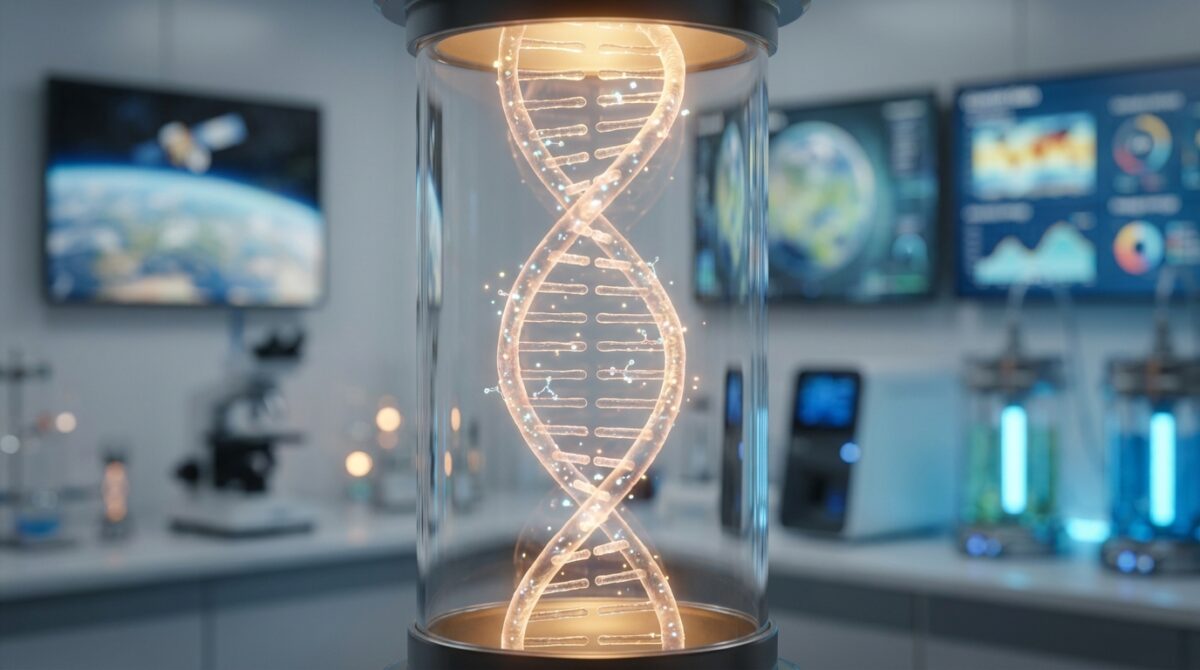
QT45: a tiny strand with big implications
To find QT45, the team generated around a trillion random RNA sequences, each just 20 to 40 nucleotides long. From this cosmic lottery of molecules, three promising candidates emerged, capable of linking together short nucleotide fragments.
Those three were fused and repeatedly mutated, then selected for better performance, a laboratory echo of evolution. The result, QT45, is only 45 nucleotides long yet can use a single-stranded RNA template to build a complementary strand from small “words” of two or three nucleotides.
How a 45-nucleotide strand copies life’s instructions
In slightly alkaline water, cooled to just above freezing, QT45 starts to behave like a primitive copying machine. It lines up short RNA fragments on a template and stitches them together, even producing a sequence complementary to its own.
Once that complementary strand exists, QT45 can work in reverse, using it as a template to rebuild its original sequence. These two steps – making the complement and then reconstructing itself – form the core reactions required for true self-replication, though they have not yet run seamlessly together in one continuous cycle.
Why cold, icy conditions matter for early life
The environment that favours QT45 looks surprisingly like certain regions of Earth – or even other worlds – today. Slightly alkaline, near-freezing water stabilises RNA, slows destructive reactions and concentrates molecules in thin films of liquid between ice crystals.
Researchers picture something akin to modern Iceland: frozen surfaces punctured by warm hydrothermal pockets, where freeze–thaw cycles and pH gradients would drive biochemistry forward. Such conditions mirror targets explored by NASA’s Europa Clipper and missions proposed by ESA to icy moons, turning a benchtop experiment into a guidebook for planetary exploration.
From RNA world to modern genetics and space missions
QT45 does more than support the RNA world hypothesis; it refines it. Previous work suggested that truly autonomous replicators would need to be large and complex, yet those turned out to be difficult to unfold and copy. A smaller strand like QT45 bypasses that problem and suggests that early life may have started from far simpler systems than expected.
Studies discussed in sources such as experimental self-replicating RNA systems and detailed reviews in modern genetics journals show a convergence: multiple teams now approach lifelike replication from different angles. QT45 joins this growing network of evidence that chemistry alone can cross the bridge into Darwinian behaviour.
Why this matters back on Earth
Unravelling how simple RNA systems evolve and optimise themselves speaks directly to genetics and biotechnology. If a short RNA can adapt and improve performance through error-prone copying, then similar principles can be harnessed to design evolving diagnostic tools, smart therapeutics or adaptive biosensors.
Such concepts already influence Earth observation and climate science, where autonomous sensor networks learn and adjust. At a molecular scale, QT45 shows how self-improving chemistry might one day power bioengineered systems that monitor pollution, optimise crops or even safeguard closed habitats on long-duration space missions.
Key takeaways on self-replicating RNA and early life
Bringing together this result with current astrobiology and laboratory research helps clarify what QT45 really tells us. A few points stand out for readers following the search for life, whether in ancient rocks or under distant ice.
- Size matters: a 45-nucleotide strand challenges the idea that only large, complex RNAs can drive replication.
- Environment shapes chemistry: near-freezing, alkaline conditions stabilise fragile nucleic acids and help replication proceed.
- Evolution starts early: even simple RNA systems can generate variation and select more efficient sequences.
- Space relevance: icy worlds targeted by agencies like NASA and ESA may host similar chemistry, informing mission design.
- Earth applications: insights from QT45 guide new tools in biochemistry, biosensing and synthetic biology.
Each of these lessons feeds directly into how scientists frame the next generation of lab experiments and space missions, tying a tiny cold strand of RNA to big questions about life across the cosmos.
What makes QT45 different from previous self-replicating RNA systems?
QT45 stands out because it is unusually short, only 45 nucleotides long, yet it can perform both key steps of replication: building a complementary strand and then reconstructing its own sequence from that complement. Earlier systems often relied on larger, more complex RNAs or external enzymes, whereas QT45 shows that a compact molecule can manage much of the replication process on its own under icy, alkaline conditions.
Does QT45 prove how life began on Earth?
QT45 does not prove a single, definitive pathway for the origin of life, but it demonstrates that realistic RNA molecules can approach self-replication without proteins or DNA. This strengthens scenarios where early life relied on RNA-based chemistry. It narrows the gap between simple prebiotic reactions and true Darwinian evolution, offering a concrete model to test alongside other hypotheses, such as droplet-based or mineral-surface origins.
Why are cold, icy environments important for RNA replication?
Cold, icy environments slow down destructive reactions and stabilise RNA, which is more fragile than DNA. Thin liquid layers between ice crystals can concentrate molecules, while freeze–thaw cycles and pH gradients help drive bond formation. These conditions appear ideal for systems like QT45, and they resemble settings found in polar regions on Earth and on icy moons, making them prime targets for astrobiology.
How does this research connect to genetics and modern biotechnology?
Nobel Laureate Omar Yaghi Unveils Groundbreaking Invention Poised to Transform the World
Middle Age Emerges as a Critical Turning Point in the U.S.
QT45 illustrates how simple RNA systems can copy information and evolve, echoing basic genetic principles in a stripped-down form. Understanding these mechanisms helps engineers design synthetic RNA circuits, evolving biosensors or diagnostic tools that adapt to new targets. Lessons from QT45 inform how to control mutation, selection and replication in engineered systems for medicine, agriculture and environmental monitoring.
Could similar RNA-based life exist elsewhere in the Solar System?
If icy, alkaline environments favour RNA chemistry, then worlds such as Mars, Europa and Enceladus become compelling places to look for related processes. While QT45 itself evolved in a human laboratory, it shows that simple RNA replicators are plausible under conditions that may exist beyond Earth. Future missions equipped with sensitive instruments for detecting complex organic molecules will use this kind of work to shape their search strategies and interpret potential biosignatures.