
Show summary Hide summary
- Magnetic avalanche: What we now know about solar flares
- Inside the “magnetic avalanche” that powers solar eruptions
- Raining plasma blobs and high-speed particles in space weather
- What this means for coronal mass ejection and storm forecasts
- Limits of the study and next steps in solar observation
- Connecting research to your daily technology
- What is meant by a magnetic avalanche on the Sun?
- How did Solar Orbiter observe this solar flare in such detail?
- Does this study mean we can now predict major solar storms?
- Why are plasma blobs and coronal rain important for space weather?
- Which institutions were involved in this magnetic avalanche research?
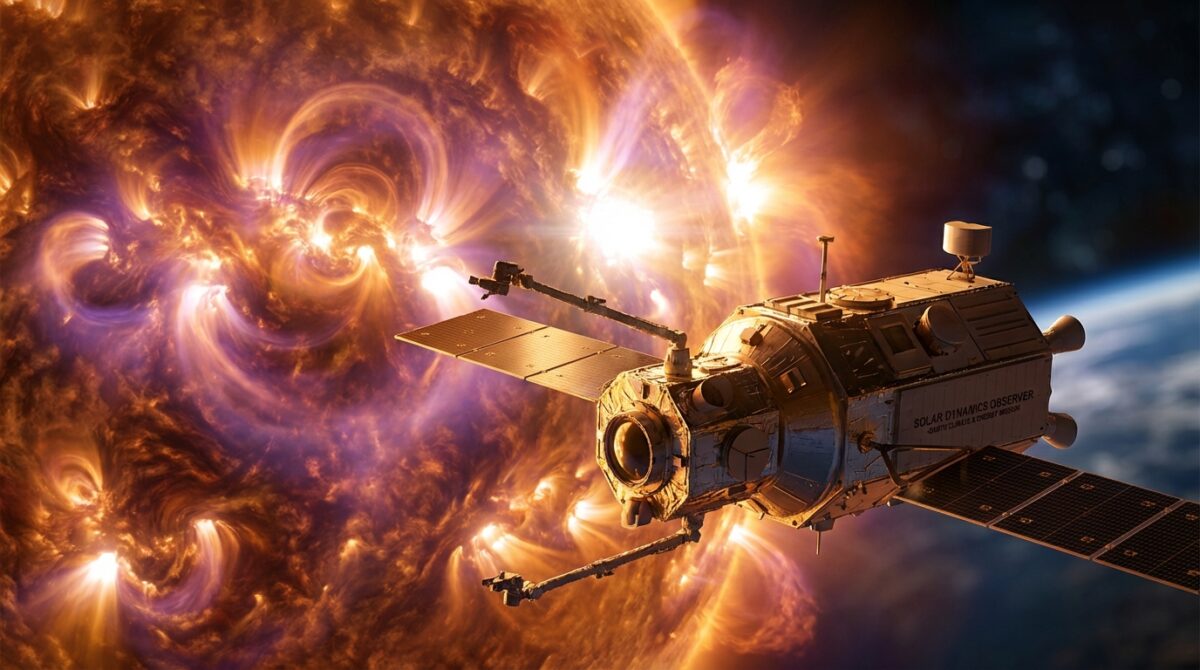
A solar flare is not a single giant blast but a cascading “magnetic avalanche” made of many smaller eruptions firing in rapid sequence. That is what a European spacecraft has now seen directly, changing how researchers think about the Sun’s most violent solar eruptions and their impact on Earth.
The finding comes from the ESA–NASA Solar Orbiter mission, which captured one of the most detailed views ever of a large flare on 30 September 2024. A study led by Pradeep Chitta at the Max Planck Institute for Solar System Research, published in Astronomy & Astrophysics, shows how tiny disturbances in the Sun’s magnetic fields can snowball into a major flare linked to intense space weather.
Magnetic avalanche: What we now know about solar flares
According to the new analysis, the “central engine” of the flare behaved like a magnetic avalanche. Small, local reconnection events in the corona triggered neighbouring regions, spreading in space and time until a full-scale flare erupted.
Researchers Unveil the Two-Decade Enigma of Gold’s Nuclear Origins
Ancient 400-Million-Year-Old Fish Fossils Unveil the Origins of Terrestrial Life
This supports earlier theoretical work and recent reports such as studies on cascading magnetic events, but here the chain reaction is directly tracked in real observations. For readers concerned about space weather, this means large solar flares may sometimes be predictable from subtle precursors, if spacecraft instruments can see them in time.
One spacecraft, four instruments, and a rare opportunity
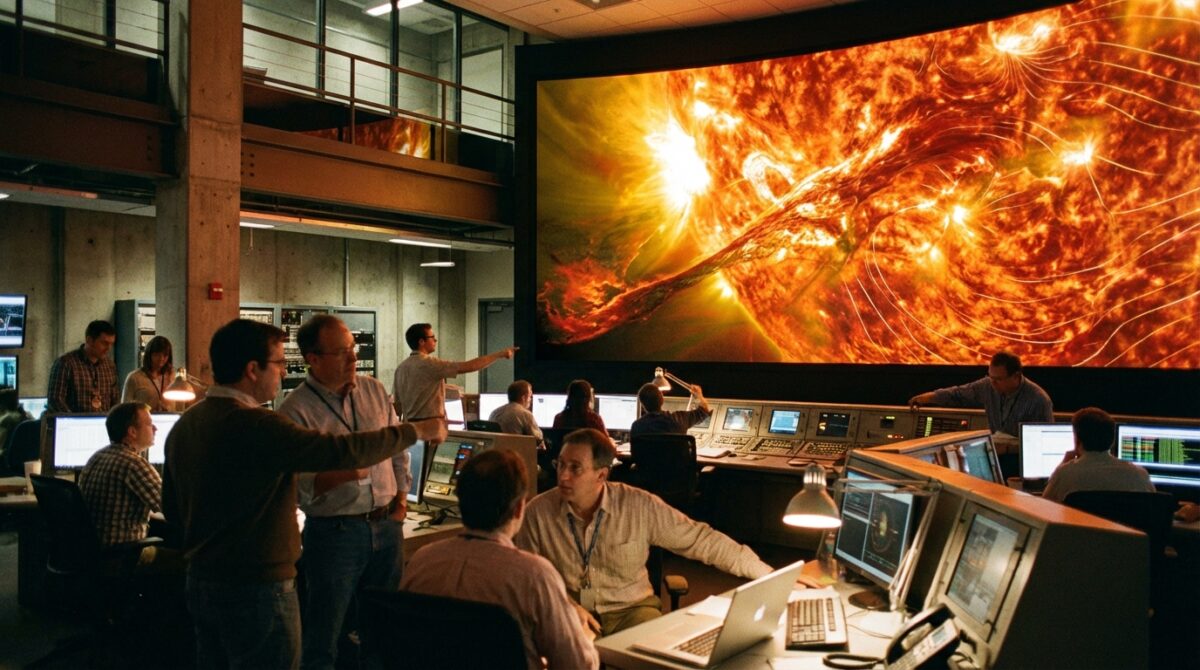
To build this new picture, the team relied on four coordinated instruments on Solar Orbiter. In one sentence, the methodology is this: multiple telescopes observed the same active region from the photosphere up to the corona, with high spatial and temporal resolution, before, during and after the flare.
The Extreme Ultraviolet Imager (EUI) recorded the corona every two seconds, resolving structures only a few hundred kilometres across. At the same time, SPICE, STIX and PHI mapped temperature, particle acceleration and surface magnetic fields. Together, they followed about 40 minutes of flare build-up, something rarely achieved due to limited data storage and observing windows on a deep-space spacecraft.
Inside the “magnetic avalanche” that powers solar eruptions
When EUI first looked at the active region at 23:06 UT, it saw a dark, arch-like filament of dense plasma suspended by twisted magnetic fields. Beneath it, a cross-shaped pattern gradually brightened, revealing where energy was building up.
Almost every EUI frame showed new fine strands of plasma, confined by magnetic tension and twisting like ropes under strain. These microstructures appeared roughly every two seconds or faster, indicating intense, local restructuring. Step by step, the region moved towards instability, until magnetic reconnection began to spread like toppling dominoes.
From local reconnection to full solar flare
Around 23:29 UT, the team observed a sharper brightening, signalling a surge of energy release. Shortly after, one side of the filament snapped and shot outward, unrolling violently as it did so. Bright points along its length marked sites of reconnection, captured with unusually fine spatial and temporal detail.
The main solar flare peaked near 23:47 UT, but the event did not behave as a single explosion. Instead, the paper describes a hierarchy of nested reconnection events, each feeding into the next. This directly supports the magnetic avalanche scenario, where many small triggers shape a large eruption.
Raining plasma blobs and high-speed particles in space weather
While EUI traced the geometry, SPICE and STIX examined the energy flow. High-energy X-rays measured by STIX revealed where accelerated particles were colliding with dense plasma, while SPICE tracked temperature and composition changes in the upper atmosphere.
During the flare, X-ray output rose sharply, with particles accelerated up to about 40–50% of the speed of light (roughly 431–540 million km/h). These numbers are broadly consistent with values found in earlier work on magnetic explosions in the corona, underlining how such processes can threaten satellites and astronauts.
The strange “rain” after solar eruptions
One striking feature was a pattern of “raining plasma blobs”. Ribbon-like structures fell rapidly through the corona, already visible before the flare’s peak and continuing afterwards. These falling streams trace where energy is being deposited as reconnected magnetic loops cool and contract.
According to the authors, this is the first time such plasma rain has been seen with this combination of spatial and temporal detail in a major flare. For a space-weather forecaster like the fictional analyst Maya Ortega, such signatures could eventually serve as clues about ongoing energy release, even after a primary coronal mass ejection has already left the Sun.
What this means for coronal mass ejection and storm forecasts
The flare observed by Solar Orbiter is one example of a process that can also drive coronal mass ejection events, which hurl billions of tonnes of plasma into space. Recent episodes, such as an X-class flare and fast CME racing toward Earth, or the storms that triggered strong aurora watches, show how disruptive these events can be for power grids and aviation.
The new “avalanche” view suggests that monitoring small-scale magnetic activity might help anticipate whether an active region is primed for a large flare or solar eruptions. However, the study does not yet demonstrate a causal forecast rule; it identifies a plausible mechanism and a set of observable precursors.
- Before the flare: growing bright cross-shaped region, frequent small reconnection events, twisting filament.
- During the rise: rapid X-ray increase, filament destabilisation, expanding ribbons and plasma blobs.
- After the peak: continued plasma rain, cooling loops, gradual return of particle fluxes to background.
For engineers managing satellite fleets or airlines planning polar routes, such a sequence could, in future, feed into risk models for communications blackouts and increased radiation exposure.
Limits of the study and next steps in solar observation
The authors emphasise that this is a detailed case study of a single M7.7 flare, not a statistical survey of all solar activity. While the event supports the avalanche paradigm, other flares may follow different patterns, and the sample size is still small compared with the diversity of active regions on the Sun.
Moreover, the spacecraft’s X-ray imaging is not yet fine enough to fully resolve every reconnection site. The paper in Astronomy & Astrophysics calls for future missions with higher-resolution X-ray telescopes to disentangle overlapping processes and verify how universal the avalanche behaviour really is.
Connecting research to your daily technology
Events like the strongest flare of 2025 from sunspot AR4274, or intense storms described in recent reports on solar flare explosions, underline why understanding these processes matters. Even if you never look at a space-weather forecast, your navigation apps, flights, and power supply depend on robust modelling of the Sun.
The Solar Orbiter result moves that modelling one step closer to the physical reality of the corona. It links subtle changes in magnetic fields to dramatic outcomes, without overstating predictive power. For now, the message is clear: behind every major flare lies a complex cascade of smaller events, and the better those are resolved, the more reliable future alerts may become.
What is meant by a magnetic avalanche on the Sun?
A magnetic avalanche describes a chain reaction in the Sun’s magnetic field where many small reconnection events trigger one another. Instead of a flare being a single uniform blast, numerous local energy releases cascade through the corona, building up to a large solar flare and sometimes a related coronal mass ejection.
How did Solar Orbiter observe this solar flare in such detail?
Solar Orbiter used four coordinated instruments to watch the same active region from different layers of the Sun. EUI imaged the corona every two seconds, SPICE measured spectral signatures, STIX tracked high-energy X-rays from accelerated particles, and PHI mapped surface magnetic fields. Together, they followed roughly 40 minutes of flare build-up, peak, and aftermath.
Does this study mean we can now predict major solar storms?
The research improves understanding of how large flares develop, highlighting observable precursors, but it does not yet provide a reliable prediction tool. It shows correlation between small-scale magnetic activity and a later flare, but more events and higher-resolution data are needed before robust operational forecasts can be based on this mechanism.
Why are plasma blobs and coronal rain important for space weather?
Researchers Unveil Microscopic Plant Mechanism Poised to Boost Crop Production Dramatically
How a Peruvian Peak is Turning into a Groundbreaking Particle Detection Frontier
The falling plasma blobs, often called coronal rain, trace where magnetic loops are releasing and redistributing energy. Their motion and brightness reveal how long energy deposition continues after a flare’s peak. This helps scientists estimate ongoing particle acceleration and heating, which influence radiation levels relevant to satellites and astronauts.
Which institutions were involved in this magnetic avalanche research?
The study was led by researchers at the Max Planck Institute for Solar System Research in Göttingen, using the ESA–NASA Solar Orbiter mission. EUI is led by the Royal Observatory of Belgium, PHI by the Max Planck Institute, SPICE by the Institut d’Astrophysique Spatiale in France, and STIX by FHNW in Switzerland. The results were published in the journal Astronomy & Astrophysics.