Show summary Hide summary
- Einstein tested by the loudest black hole collision
- How GW250114 lets scientists “hear” Einstein’s equations
- Inside the detectors: lasers, budgets and Earth-based benefits
- Future missions and the next cracks in relativity
- From ground observatories to space-based detectors
- What exactly did GW250114 confirm about Einstein’s Theory of Relativity?
- How do LIGO and Virgo detect Gravitational Waves?
- Why are black hole collisions important for Astrophysics and Cosmology?
- Can future detections ever disprove General Relativity?
- What practical technologies came from gravitational wave research?
The universe just rang like a struck cosmic bell, and this time, humanity heard every nuance. A new Gravitational Wave Detection, the loudest black hole collision ever recorded, has once again confirmed Einstein and his Theory of Relativity with a clarity that feels almost unsettling.
Behind this neat confirmation lies a story of extreme violence in deep space, cutting-edge lasers on Earth, and a question that goes straight to how reality itself bends and vibrates.
Einstein tested by the loudest black hole collision
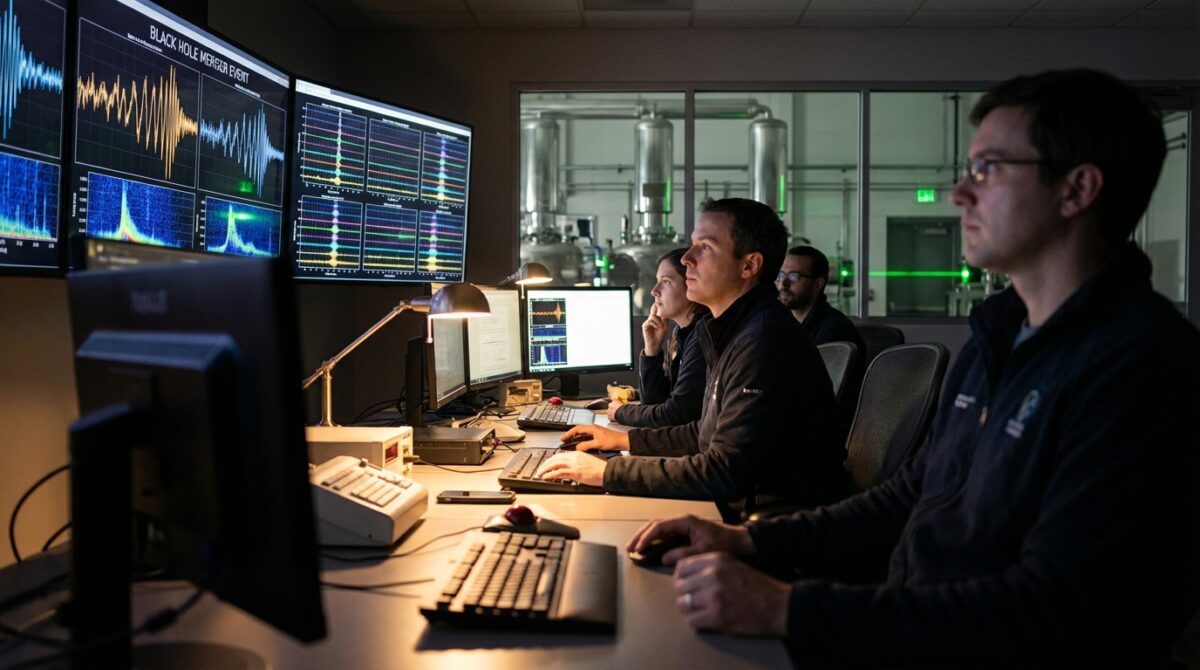
In 2025, the global network of gravitational wave observatories picked up a signal so sharp that researchers instantly knew it would mark a turning point. The event, named GW250114, came from a pair of massive black holes spiralling together before fusing into a single, heavier monster somewhere billions of light-years away.
Revealing the ancient secrets of the Greenland shark
Discovery of New Fossils Could Resolve the Enigma of Sail-Backed Spinosaurs
The detection relied on the upgraded LIGO observatories in the United States and the Virgo instrument in Italy, soon cross-checked with Japan’s KAGRA detector. These facilities use laser interferometers capable of sensing changes in distance smaller than a proton’s width as Space-Time itself stretches and compresses when Gravitational Waves pass through Earth.
From Hawking’s horizon to General Relativity
Researchers first used GW250114 to revisit Stephen Hawking’s famous theorem about black hole horizons. By reconstructing the masses before and after the merger, they confirmed with near-total confidence that the final event horizon was not smaller than the combined area of the original black holes, in line with Hawking’s prediction.
That success set the stage for a deeper challenge: could this single, thunderous event also probe General Relativity itself, pushing Astrophysics and Cosmology beyond previous limits and testing whether gravity behaves exactly as Physics textbooks claim under the most extreme conditions known?
How GW250114 lets scientists “hear” Einstein’s equations
Einstein’s Theory of Relativity predicts a very specific choreography when two black holes collide. They first orbit each other faster and faster, then merge in a flash of gravitational energy, before the new black hole settles, vibrating at precise frequencies. This final phase, called the ringdown, is the equivalent of a bell’s fading tone after a strike.
Until GW250114, those ringdown notes were buried in noise. The new signal was so “loud” that researchers, including a team led by Keefe Mitman at Cornell University, could finally isolate several of these modes. By running large-scale numerical simulations of LIGO-style systems solving Einstein’s equations, they predicted how strong each ringdown frequency should be and then compared them to the actual data.
Matching the cosmic bell with theory
When the team overlaid the measured frequencies with the simulated ones, the agreement came out strikingly tight. The amplitudes and tones of the ringdown matched the expectations of General Relativity within about ten percent, limited mostly by detector sensitivity rather than theoretical uncertainty.
This overlap means that, even under the wild conditions of a black hole collision releasing more energy in a fraction of a second than all the stars in a galaxy emit in the same instant, Einstein’s description of Space-Time still holds. Gravity, at least so far, refuses to reveal any cracks.
Inside the detectors: lasers, budgets and Earth-based benefits
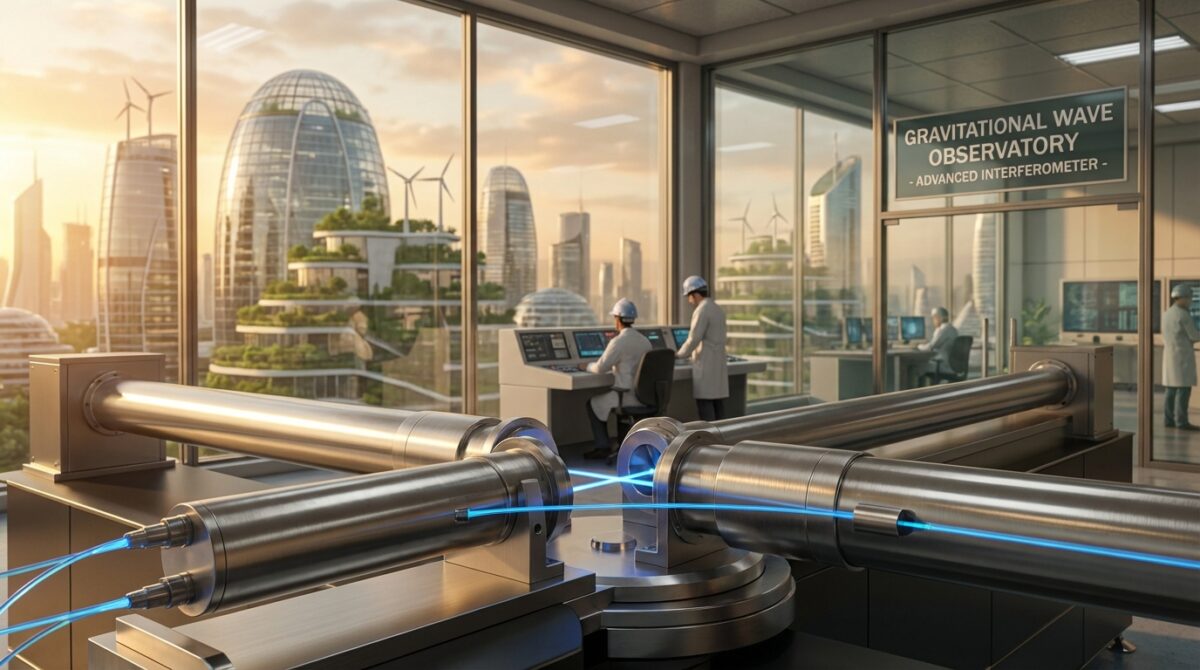
The instruments that captured GW250114 rely on astonishing engineering. LIGO and Virgo each send laser beams down vacuum tunnels several kilometers long, then recombine them to spot distortions caused by passing Gravitational Waves. The technology sits at the edge of what is currently possible in precision measurement and noise reduction.
Since the first detection in 2016, funding from agencies like NASA, the US National Science Foundation and the European Space Agency has poured into upgrades. The combined global investment across LIGO, Virgo and KAGRA now runs into several billions of dollars, spread over decades, but the spin-offs in optics, vibration control and data science are already finding uses far from astrophysics.
What Earth gains from listening to black holes
Techniques created for Wave Detection now improve seismic monitoring, advanced medical imaging and ultra-stable timing systems used in navigation and communications. Companies designing future quantum sensors study LIGO’s methods to push their own instruments to similar levels of sensitivity.
For a climate researcher or an engineer designing new satellites, the same kind of noise filtering used to extract faint gravitational signals helps clean up messy environmental and Earth-observation data. The tools built to “hear” the universe also sharpen humanity’s vision of its own planet.
- High-precision lasers inspire better optical communications and lidar mapping.
- Vibration isolation feeds into earthquake early-warning systems and delicate manufacturing.
- Big-data algorithms developed for Astrophysics now process satellite streams and healthcare records.
- International collaboration across LIGO, Virgo and KAGRA guides future global science infrastructure.
Future missions and the next cracks in relativity
GW250114 does not close the case on General Relativity; it sharpens the tools for the next interrogation. The current analysis still allows for deviations of up to about ten percent from Einstein’s predictions, largely because even this record-breaking event remains faint by the time it reaches Earth.
As detector sensitivity improves and more observatories join the network, the error bars will shrink. Either the measurements will continue to cling to Einstein’s curves, or they will start to drift, hinting at new physics that might tie gravity to quantum mechanics and reshape modern Cosmology.
From ground observatories to space-based detectors
The next decade will see a new player: space-based missions such as ESA’s planned LISA, developed in partnership with NASA. Instead of four-kilometer arms on Earth, LISA will fly three spacecraft in a triangle millions of kilometers across, measuring slow, deep Gravitational Waves from supermassive black holes.
Together, ground-based facilities like LIGO and space missions will turn the universe into a full-frequency observatory for gravity. Each new detection, from stellar mergers to ancient signals from the early universe, will ask the same core question: does Einstein still describe reality perfectly, or is there another layer of Physics waiting to be uncovered?
What exactly did GW250114 confirm about Einstein’s Theory of Relativity?
GW250114 allowed scientists to measure the ringdown vibrations of a newly formed black hole after a merger. The frequencies and amplitudes of these vibrations matched predictions from Einstein’s General Relativity, within current measurement limits. This shows that space-time behaves as the theory expects under extremely strong gravitational fields.
How do LIGO and Virgo detect Gravitational Waves?
LIGO and Virgo use laser interferometers. Lasers travel along long vacuum tunnels, reflect off mirrors and recombine. When a Gravitational Wave passes, it slightly changes the distance between the mirrors, altering the interference pattern of the lasers. Ultra-sensitive instruments record these tiny changes, revealing signals from distant cosmic events.
Why are black hole collisions important for Astrophysics and Cosmology?
Black hole mergers generate some of the strongest gravitational fields in the universe. Studying them tests gravity in extreme regimes, helps measure black hole populations across cosmic history and refines models of galaxy evolution. These events also provide a new way to map the universe beyond traditional light-based astronomy.
Can future detections ever disprove General Relativity?
Yes. If future Gravitational Waves show consistent, statistically significant deviations from Einstein’s predictions, physicists would need to extend or revise General Relativity. Researchers are actively looking for such discrepancies, which could point toward a theory that unifies gravity with quantum physics.
What practical technologies came from gravitational wave research?
Explore Five Breathtaking Shots in Photography Awards
Nobel Laureate Announces Quantum Computer Breakthrough
Work on gravitational wave detectors has advanced high-power lasers, vibration isolation systems, ultra-stable optics and big-data analysis techniques. These now benefit areas like precision manufacturing, earthquake monitoring, medical imaging, satellite navigation and secure communications, connecting frontier Physics research to everyday applications on Earth.