
Show summary Hide summary
- A hidden distinction that changes the dinosaur–mammal comparison
- Young dinosaurs living like different species
- Mesozoic ecosystems were denser than we thought
- A checklist to visualize these ecological differences
- Why does this comparison between dinosaurs and mammals change ecological models?
- What does the term functional species mean in this context?
- Do mammals also show this partition of niches by age?
- What role does Mesozoic plant productivity play in these results?
- Do these ideas change our understanding of the extinction of the dinosaurs?
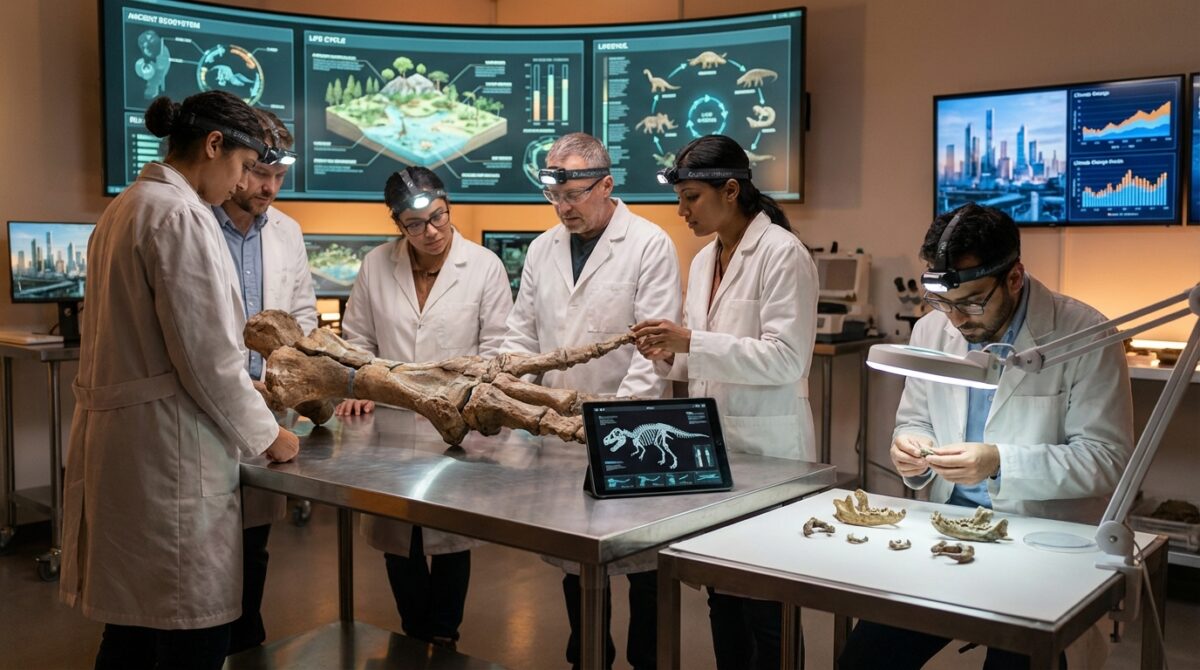
Imagine a baby Brachiosaurus no taller than a golden retriever, foraging nervously in the ferns while predators lurk, and its 40-foot parents graze far away, barely paying attention. That tiny scene sums up a difference that upends our comparison between dinosaurs and mammals.
For Thomas R. Holtz Jr., a specialist in paleontology, this emotional distance between parents and offspring is no mere behavioral detail. It changes the way ecosystems worked in the Mesozoic, and forces us to rethink all we thought we knew about the comparative evolution of dominant terrestrial animals.
A hidden distinction that changes the dinosaur–mammal comparison
For decades comparing dinosaurs and mammals, scientists contrasted them by focusing on size, morphology, or the speed of adaptation. Holtz offers a different angle: the way of giving birth and raising young. In classic models, dinosaurs play the role of the mammals of the Mesozoic, occupying the top of food chains, while the earliest mammals remain small and discreet.
Scientists uncover microbe rewriting a core genetic code principle
Scientists Discover Ancient Genes Older Than Life
But new research on fossils shows a different landscape. Studies conducted at Oxford on competition between groups of ancient mammals, described for instance in a study on mammals in the age of dinosaurs, had already shaken the idea that dinosaurs held mammals back. Holtz adds another layer: the crucial distinction lies in parental strategies.
Helicopter moms versus prehistoric “latchkey kids”
In most mammals, the young stay attached to their mother for a long time. A nearly adult tiger cub still depends on the tigress for hunting. A young elephant, already massive at birth, follows its mother for years. You recognize the pattern in humans: feeding, protection, learning—everything is managed by adults until maturity.
The result: parents and offspring share habitat, prey, and risks. For the ecologist reconstructing a fossil landscape, a mammal family often forms a single functional unit. This view is supported by ecological radiation studies, like those on Jurassic mammaliaforms, where several species specialize but remain similar in how they live.
Young dinosaurs living like different species
Dinosaurs, for their part, lay eggs and bet on laying many at once. Some briefly guard the nest, but the young become independent very quickly. Fossils show “pods” of juveniles—whole groups of animals of the same age with no adult present, a bit like bands of teenagers fending for themselves in a gigantic park.
Holtz compares this model to that of modern crocodiles. Adults defend the nest and then quickly let their young disperse. These youngsters take years to reach adult size, changing diet, hiding spots, and predators along the way. Each growth stage occupies a different role in the ecosystem, almost like successive “species stages” for the same animal.
Brachiosaurus: one dinosaur, four ecological lives
Think again of our miniature Brachiosaurus. At the size of a sheep, it can’t reach leaves ten meters up. It eats low plants, avoids mid-sized predators, and stays in sheltered areas. A few years later, once it’s horse-sized, its diet has already changed and it moves in different areas.
As an adult, this giant sweeps the treetops, impervious to the predators that threatened it as a juvenile. For Holtz, each stage creates a distinct ecological niche. On paper, a single dinosaur thus counts as several “functional species,” which greatly boosts the diversity of a fossil dinosaur assemblage compared to an equivalent group of modern mammals.
Mesozoic ecosystems were denser than we thought
How could these ancient worlds support so many different “roles”? The first factor comes from climate. Higher temperatures and a thicker atmospheric CO₂ content probably boosted plant productivity. Denser plant cover means more energy to feed herbivores, then carnivores. Holtz sums it up by saying our present world is almost “underfed” by comparison.
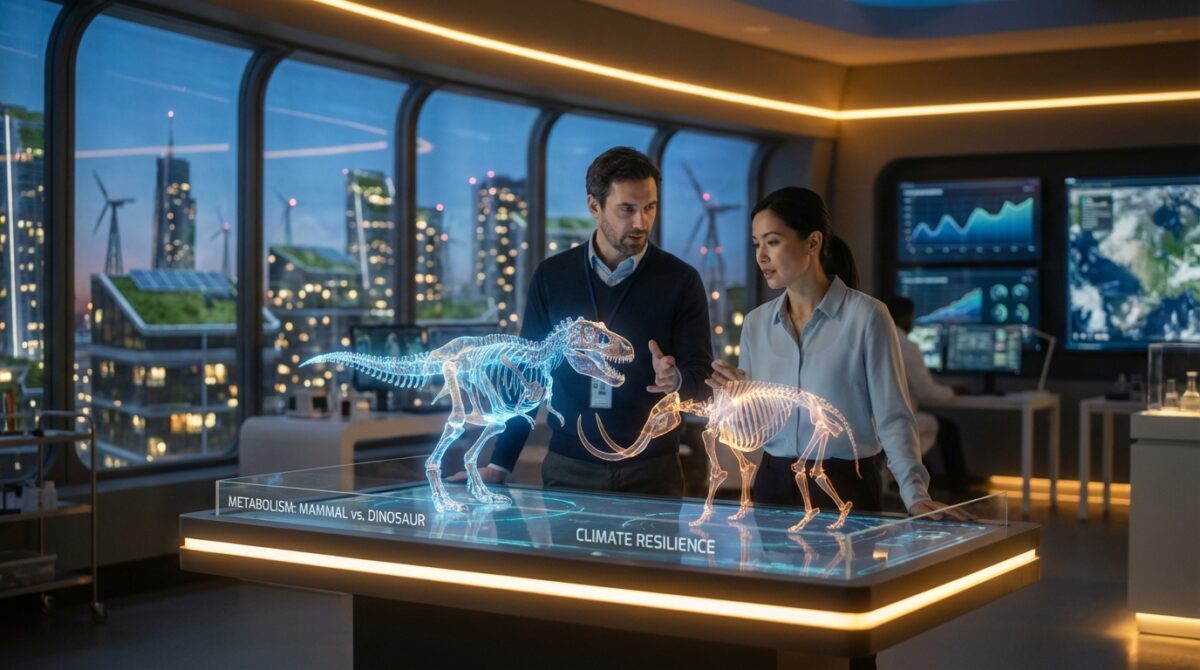
Second suggested factor: dinosaurs may have had a less demanding metabolism than mammals of the same size. If a giant animal consumes less per kilo than a giant mammal would, the ecosystem can support more individuals and more “life forms.” Recent syntheses on dinosaur-mammal interactions, like this work on evolutionary competition, further support the idea of a differently structured, not poorer, past.
A checklist to visualize these ecological differences
For Lucas, a master’s geo-sciences student writing a thesis on the Cretaceous extinction, Holtz suggests a simple tool. He asks Lucas to list, for a typical large dinosaur and for a large modern mammal, the ecological roles by age:
- Type of food (low plants, high foliage, specific prey).
- Predators and threats at each growth stage.
- Areas frequented (dense forest, edge, open plain).
- Impact on the environment (trampling, seed dispersal, biomass consumption).
- Parental strategy (long-term protection or rapid independence).
Filling in these categories for a Brachiosaurus and then for an elephant, Lucas finds the dinosaur “checks” far more boxes. So, functional diversity is as much hidden in the life history of individuals as in the number of observed species, reshuffling the deck of our usual comparisons between lost worlds and today’s biodiversity.
Why does this comparison between dinosaurs and mammals change ecological models?
Because it shows that young dinosaurs occupied very different niches from adults. By counting these life stages as separate ecological units, dinosaur communities appear denser and more complex than previously thought, which alters our estimates of past diversity and productivity.
What does the term functional species mean in this context?
A functional species means a group of individuals that play the same ecological role, regardless of their exact biological identity. A juvenile dinosaur and an adult are one biological species, but they may form two functional species if their diet, predators, and impact on the environment differ greatly.
Do mammals also show this partition of niches by age?
Yes, but much more limited. Since mammals protect and feed their young for a long time, the young usually share the same habitat and resources as their parents. Differences in niche between ages do exist (for example in some ungulates), but are less pronounced than in many dinosaurs.
What role does Mesozoic plant productivity play in these results?
The epic return of epicyon: prehistoric america’s fearsome bone-crushing predator
How the Rethinking Economics Movement Is Transforming Education
Higher levels of CO₂ and a warmer climate probably increased plant biomass. This surplus of available energy could support more herbivores of varied sizes, and therefore more associated predators. This richer base makes it plausible for many functional species to coexist in the same landscape.
Do these ideas change our understanding of the extinction of the dinosaurs?
They don’t directly explain the extinction, but refine the context. Understanding how each life stage depended on precise ecological conditions helps assess which phases were most vulnerable to rapid changes, whether climate, volcanic, or asteroid-related.