Show summary Hide summary
- Ancient vertebrate ancestors and the four‑eye hypothesis
- How scientists read vision in half‑billion‑year‑old fossils
- Why four ancient eyes matter for life on Earth today
- Reframing our place in vertebrate evolution
- Did early vertebrate ancestors definitely have four eyes?
- How are these ancient eyes connected to the human pineal gland?
- What makes the Chengjiang fossils so important for evolution biology?
- How do scientists detect eyes in fossils this old?
- Why should people outside palaeontology care about four-eyed ancestors?
Imagine discovering that your distant vertebrate ancestors did not just watch the world with two eyes, but with four eyes peering through Cambrian seas. That is the unsettling and exciting possibility scientists now debate, using fossils so detailed they preserve individual pigment grains.
This fresh look at ancient vision does more than rewrite an anatomy diagram. It connects your modern sleep cycle, your brain’s wiring and the deep history of the vertebrate head into a single evolutionary storyline.
Ancient vertebrate ancestors and the four‑eye hypothesis
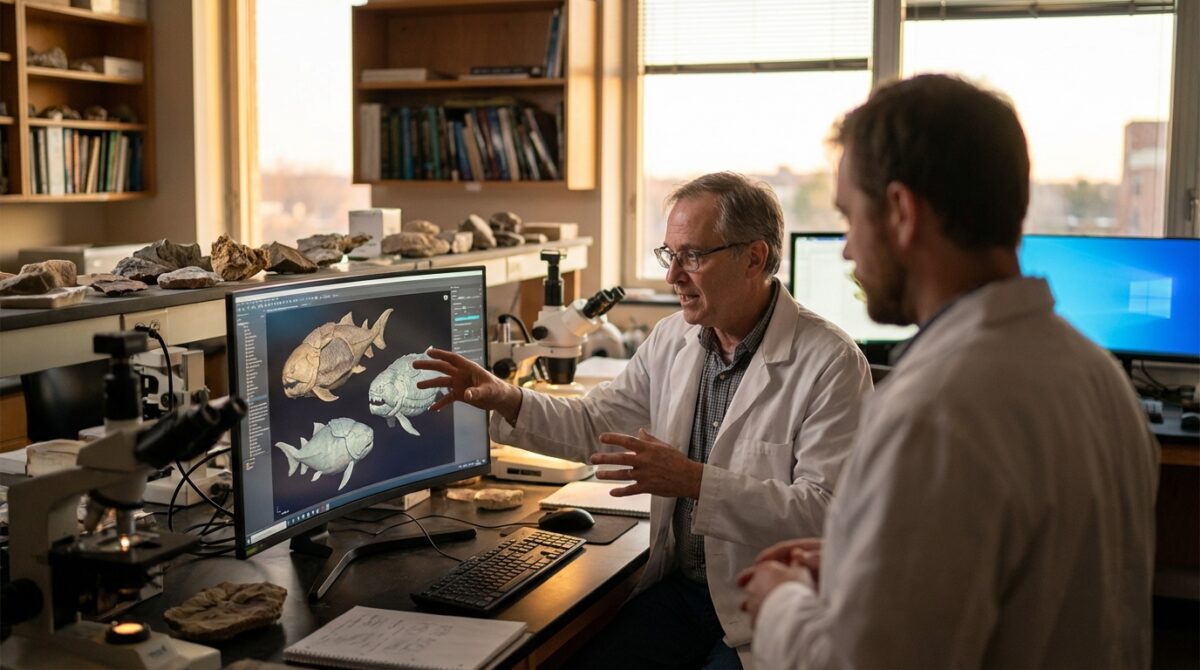
Between 2019 and 2024, a team led by Peiyun Cong at Yunnan University uncovered exquisite fossils of tiny jawless fish called myllokunmingids near Dianchi Lake in south‑west China. These animals, part of the famous Chengjiang biota, lived around 518 million years ago during the Cambrian explosion, when most major animal groups first appeared. Their preservation is so fine that soft tissues, including eyes and pigment structures, can be examined in microscopic detail.
Researchers Unveil the Two-Decade Enigma of Gold’s Nuclear Origins
Ancient 400-Million-Year-Old Fish Fossils Unveil the Origins of Terrestrial Life
When scientists explored these fossils with electron microscopes, they saw a familiar pair of camera‑type eyes on the sides of the head, but also two smaller dark spots between them. Both sets contained melanin‑bearing structures, suggesting functional visual organs rather than random stains. According to an analysis discussed by New Scientist, this points to early vertebrate ancestors potentially having a second, smaller pair of eyes on the top of the head.
From four eyes to the pineal complex in modern biology
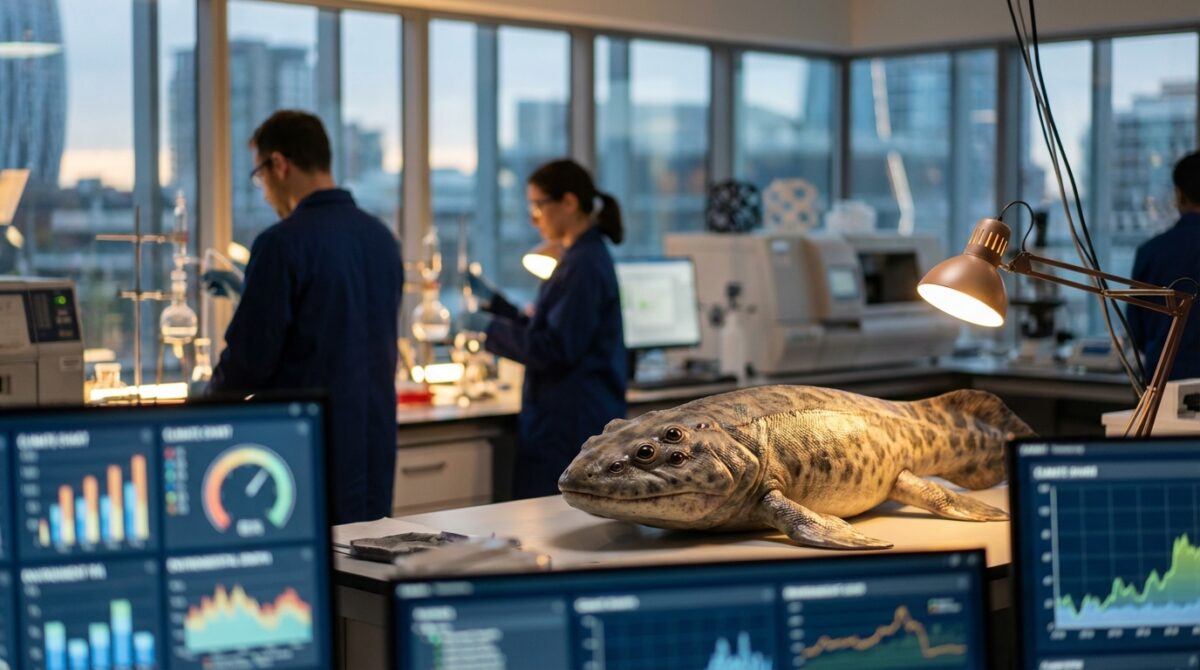
The proposed interpretation links those extra organs to the modern pineal complex, the group of structures that in mammals includes the pineal gland deep inside the brain. In many reptiles, a light‑sensitive “parietal eye” still sits on top of the skull. According to work on the evolution of vertebrate sensory organs, such as studies highlighted in research on vertebrate eye evolution, these tissues likely share a common origin. The new fossils suggest that what is now a hormone‑secreting organ once behaved much more like a true eye.
Researchers argue that early vertebrates may have used the larger lateral eyes for high‑resolution forward and side vision, while the smaller dorsal pair monitored approaching objects and overall brightness. In Cambrian seas full of predators, that combination could mean the difference between survival and becoming someone else’s meal. The idea builds on decades of effort to reconstruct the first vertebrates, as described in works such as fossil clues about the first vertebrates, but adds an unexpected layer: more eyes than modern vertebrates usually possess.
How scientists read vision in half‑billion‑year‑old fossils
Turning dark smudges in rock into a story about evolution and vision demands technology and caution. Cong’s team used scanning electron microscopy to resolve melanosomes, the tiny pigment bodies that also influence human eye colour. Their arrangement in both lateral and central spots resembled that in camera‑type eyes rather than diffuse patches. Impressions consistent with fossilised lenses added another line of evidence, indicating image‑forming organs rather than simple light sensors.
Other specialists are intrigued but cautious. Some, including researchers featured in a recent Nature commentary, question whether the central structures might instead represent other tissues, or even artefacts formed during fossilisation. Critics also ask a developmental question: if there are four well‑developed eyes, where is the preserved nose, which plays a major role in early vertebrate head organisation? Such doubts ensure that every pixel‑like granule of pigment and every contour in the rock is being re‑examined.
Where this fits in the long story of vertebrate eyes
The four‑eye proposal sits within a much broader body of work tracing how vertebrate eyes emerged from simple light patches. Detailed syntheses, such as those available on the evolution of the eye, describe stages from flat photoreceptive fields to deep camera‑type organs with lenses and retinas. Studies on hagfish and lampreys, reported by outlets like the New York Academy of Sciences, show that even modern jawless vertebrates preserve ancestral eye designs that bridge gaps in this sequence.
The Chengjiang material could anchor this timeline with direct fossil evidence rather than only comparative anatomy. By matching soft‑tissue structures to modern gene networks involved in opsin proteins and retina development, researchers can test whether these ancient organs fit the same blueprint discussed in works like studies on vertebrate sensory evolution. The more converging lines of data, the stronger the case becomes that four‑eyed vertebrate ancestors were not a fantasy but a genuine stage in our lineage.
Why four ancient eyes matter for life on Earth today
At first glance, the possibility of extra eyes in small Cambrian fish seems distant from modern concerns. Yet this research sits at the crossroads of biology, neuroscience and even medicine. The transformation of a true visual organ into the pineal gland links ancient seafloor ecosystems to the regulation of human sleep via melatonin. Understanding how that shift occurred could influence how chronobiology tackles jet lag, shift work and light pollution.
The methodological advances also have wider impact. The same imaging tools used to study these fossils now support ecological monitoring and biomedical imaging. Projects described in resources such as studies on fossil soft tissues show that high‑resolution pigment detection helps reconstruct ancient climates and animal behaviours, informing models of how life responds to environmental stress. That knowledge feeds directly into present‑day resilience planning on a warming planet.
Reframing our place in vertebrate evolution
A fictional graduate student, Lina, holding a Chengjiang slab in a Yunnan lab, may feel she is simply cataloguing another fossil fish. Yet the rock in her hands links her own brain and eyes to a 518‑million‑year‑old experiment in sensory design. Through work synthesized in classic reviews such as analyses of early vertebrate origins and in historical perspectives like The Life of the First Vertebrates, she can place those four hypothetical eyes in a continuum leading to dinosaurs, birds and humans.
Key takeaways from this research resonate far beyond palaeontology. They show that:
- Sensory systems are flexible, capable of shifting from image formation to hormone control.
- Complex traits leave physical traces that can be read after half a billion years.
- Our own anatomy carries ancient echoes, from the pineal gland to the structure of the vertebrate skull.
Each new fossil eye, real or reinterpreted, refines how your species fits into the vast, shared story of vertebrate evolution.
Did early vertebrate ancestors definitely have four eyes?
Current evidence from Cambrian myllokunmingid fossils suggests two pairs of camera-type eyes, but the interpretation is still debated. Some researchers see strong support in preserved lenses and melanosomes, while others argue the central structures might represent different tissues or fossilisation artefacts. The idea is plausible and testable, but not yet universally accepted.
How are these ancient eyes connected to the human pineal gland?
Scientists propose that the smaller dorsal eyes in early vertebrates gradually transformed into the pineal complex. In reptiles, this survives as a parietal eye on top of the head, while in mammals it became the pineal gland, a deep-brain organ that secretes melatonin and helps regulate sleep-wake cycles instead of forming images.
What makes the Chengjiang fossils so important for evolution biology?
The Chengjiang biota preserves soft tissues such as eyes, nerves and internal organs in exceptional detail, dating back about 518 million years. This allows researchers to test evolutionary hypotheses about the first vertebrates, rather than inferring everything from bones alone. Such fossils link anatomical features to early stages in our lineage with unusual clarity.
How do scientists detect eyes in fossils this old?
Researchers use tools like scanning electron microscopy to study pigment bodies called melanosomes and to identify lens-like structures. The shape, density and arrangement of these features can distinguish true visual organs from random stains. Comparisons with modern vertebrate eyes help confirm whether fossil structures likely contributed to vision.
Why should people outside palaeontology care about four-eyed ancestors?
Researchers Unveil Microscopic Plant Mechanism Poised to Boost Crop Production Dramatically
How a Peruvian Peak is Turning into a Groundbreaking Particle Detection Frontier
The research illuminates how complex organs evolve, reshape their functions and persist as small structures in our own bodies. Insights from these fossils inform neuroscience, chronobiology and imaging technologies. They also deepen our understanding of how life adapts to changing environments, offering perspective for navigating today’s planetary challenges.