
Show summary Hide summary
- Ancient Roman mosaic in Britain rewrites Trojan War story
- How researchers decoded this 1,700 years old Trojan War puzzle
- Detailed results: what the Ketton mosaic reveals about Roman Britain
- Implications, limits and the ongoing historical mystery
- Correlation, not simple causation: what remains uncertain
- Where exactly was the Trojan War mosaic found in Britain?
- How old is the Ancient Roman mosaic depicting the Trojan War?
- Why do researchers think the mosaic follows Aeschylus and not Homer?
- What does this discovery tell us about Roman Britain?
- Can the public visit the Rutland Trojan War mosaic site?
What if a quiet English field held a missing chapter of the Trojan War? That is what researchers now argue after decoding an Ancient Roman mosaic in rural Britain, revealing a forgotten version of Achilles and Hector’s story that had slipped from written history.
This discovery reshapes what we know about cultural life in late Roman Britain. It suggests landowners in the provinces followed sophisticated Greek theatre, not just popular Homeric tales, and that local artists plugged into visual trends circulating around the Mediterranean for centuries.
Ancient Roman mosaic in Britain rewrites Trojan War story
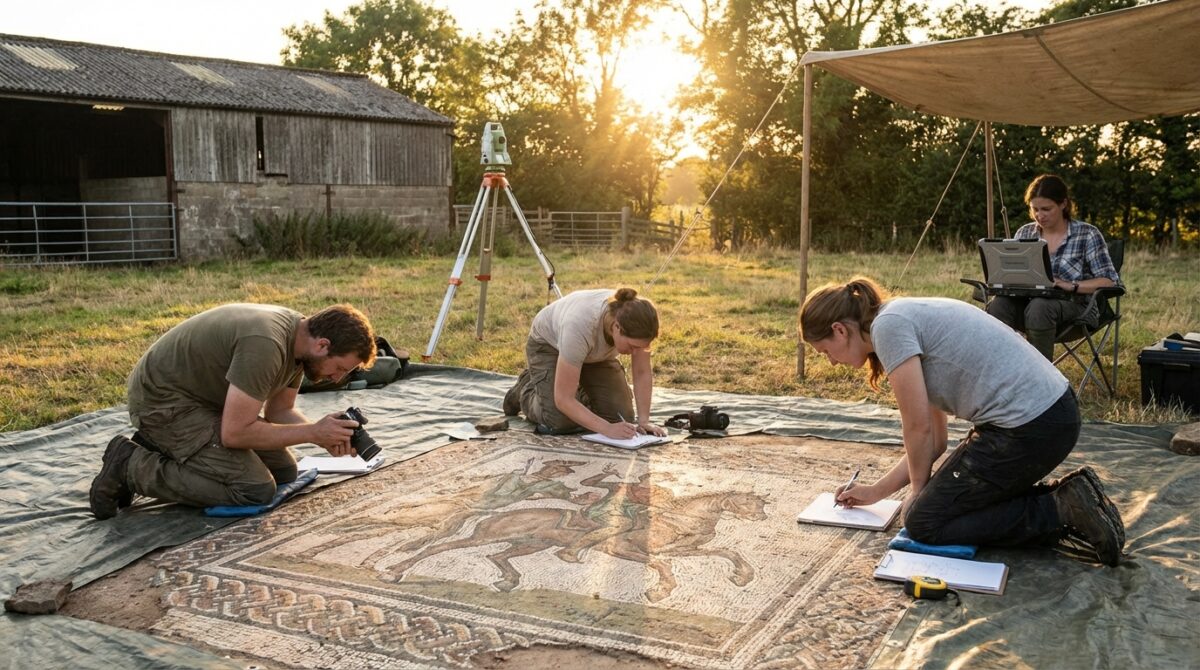
The mosaic, unearthed during COVID-19 lockdown on a farm in Rutland, is now known as the Ketton mosaic. Excavations by University of Leicester Archaeological Services, funded by Historic England, revealed a lavish villa floor around 1,700 years old, later granted Scheduled Monument status for its national significance.
Near Self-Replicating RNA Strand Could Unlock Mysteries of Life’s Origins
Scientists Unveil Hidden Geometry Steering Electrons with Gravity-Like Force
Researchers from the University of Leicester have now published their analysis in a peer‑reviewed study highlighted by outlets such as recent science news coverage. Led by ancient historian Dr Jane Masséglia, the team argues that the scenes do not follow Homer’s Iliad, as first assumed, but line up instead with a lost tragedy by Aeschylus called Phrygians.
What we now know about the scenes of Achilles and Hector
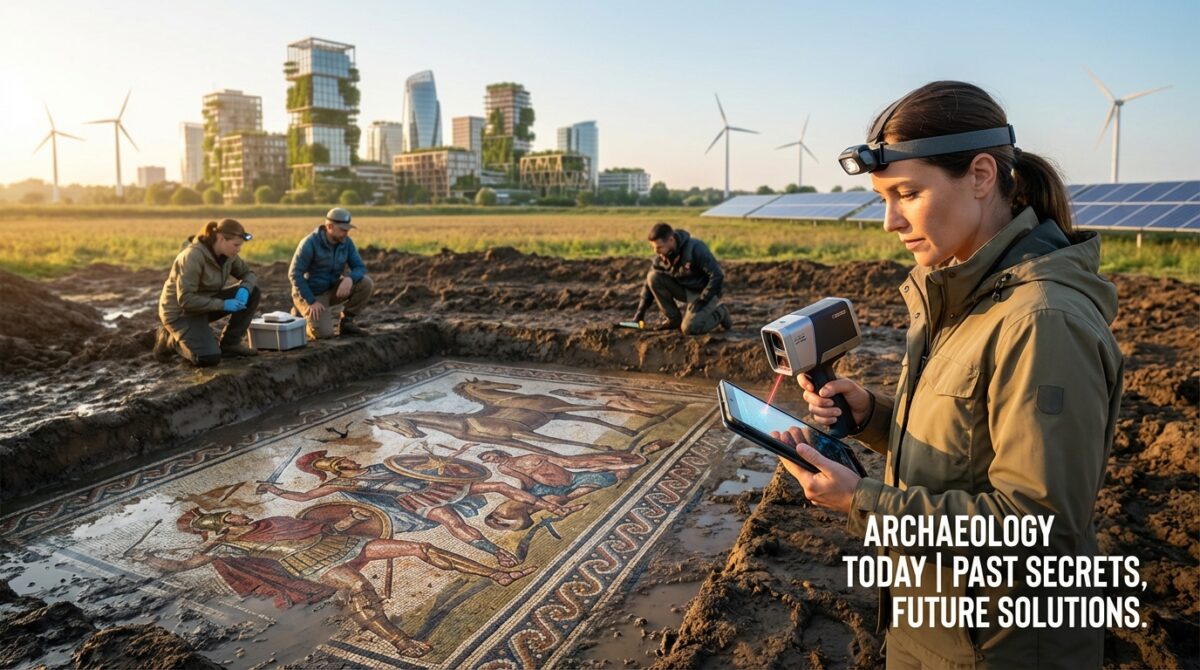
The mosaic unfolds like a graphic novel in stone. Three panels show: the duel between Achilles and Hector, Achilles dragging Hector’s body behind his chariot, and King Priam ransoming his son’s corpse, weighed against gold. These episodes sound familiar, yet key visual details match Aeschylus’ rarer version instead of Homer’s more famous sequence.
This matters because Aeschylus’ play survives only in fragments. By comparing the imagery to known descriptions of Phrygians, the Leicester team suggests the mosaic acts almost like a visual script, preserving choices about posture, props and emotional focus that differ from Homeric tradition.
How researchers decoded this 1,700 years old Trojan War puzzle
Methodologically, the study is straightforward but powerful: experts carried out a scene‑by‑scene iconographic comparison between the Ancient art in Rutland and long‑known motifs from Greek vases, silverware, coins and other Roman Empire mosaics. Rather than relying on one visual echo, they mapped repeated pattern matches across the whole floor.
Once one panel was linked to a specific Greek pot design dating back to the era of Aeschylus, around eight centuries earlier, other sections fell into place. Standard motifs — the way a chariot is turned, the posture of a grieving king, the arrangement of armour — showed near‑formulaic borrowing from older Mediterranean models.
Tracing design “DNA” across the Mediterranean
Dr Masséglia and colleagues highlight several artistic “genealogies”. The top panel borrows a composition from a Greek vase of the Classical period. Other decorative bands mirror patterns visible on luxury silver dishes from Asia Minor and coin designs from Gaul, revealing a shared catalogue of images circulating for generations.
This suggests Romano‑British artisans did not simply improvise heroic scenes. They likely worked from pattern books or workshop traditions that travelled via traders, soldiers and migrants. The mosaic becomes evidence of a visual network linking Archaeology sites in Greece, Türkiye, France and Britain through repeated artistic templates.
Detailed results: what the Ketton mosaic reveals about Roman Britain
Several key findings emerge from this research. First, the mosaic’s narrative sequence fits Aeschylus’ focus on Trojan suffering and negotiation, more than Homer’s emphasis on Greek heroism. Priam’s gesture and the weighing of Hector’s body against gold visually foreground the tragedy of the Trojan side, echoing what little survives of Phrygians.
Second, the choice of subject hints at the identity and aspirations of the villa’s owner. Commissioning an Aeschylean version of the Trojan War would signal knowledge of higher Greek drama rather than just popular epic. Scholars cautiously propose that the patron belonged to a Romanised elite keen to display cultural sophistication on a par with Mediterranean peers.
A cosmopolitan corner of late Roman Empire Britain
Voices from the project underline this cosmopolitan picture. Landowner Jim Irvine, who first spotted the mosaic in 2020 while walking the family fields, described the research as proof that provincial Britain was far more connected than the stereotype of a remote backwater.
Historic England specialists agree that the evidence points to a nuanced social world. The mixing of local workmanship and imported visual ideas hints at craftsmen who might never leave Britain, yet regularly handled patterns born in Athens, Pergamon or Marseille.
- Story choice: a rare Aeschylean Trojan narrative, not the mainstream Homeric one.
- Artistic sources: repeated borrowing from centuries‑old Greek and Anatolian designs.
- Cultural signal: an owner advertising education and status through complex myth.
- Network insight: patterns showing long‑distance artistic exchange across the empire.
- Archaeological value: a visual witness to a partially lost Greek tragedy.
Implications, limits and the ongoing historical mystery
The implications stretch beyond a single villa floor. For cultural historians, the Ketton mosaic strengthens arguments that late Roman Empire provinces could sustain refined tastes, even as political authority weakened. For theatre scholars, it offers rare visual hints about Aeschylus’ lost plays, helping reconstruct staging choices and emotional emphases.
For readers far from Rutland, the case shows how Unearthed objects can still shift modern narratives. A farmer’s lockdown walk ended up revising how experts map the flow of Greek myths into Latin‑speaking communities at the edge of the empire. The find also sits alongside other coverage, such as analyses on Roman mosaics in Britain telling lost Trojan stories, creating a growing comparative archive.
Correlation, not simple causation: what remains uncertain
The study remains careful about its claims. Iconographic similarity supports a strong correlation between the Rutland images and Aeschylus’ Phrygians, yet it cannot prove direct reading or performance of that exact play at the villa. The patron may have known the story through summaries, retellings or visual copybooks, rather than via a written script.
Dating is based on standard archaeological methods — pottery typology, construction phases, and comparison with similar mosaics — rather than inscriptions naming the owner or the mosaicist. Without explicit texts, researchers infer social status and cultural leanings from indirect clues like layout, imports and stylistic choices.
Another limit lies in sample size. This is a single, albeit spectacular, Mosaic. It hints Roman Britain could be cosmopolitan, but does not prove that all villas were. Future finds may nuance or even challenge this picture, which is why ongoing excavations and comparative databases across Europe remain so important.
Despite these caveats, the Ketton floor adds a powerful new piece to the Historical mystery of how Greek tragedy travelled. Each tessera carries both local and long‑distance stories: a British farm, a Greek stage, a Roman patron, an artisan’s handbook. Taken together, they show how Ancient Roman art in Britain stitched provincial lives into a wider Mediterranean conversation that continues to fascinate researchers today.
Where exactly was the Trojan War mosaic found in Britain?
The mosaic was discovered on a private farm in Rutland, in the English East Midlands. The site, now known as the Ketton villa, came to light in 2020 when the landowner noticed patterned stone fragments during the COVID-19 lockdown, triggering a full archaeological investigation.
How old is the Ancient Roman mosaic depicting the Trojan War?
Based on pottery, building phases and stylistic comparisons with other Roman sites, archaeologists date the Rutland mosaic to around the 3rd to 4th century CE. That makes it roughly 1,700 years old, created in the later centuries of the Roman Empire in Britain.
Why do researchers think the mosaic follows Aeschylus and not Homer?
Key visual details in the scenes of Achilles, Hector and King Priam match descriptions of Aeschylus’ lost tragedy Phrygians more closely than Homer’s Iliad. The emphasis on Trojan suffering and ransom, plus specific artistic compositions borrowed from Classical Greek art, point toward the Aeschylean version.
What does this discovery tell us about Roman Britain?
Top Must-Read Popular Science Books Released in February 2026
Nobel Laureate Omar Yaghi Unveils Groundbreaking Invention Poised to Transform the World
The Ketton mosaic suggests parts of Roman Britain were culturally plugged into wider Mediterranean networks. Local elites appear to have valued sophisticated Greek drama, while artisans reused long‑travelled design patterns, indicating a surprisingly cosmopolitan environment at the empire’s north‑western edge.
Can the public visit the Rutland Trojan War mosaic site?
Because the villa lies on private land and has Scheduled Monument protection, access is controlled to preserve the remains. Portions of the mosaic have been lifted for conservation and research, and updates about any public displays or exhibitions are typically shared by Historic England and the University of Leicester.