Show summary Hide summary
- Ancient giant kangaroos and what we now know
- Inside the bones: metatarsals, heels and tendons
- Short bursts of hopping, not marathon bouncing
- What this means for evolution, fossils and modern science
- Key insights, limitations and what remains unknown
- How heavy were the ancient giant kangaroos studied?
- Did giant kangaroos hop all the time like modern species?
- What evidence supports the idea that they could hop?
- Where did these prehistoric kangaroos live in Australia?
- What does this tell us about marsupial evolution?
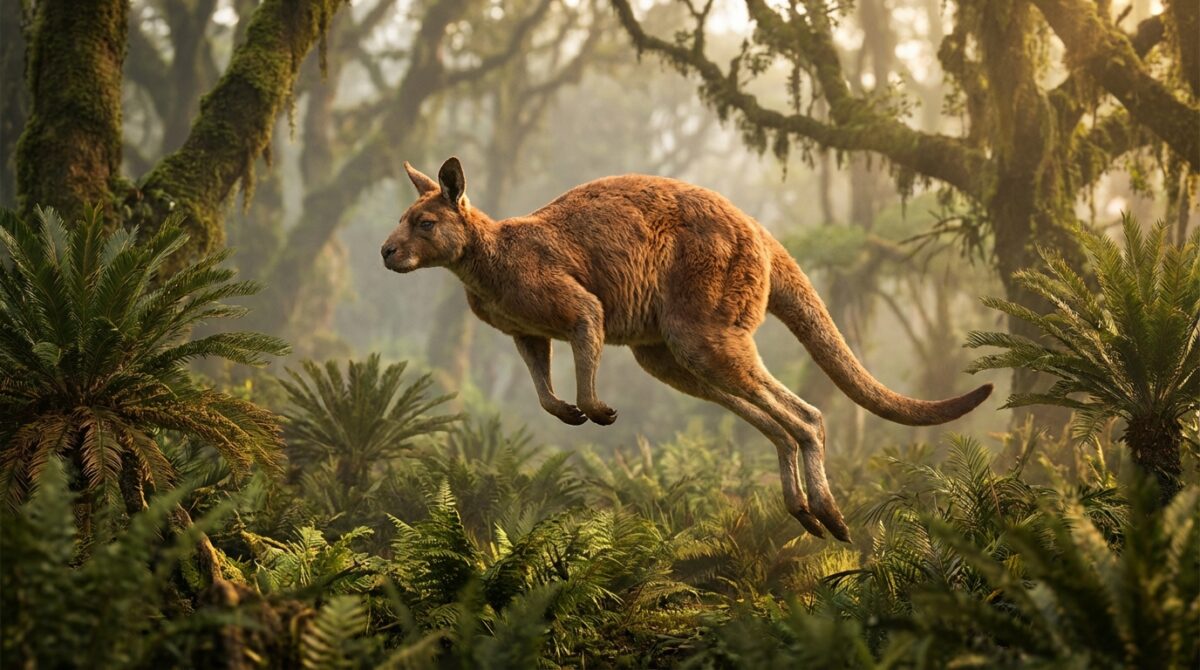
What if the heaviest kangaroos ever to roam Australia could still launch themselves into sudden, powerful hops? New fossil analysis suggests that these ancient giant kangaroos, weighing up to 250 kilograms, were not the lumbering walkers many scientists once imagined.
This new picture of Ice Age prehistoric marsupials does more than adjust a museum label. It reshapes how you can think about evolution, predator–prey dynamics, and the limits of animal locomotion under extreme body mass.
Ancient giant kangaroos and what we now know
According to a study in Scientific Reports, led by palaeontologist Megan Jones from the University of Manchester with colleagues from the University of Bristol and the University of Melbourne, even the largest known fossil kangaroos had hindlimbs strong enough for hopping in short bursts. Earlier work had argued that individuals heavier than about 160 kilograms would snap their ankle bones if they tried.
Ancient 400-Million-Year-Old Fish Fossils Unveil the Origins of Terrestrial Life
Researchers Unveil Microscopic Plant Mechanism Poised to Boost Crop Production Dramatically
The new findings, also summarised in outlets such as ConnectScience Australia and ScienceDaily, indicate that these massive animals were not confined to a walking gait. Instead, they may have switched between walking and occasional hopping, especially when escaping predators or crossing rough ground.
How scientists tested giant kangaroo hopping capacity
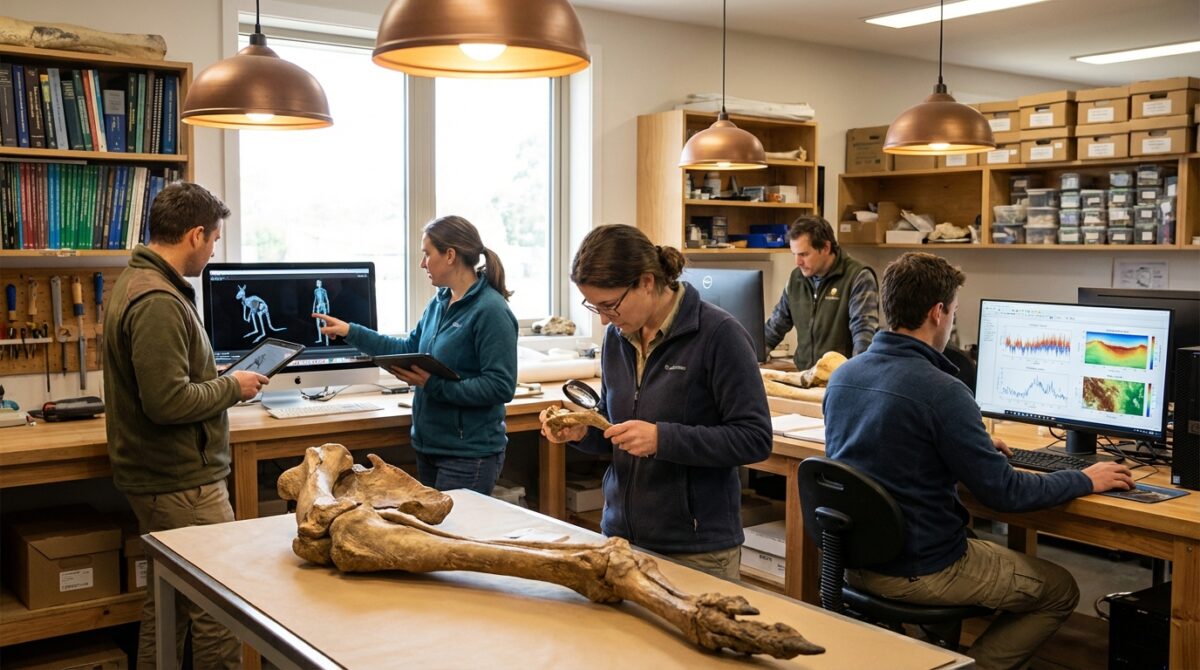
The team used a simple but powerful approach: compare bone size and shape in fossils with those of modern animals whose movements are already known. In one sentence, their method combined hindlimb measurements, body mass estimates, and biomechanical models to test how much stress the bones could safely bear during hopping.
Jones and colleagues examined 94 modern kangaroo and wallaby skeletons and 40 fossil specimens, covering 63 species in total. This broad dataset included members of the extinct genus Protemnodon, some of the most imposing giant kangaroos that lived in the Pleistocene, between about 2.6 million and 11,700 years ago.
Inside the bones: metatarsals, heels and tendons
At the centre of the analysis sits one key structure: the fourth metatarsal, the long foot bone that channels forces during hopping in living kangaroos. For each species, the researchers combined existing body weight estimates with this bone’s length and diameter, then calculated how much force it could safely withstand before failing.
The result surprised many in the field. Across all known giant kangaroos, the metatarsals appeared robust enough to handle the forces expected during fast, explosive hops. Reports in Popular Science and New Scientist underline how this overturns years of debate about whether sheer mass made these animals biomechanically grounded.
What heel bones reveal about prehistoric locomotion
The team also turned to the calcaneus, or heel bone, because it anchors the Achilles tendon, a structure that stores and releases elastic energy during hopping. By comparing fossil heel bones with those of modern species, they estimated how thick a tendon would need to be to handle hopping loads at very high body weights.
The fossil heels were large enough to support tendons wide enough for this job, suggesting a limb system that could power short, vigorous bounds. Coverage in Phys.org and Mirage News echoes the same message: anatomically, ancient Ice Age kangaroos had the hardware required for hopping, even if they did not use it constantly.
Short bursts of hopping, not marathon bouncing
The study does not claim that these prehistoric animals moved like modern red kangaroos over long distances. On the contrary, the models indicate that sustained, high-speed hopping would have been metabolically expensive for bodies approaching 250 kilograms. For daily travel across the Australian landscape, walking or a mixed gait likely made more energetic sense.
Instead, the authors suggest that hopping was probably situational. Brief, intense bursts could have been useful for crossing difficult terrain or evading danger. Accounts on ScienceAlert and Discover Magazine highlight exactly this point: hopping was likely one option in a flexible movement toolkit, not an all-or-nothing behaviour.
Predators, landscapes and why hopping still mattered
To understand why short hops could be valuable, imagine a fictional Pleistocene researcher, “Kara”, standing on an ancient plain in northern Australia. In the distance, a heavy-bellied Protemnodon grazes, while a Thylacoleo—the so-called marsupial lion—lurks nearby. When the predator charges, a few sudden hops could mean the difference between escape and a fossil in the making.
According to the authors, occasional hopping might have been most useful when: terrain was broken or rocky, predators launched surprise attacks, or rivers and gullies needed quick crossing. In these situations, a rapid burst of elastic-powered motion offered advantages that slow walking simply could not match.
What this means for evolution, fossils and modern science
From an evolutionary perspective, the study shows how a hallmark behaviour such as hopping may persist across a wide range of body sizes, rather than vanishing once a weight limit is reached. This nuance refines earlier claims that giant kangaroos represented a complete locomotor departure from their smaller relatives.
The work also illustrates how fossils continue to reshape living narratives about marsupials. Analyses like this influence how museums design exhibits and how documentaries frame Ice Age ecosystems. News coverage from ABC News and EurekAlert! has already started to adjust that public story.
Key insights, limitations and what remains unknown
Several points emerge from the research that matter for how you interpret these results:
- Bone strength indicates capacity, not behaviour: The study shows that hopping was mechanically possible, but does not prove how often it occurred in the wild.
- Body mass estimates carry uncertainty: Reconstructed weights for fossil animals include error margins, which influence force calculations and safety factors.
- Soft tissues do not fossilise well: Tendons and muscles are inferred from bone surfaces and modern analogues, so exact tendon size or muscle power remains an estimate.
- Environment and climate mattered: Changing vegetation, ground conditions and predator communities across the Pleistocene likely shaped how useful hopping really was in different regions.
These limitations do not invalidate the conclusions, but they frame them appropriately. The results strongly suggest, rather than conclusively prove, that ancient giant kangaroos could hop when they needed to. Future work combining digital simulations, trackway evidence and additional fossils may narrow these uncertainties.
How heavy were the ancient giant kangaroos studied?
Body mass estimates for the largest prehistoric kangaroos in the study reach about 250 kilograms, more than twice many modern red kangaroos. Earlier hypotheses suggested that animals above roughly 160 kilograms could not hop safely, but the new analysis indicates that their hindlimbs could still tolerate hopping forces in short bursts.
Did giant kangaroos hop all the time like modern species?
The study indicates that hopping was mechanically possible but probably not the dominant way these animals moved. Walking or mixed gaits were likely more energy efficient for long distances at such high body mass. Hopping was likely reserved for specific situations such as evading predators or quickly crossing difficult terrain.
What evidence supports the idea that they could hop?
Researchers examined the fourth metatarsal and heel bones of fossil kangaroos and compared them with modern species. Calculations of bone strength and inferred Achilles tendon size showed that both structures were robust enough to withstand forces typical of hopping. This anatomical evidence points to a real, though probably occasional, hopping ability.
Where did these prehistoric kangaroos live in Australia?
Fossil remains of giant kangaroos, including species of Protemnodon, have been found at multiple Pleistocene sites across Australia. These include open plains, woodland margins and riverine environments, suggesting that the animals inhabited varied landscapes where mixed locomotion strategies—walking plus occasional hopping—could have been advantageous.
What does this tell us about marsupial evolution?
How a Peruvian Peak is Turning into a Groundbreaking Particle Detection Frontier
Scientists Unveil the Secrets Behind Yeast’s Minuscule Centromeres
The findings suggest that the biomechanical foundation for hopping was retained even as some kangaroo lineages evolved to much larger sizes during the Ice Age. Rather than representing a complete break from their smaller relatives, giant kangaroos likely modified an existing locomotor strategy, using it more selectively in response to body size, terrain and predator pressure.