Show summary Hide summary
- How scientists turned methane gas into medicine
- A custom iron catalyst that tames free radicals
- From natural gas to a circular chemical economy
- What this methane-to-medicine breakthrough changes for patients
- How is this transformation of methane into medicines different from classical processes?
- Can this technology really reduce emissions from natural gas?
- What types of drugs could benefit from this innovation?
- How soon could this technology reach the pharmaceutical industry?
- Can this approach be applied to gases other than methane?
You heat your home with it, power factories with it… and soon, doctors could prescribe medicines made from it. Scientists achieve groundbreaking breakthrough: turning cheap methane from natural gas directly into life-saving drug ingredients.
Behind this advance, a team of European chemists decided to treat natural gas no longer as a mere fuel, but as a true mine of molecules. Their bet: to transform this abundant resource into useful chemical building blocks for medicine, rather than burning it and making climate change worse.
How scientists turned methane gas into medicine
At the heart of this story is the CiQUS lab at the University of Santiago de Compostela. Under the direction of Martín Fañanás, the research team showed it was possible to directly convert methane into bioactive compounds, thanks to an innovation in catalysis and light. The result was published in Science Advances, confirming the seriousness of this approach.
Scientists Unveil Breakthrough Diet to Burn Fat Without Exercise
Combined Impact of Insomnia and Sleep Apnea Significantly Elevates Heart Disease Risk
The researchers chose a particularly telling experiment: to directly manufacture dimestrol, a non-steroidal estrogen used in hormone therapy, from natural gas. Moving from a molecule as simple as methane to a sophisticated drug in just a few steps is a potential gamechanger for pharmaceutical chemistry. This is no longer theoretical; it’s solid experimental proof.
The allylation step that unlocks methane’s potential
To make methane usable, the chemists bet on a key reaction: allylation. They attached a small fragment, the allyl group, to the gas molecule, acting like a chemical handle. With this handle, the gas becomes a true molecular Lego, ready to be transformed into hundreds of different derivatives, including active pharmaceutical ingredients for medicine.
This seemingly simple step conceals a real challenge: methane is very stable, nearly inert. Achieving a selective transformation without generating a flood of byproducts has long been the nightmare of natural gas chemistry. The CiQUS method shows it is finally possible to escape this trap, with fine control over chain reactions.
A custom iron catalyst that tames free radicals
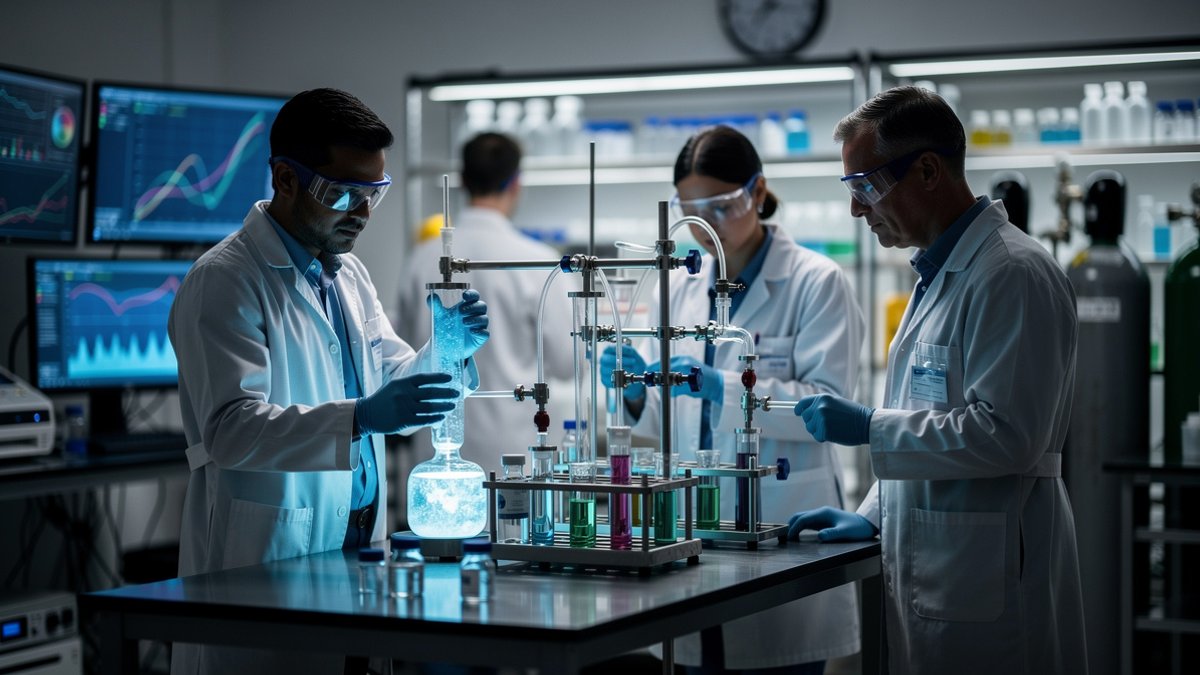
To achieve this breakthrough, the team designed a custom catalyst, based on a tetrachloroferrate anion stabilized by collidinium cations. Behind the jargon is a simple idea: using iron—abundant and low in toxicity—to generate highly reactive radicals, then channeling them in the right direction. A network of hydrogen bonds around the iron atom maintains reactivity while avoiding unwanted side reactions.
Without this control, the radicals would have caused runaway chlorination, ruined yields, and made the process unusable on a large scale. Here, the catalyst acts like a conductor: every radical finds its place, allylation proceeds smoothly, and the path to bioactive compounds is opened. This strategy aligns with other recent advances in methane catalysts that are reinventing the role of this gas.
Why iron and LED light matter for green chemistry
The choice of iron and LED light is anything but incidental. Many fine chemistry processes rely on rare, expensive, and sometimes toxic metals. Here, the iron + LED combination enables an innovation in photocatalysis that is easier to deploy in industry, with lower costs and greater environmental acceptability.
This kind of approach is part of a broader movement toward low-carbon chemistry. When teams use carbene metals to accelerate drug synthesis a hundredfold, as in some studies on carbene chemistry, or others explore the impact of radiation on simple gases, a new landscape for biotechnology and pharmacy emerges.
From natural gas to a circular chemical economy
To measure the scope of this work, imagine the fictional company GasMed Pharma. Today, it buys tons of natural gas solely to feed boilers. With the CiQUS strategy, it could divert part of this methane to photocatalytic reactors and locally produce high-value pharmaceutical intermediates. The same amount of gas, but a value chain that is much more profitable and much less polluting.
This vision is part of a broader European effort. The same CiQUS group, for example, showed in Cell Reports Physical Science that it is possible to directly combine natural gas and acid chlorides to obtain industrial ketones in a single step. Taken together, these advances outline the contours of a more circular chemical economy, where existing fossil resources are used to make materials and medicines rather than just fueling flames.
What this methane-to-medicine breakthrough changes for patients
For patients, the impact will not be limited to a nice lab story. Turning a cheap gas into complex molecules opens the way for shorter, more flexible production chains that are less dependent on petroleum. Labs can respond more rapidly to urgent demands for life-saving treatments, for example in the case of an epidemic outbreak or a sudden shortage of an active ingredient.
In the medium term, such innovation could also facilitate decentralized manufacturing of certain drugs, closer to hospitals or underserved regions. The scientists at CiQUS show that natural gas can become a versatile chemical platform. This new way of thinking about methane adds to the major scientific advances reshaping our daily lives, from climate to health.
Methane is no longer just a fuel, but a raw material for fine chemistry.
The iron catalyst precisely controls highly reactive radicals.
LED light and mild conditions reduce the energy footprint of the process.
Direct synthesis of dimestrol demonstrates the process’s pharmaceutical potential.
This breakthrough fuels the transition to a more circular chemical economy.
How is this transformation of methane into medicines different from classical processes?
Conventional processes often start from already-functionalized petroleum derivatives and involve several heavy steps. Here, the reaction starts directly from natural gas, using an iron catalyst and LED light to create a chemical handle (an allyl group) on the molecule. This reduces the number of steps, uses an abundant resource, and limits waste.
Can this technology really reduce emissions from natural gas?
It doesn’t eliminate the energy use of gas, but diverts some methane into making high-value molecules that remain trapped in products rather than being burned. By reducing the need for other fossil raw materials in fine chemistry, it contributes to a lower overall carbon footprint—especially if the energy for photocatalysis comes from renewable sources.
What types of drugs could benefit from this innovation?
The demonstrated example is dimestrol, a non-steroidal estrogen. However, the real strength of the process lies in creating versatile molecular building blocks from methane. These blocks can then be used to develop anti-cancer, anti-inflammatory, or antiviral drugs, as long as their structure is accessible via allylation.
How soon could this technology reach the pharmaceutical industry?
The published work is a proof of concept at the laboratory level. It will take several years to optimize yields, adapt reactors for industrial scale, and meet regulatory standards. Nevertheless, the use of a common metal like iron and LEDs makes scale-up more realistic than for processes relying on rare metals.
Can this approach be applied to gases other than methane?
Unveiling the Secrets of Aging: Mapping 7 Million Cells Across 21 Human Organs
Scientists Unveil a Bacterial Kill Switch That Could Revolutionize the Battle Against Superbugs
Yes, the CiQUS team is already working on other components of natural gas, such as ethane and propane, and has shown they can react with acid chlorides to form ketones. The general principle of gentle alkane activation by photocatalysis and iron catalysis could be extended to a wider range of gases, with applications beyond just pharmaceuticals.