
Show summary Hide summary
- AI mammograms shift the odds of aggressive breast cancer
- Inside the AI that reads mammograms alongside radiologists
- From trial results to real-world health technology decisions
- What AI mammograms mean for everyday patients
- Key ways AI supports better breast screening
- How do AI mammograms actually reduce aggressive breast cancer risk?
- Are radiologists still needed when AI is used in breast screening?
- Does AI increase false positives or unnecessary biopsies?
- Will AI mammograms work equally well for all women?
- When might AI-assisted breast cancer screening reach my country?
Imagine leaving a routine breast screening believing everything is fine, only to face an aggressive cancer diagnosis months later. A new generation of AI mammograms is quietly changing that story, cutting these missed cases and catching tumours when treatment is most effective.
At the heart of this shift lies a randomised trial in Sweden, where radiologists supported by machine learning tools are finding more cancers, while women screened this way face fewer dangerous interval tumours. This is not a future promise of health technology; it is already reshaping how risk is managed between screening rounds.
AI mammograms shift the odds of aggressive breast cancer
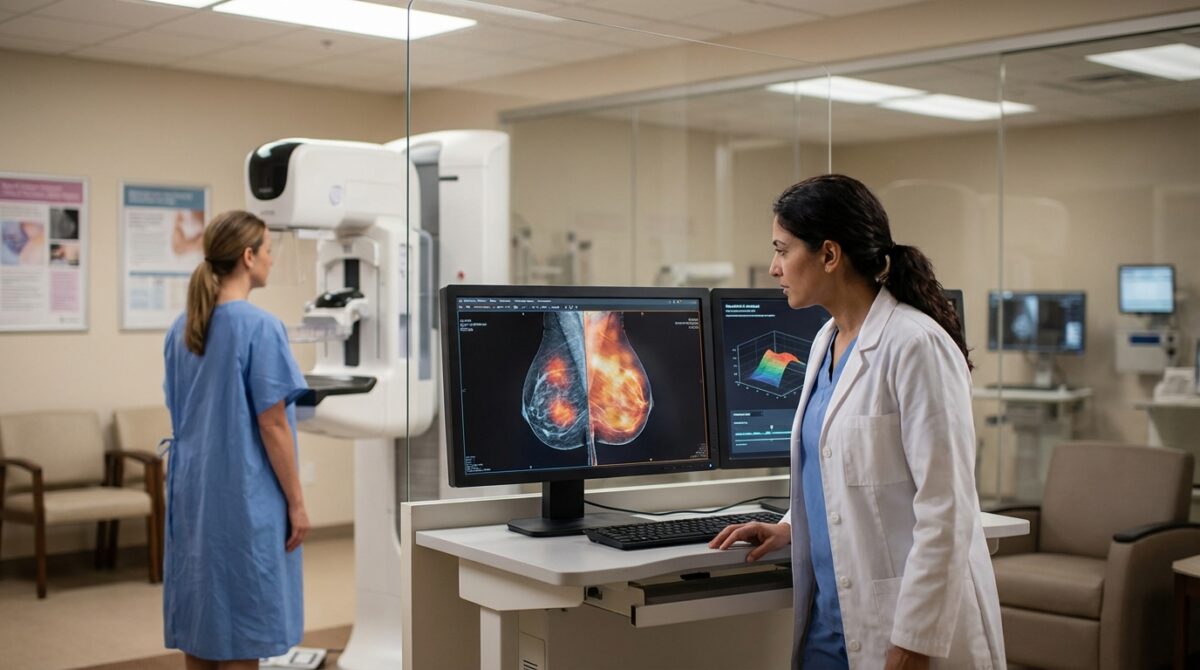
In southern Sweden, more than 100,000 women around 55 years old entered what researchers describe as the first fully randomised trial of AI-supported mammography. Half received standard double reading by two radiologists. The other half had their scans triaged by an algorithm trained on over 200,000 mammograms from ten countries.
Researchers Unveil Groundbreaking Insights into the Brain’s Memory Storage Mechanism
Innovative Tooth Powder Whitens Teeth Safely and Effectively
The outcome that caught oncologists’ attention was not only higher early detection, but a measurable risk reduction in interval cancers. Women in the AI-assisted group were about 12% less likely to develop these rapidly growing tumours between scheduled screenings, a result echoed in analyses reported by outlets such as The Guardian and New Scientist.
Why interval cancers matter for survival
Interval cancers grow fast in the gap between scheduled mammograms and are more likely to have spread beyond the breast by the time they appear. They are often the tumours that families describe as “coming out of nowhere”, even when screening programmes are in place.
By lowering the rate of these aggressive cases, AI-supported reading changes the balance between reassurance and risk in screening programmes. Instead of catching the cancer at a later, harder stage, the system is more likely to spot it when it is still confined and treatable, giving oncologists more options and patients a better outlook.
Inside the AI that reads mammograms alongside radiologists
The software used in the Swedish trial, developed by ScreenPoint Medical in the Netherlands, does not replace human expertise. It assigns each mammogram a score from 1 to 10, estimating the likelihood that breast cancer is present based on subtle visual patterns that medical imaging specialists know can be easy to overlook.
Images scored between 1 and 9 go to one experienced radiologist for assessment. Scans scored 10, where the probability of cancer is highest, are reviewed by two radiologists. Earlier work with this same system showed about 29% more cancers detected compared with standard double reading, without an increase in false alarms, a performance also highlighted in reports such as Scimex.
How machine learning changes cancer diagnosis workflow
The algorithm has been trained using machine learning on more than 200,000 labeled scans, enabling it to recognise densities, microcalcifications and asymmetries linked to malignancy. Instead of combing every image with the same intensity, radiologists can focus deepest attention on the highest-risk cases ranked by the AI.
This reshaping of workflow brings two advantages: it supports earlier cancer diagnosis and helps manage rising workloads as screening programmes expand. In practice, it means subtle early tumours that might have evolved into interval cancers are flagged and investigated when they are still small shadows rather than palpable masses.
From trial results to real-world health technology decisions
The Swedish team now expects the AI-supported system to be rolled out across south-west Sweden in routine screening. Other countries are watching closely, while running their own studies to understand performance in different populations, screening intervals and health systems, as covered by sources like The Independent and recent clinical reviews.
Health authorities must still answer difficult questions: how does this change costs, staffing and patient communication, and how does performance hold across diverse ethnic groups and body types? Some analyses suggest AI becomes economically attractive if it cuts interval cancers by at least 5%, a threshold already surpassed in this trial.
Keeping the human in the loop
Despite the promise of AI mammograms, women in focus groups consistently describe wanting a human expert involved in their screening decision. The Swedish researchers share this view, positioning AI as a tool that supports radiologists rather than an autonomous decision-maker.
This human-AI partnership matters clinically and psychologically. Trust in screening programmes depends not only on sensitivity and specificity, but also on the feeling that someone experienced is responsible for the final call, especially when discussing an aggressive cancer risk with a patient sitting in the consulting room.
What AI mammograms mean for everyday patients
For someone like Lena, a fictional composite drawn from many patient stories in Sweden, the difference is tangible. Her tiny tumour, barely a few millimetres, triggered a high suspicion score on the AI system. The radiologist, alerted by that ranking, ordered extra imaging and a biopsy, leading to early detection and a far less intensive treatment plan.
Stories like this give texture to statistics. A 12% reduction in interval cancers across a population translates into thousands of women avoiding late-stage diagnoses, aggressive chemotherapy courses, and the trauma that accompanies a surprise cancer discovery between routine checks.
Key ways AI supports better breast screening
For patients and clinicians trying to understand what changes in practice, several concrete benefits are emerging from the data:
- More cancers found during scheduled screening, including very small lesions that traditionally slip through.
- Fewer interval cancers, which are usually more advanced and harder to treat when finally discovered.
- More efficient use of radiologists’ time, focusing expert attention on the most suspicious images.
- Potential cost savings over time if earlier diagnosis avoids long, intensive treatment courses.
- Transferable algorithms for other imaging tasks, from lung nodules to cardiovascular risk assessment.
How do AI mammograms actually reduce aggressive breast cancer risk?
AI mammograms use machine learning to score each image for the likelihood of cancer. High-risk scans receive closer human review, helping detect small tumours that might otherwise be missed and later appear as aggressive interval cancers. By catching these lesions earlier, the overall rate of advanced cases between screening rounds drops.
Are radiologists still needed when AI is used in breast screening?
Yes. In the Swedish trial and similar programmes, AI supports, not replaces, radiologists. The system ranks mammograms by risk, but experienced clinicians make the diagnostic decisions, discuss findings with patients and decide on further tests or treatment. Patients consistently say they want a human specialist involved in their care.
Does AI increase false positives or unnecessary biopsies?
In the large Swedish randomised trial, AI-supported screening detected about 29% more cancers without increasing the false positive rate compared with standard double reading. That means more clinically relevant cancers were found, but women were not exposed to extra anxiety or unnecessary procedures at higher rates.
Will AI mammograms work equally well for all women?
Researchers are still studying performance across different ethnic groups, ages and breast densities. The Swedish trial drew from a relatively homogeneous population, so ongoing studies in the UK, North America and other regions aim to verify how well the algorithms generalise and whether they need local retraining.
When might AI-assisted breast cancer screening reach my country?
Are Humans Experiencing Genetic Decline and Cognitive Diminishment Over Time?
How Basic Questions Are Unlocking the Mysteries of Consciousness
Rollout depends on national trials, regulatory approvals and cost assessments. Sweden is preparing wider adoption after its trial, while other countries are conducting their own evaluations. Health agencies will consider clinical benefit, equity of access, training needs and budget before integrating AI into national screening programmes.