Show summary Hide summary
- Dutch Air Force brainwave project reshapes pilot training
- What the science reveals about brainwaves and pilot performance
- Inside the neurotechnology: from EEG signals to neural control
- From fighter cockpits to everyday applications on Earth
- Why this matters for the future of flight and safety
- How does the Dutch Air Force read pilots’ brainwaves during training?
- Does using brainwave-based AI actually improve pilot performance?
- Is this neurotechnology safe for pilots and can it be used in real aircraft?
- What are the potential civilian uses of brainwave-based training systems?
- How does this research relate to broader aerospace and defence trends?
Imagine flying a fighter jet in virtual reality while an AI quietly listens to your brainwaves, judges your stress level, then makes the mission harder without you realising. That is exactly what the Dutch Air Force has started testing to push pilot training into a new era.
This experiment, carried out with student fighter pilots, uses neuroscience to keep each mission on the edge of their abilities, where learning is most intense and mental focus is razor sharp.
Dutch Air Force brainwave project reshapes pilot training
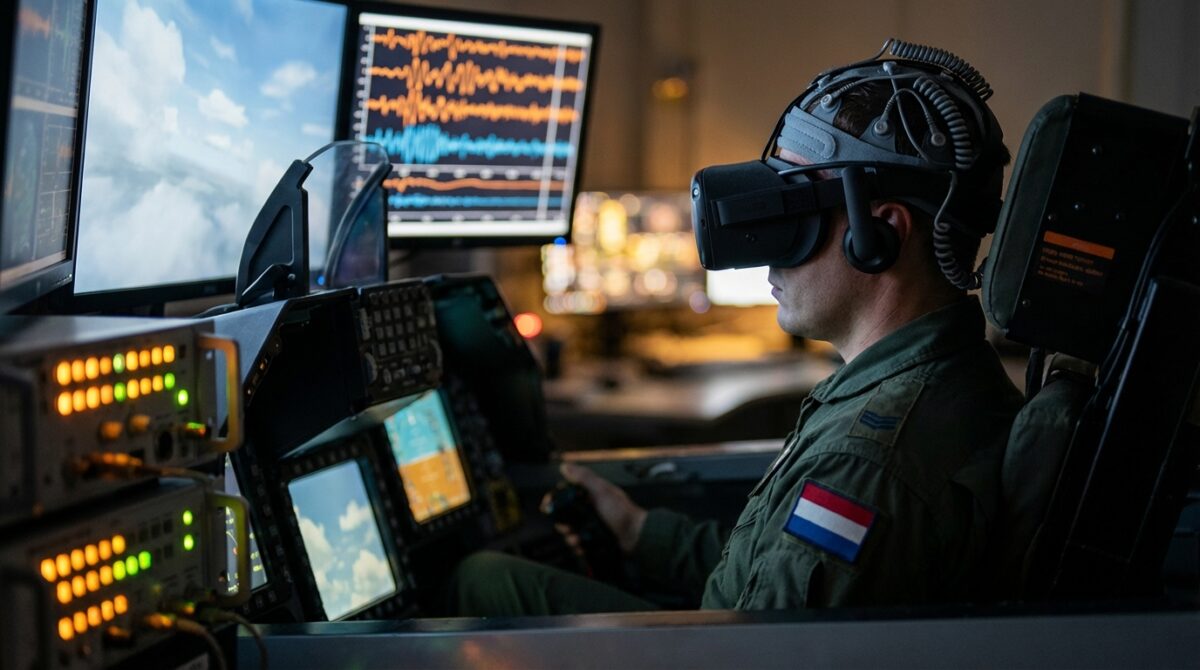
At the Royal Netherlands Air and Space Force, a group of fifteen trainee pilots stepped into high-end VR simulators for a series of air combat scenarios. Behind the sleek helmets and flight controls, electrodes on their scalps captured real-time electrical activity from the brain.
Researchers Identify Protein Potentially Repairing Leaky Gut and Alleviating Depression
How Alzheimer’s Disrupts Memory Consolidation During Brain Rest
Those signals were streamed to an AI model trained to read how demanding each task felt. When the algorithm detected that a mission became too easy, it ramped up the training challenges by reducing visual clarity in the simulation. When cognitive load peaked, it eased conditions slightly to prevent overload.
Adaptive scenarios that pilots barely notice
Strikingly, none of the pilots reported feeling the difficulty changes during the debrief. Missions seemed continuous and natural. Yet ten of the fifteen said they preferred this adaptive format over a classic, fixed syllabus where difficulty increases in pre-set steps.
The result hints at something subtle: pilots value training that “listens” to their minds, even when they cannot consciously sense the adjustments. This is where neurotechnology starts to blend almost invisibly into everyday aviation practice.
What the science reveals about brainwaves and pilot performance
The research team built on a decade of work decoding EEG signals to estimate workload and attention. Similar approaches have been used to separate novice from expert pilots, and even to help surgeons manage intense focus in the operating room, as explored in projects like brain-wave based training for pilots and surgeons.
In this Dutch experiment, the AI model was first trained on data from a different group of student aviators. It learned patterns associated with high and low cognitive strain, then applied those patterns to the new set of fifteen trainees in the simulator.
Why liking the system does not yet mean better pilots
Here comes the twist. When researchers compared performance scores, they found no clear improvement between the adaptive brain-driven system and a traditional, rigid exercise. Pilots enjoyed the smart simulator, but they did not fly better because of it, at least not yet.
One likely reason lies in the quirks of the human brain. Six participants showed almost no variation in how the AI rated their difficulty level, suggesting the algorithm was not interpreting their neural signatures correctly. This mirrors broader findings in cognitive research, such as those discussed in analyses of neural quirks behind auditory hallucinations: brains follow shared rules, yet each one has its own wiring.
Inside the neurotechnology: from EEG signals to neural control
The system relies on a non-invasive brain-computer interface. Lightweight electrodes capture EEG activity, particularly in frequency bands known to track attention and workload. The data stream then passes through a software decoder that transforms raw waves into a single difficulty index.
Whenever that index drops below a set band, the simulator reduces visibility, for instance by adding haze or lowering contrast. When the index spikes, conditions clear slightly. This creates a feedback loop where neural control indirectly shapes the environment without the pilot touching a dial.
Key components of the Dutch Air Force experiment
Seen from the cockpit of one of the trainees, call him “Mark”, the process feels straightforward: strap on a VR headset, fly interception missions, respond to threats. Hidden beneath that experience sits a full stack of aviation science. The main building blocks include:
- EEG headband and sensors that read brainwaves during every second of the sortie.
- AI workload model trained on previous pilots to estimate mental load on the fly.
- VR combat simulation that can instantly tweak visibility and task complexity.
- Performance analytics comparing adaptive and fixed training runs.
Research from other teams, including work on how automation levels influence cognitive workload and EEG patterns, suggests this type of loop could eventually integrate directly into real cockpits, not just simulators.
From fighter cockpits to everyday applications on Earth
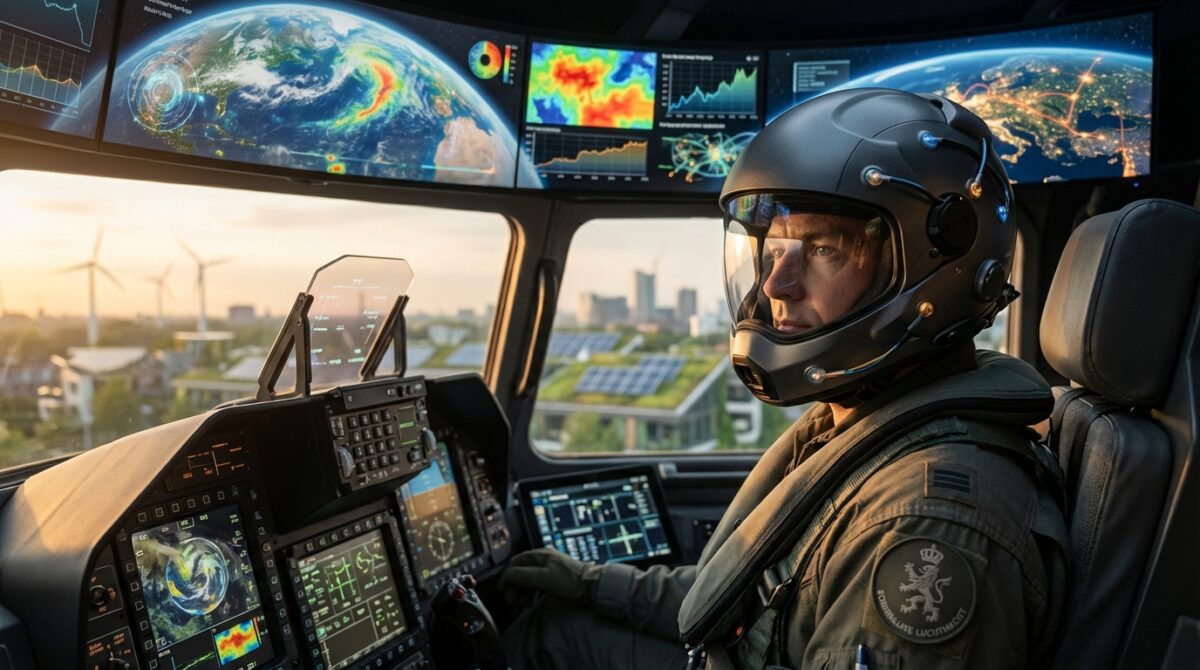
For now, the project sits inside simulators at the Royal Netherlands Air and Space Force, a modern branch of NATO defence. Yet its implications travel far beyond one country’s pilots. Reading brain activity to tailor difficulty could reshape how surgeons rehearse complex operations or how drone crews learn to interpret cluttered radar screens.
Studies on brainwave-based adaptive training and research into amping up brain function with stimulation show a wider shift: cognitive enhancement is no longer science fiction; it is edging into classrooms, hospitals and control rooms.
Why this matters for the future of flight and safety
The long-term ambition is clear. If aircraft can sense when a pilot is startled, overloaded or losing mental focus, onboard systems could momentarily help stabilise the situation or guide attention back to key instruments. Some labs already test prototypes that detect panic and gently nudge pilots back toward level flight.
For everyday travellers, that translates into another safety layer on top of automation and rigorous training. For industries beyond aviation, it signals a future where training software adapts to the mind, not just the mouse and keyboard. The Dutch experiment does not solve pilot performance overnight, but it opens a door to smarter, more humane training built around how the brain truly works.
How does the Dutch Air Force read pilots’ brainwaves during training?
Trainee pilots wear a VR headset combined with EEG electrodes placed on the scalp. These sensors capture electrical activity from the brain. An AI model analyses the incoming brainwaves in real time to estimate mental workload. When the model detects that a task is too easy or too demanding, it automatically adjusts the simulation difficulty, mainly by changing visual conditions such as haze or contrast, without the pilot having to do anything.
Does using brainwave-based AI actually improve pilot performance?
In the current experiments, pilots reported that they preferred the adaptive, brain-driven system compared with a rigid, pre-programmed syllabus. However, when researchers measured task success and flying accuracy, they did not observe a clear improvement. The lack of performance gains seems linked to how differently individual brains express workload, which can confuse AI models trained on other people. Future systems will likely need more personalised calibration.
Is this neurotechnology safe for pilots and can it be used in real aircraft?
The technology used in the Dutch trials relies on non-invasive EEG sensors and software, which makes it physically safe for pilots. The main challenges are technical and operational, not medical. Researchers are now studying how similar workload-detection algorithms could move from simulators into live cockpits to monitor stress, startle and attention. Before that happens, the systems must prove they are reliable, resistant to noise and do not distract crews during critical phases of flight.
What are the potential civilian uses of brainwave-based training systems?
How Denmark Eradicated Smallpox in Just 7 Years Through an 1800s Vaccination Campaign
How Yawning Secretly Affects the Fluid Dynamics Inside Your Brain
Beyond fighter aviation, decoding brainwaves could support training for surgeons, drone operators, air traffic controllers or even students in demanding STEM fields. By keeping exercises in a mental ‘sweet spot’, adaptive platforms might reduce burnout and speed up skill acquisition. Early pilots of this technology already appear in research on medical simulators and high-risk industrial roles, where mental focus and rapid decision-making matter as much as technical knowledge.
How does this research relate to broader aerospace and defence trends?
The Dutch brainwave project fits into a larger push to optimise air and space power through advanced simulation, AI and human-factor research. Policy analyses on modern air forces highlight the need to maximise the performance of smaller, highly trained crews. Neurotechnology becomes one more tool in that effort, complementing automation, unmanned systems and data-driven mission planning, while keeping the human pilot at the centre of decision-making.