
Show summary Hide summary
- LA plans high-tech subway to tame the 405 grind
- How the computer-controlled Sepulveda Corridor subway works
- From board vote to tunnel boring: real-world implementation
- Scalability, climate stakes, and LA’s transit future
- Limits, lessons and what it means for daily life
- When could the Sepulveda Corridor subway open to riders?
- How will the new subway line connect with existing LA Metro services?
- Will automation mean fewer staff and lower safety on trains?
- How is the $24–25 billion project being funded?
- What benefits can residents expect beyond faster commutes?
Forty minutes to travel 14 miles, sometimes 80 on a bad day. For people stuck on the 405 through the Sepulveda Corridor, time does not feel like a number, it feels like stress. Los Angeles is now betting tens of billions that a High-Tech, Computer-Controlled Subway Line can give those hours back.
At the center of this shift is a new north–south rail spine that aims to move everyday riders, not just transit enthusiasts, faster than cars have ever managed along this canyon of congestion.
LA plans high-tech subway to tame the 405 grind
The Los Angeles County Metropolitan Transportation Authority has approved preliminary designs for a 14‑mile, fully automated heavy rail line between Van Nuys and Santa Monica. Official board reports and coverage from outlets such as LA Public Press describe a project budgeted at about $24–25 billion, making it one of the largest Public Transit investments in U.S. history.
Satellites Reveal Hidden Flaws in Bridges Across America and Beyond
New Study Reveals AI Enthusiasm Amidst Poor Preparation
For commuters, the headline number is not the cost but the clock. The rail link is expected to cut today’s car journey of 40 to 80 minutes along I‑405 or Sepulveda Boulevard down to roughly 20 minutes. According to LA Metro’s project overview, more than 120,000 daily riders are projected, a figure closer to a busy European metro line than a conventional American commuter route.
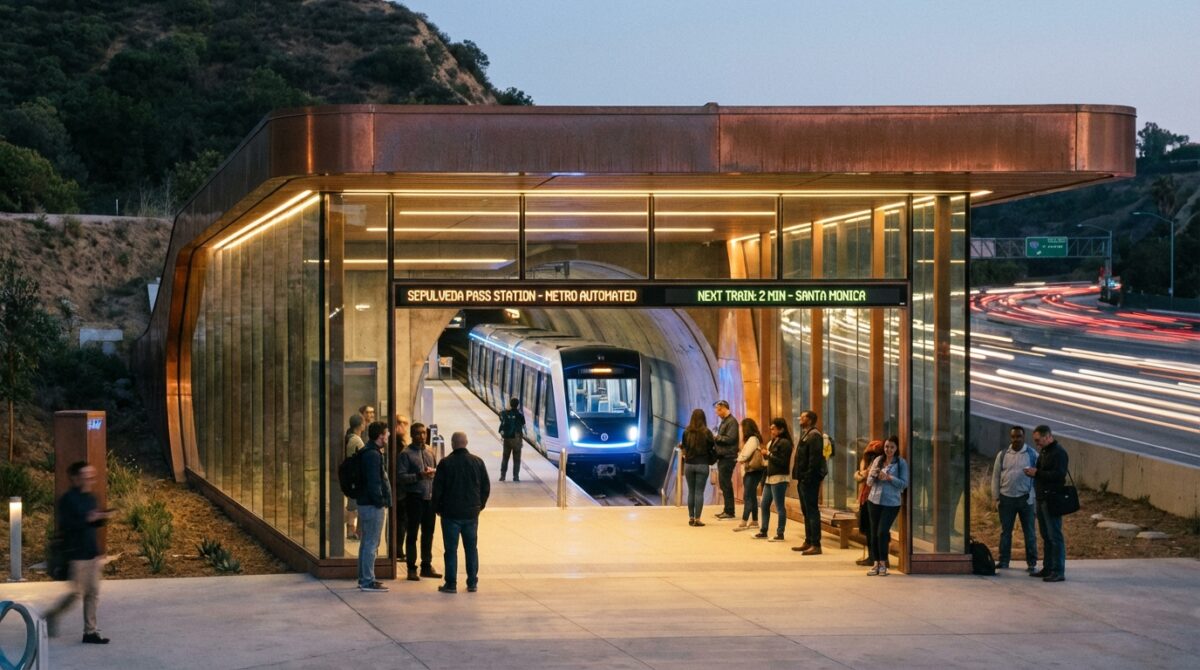
Street‑level frustration shaping urban mobility
Along the corridor, residents like a fictional nurse, Lucia, working split shifts in Santa Monica but living in the Valley, face daily uncertainty. Leaving home at 5:30 a.m. might mean a 35‑minute drive, or an hour and a half. Her story reflects why LA Metro’s board, as detailed by local television reports, has embraced a subway that runs under the mountains instead of squeezing more cars onto the freeway.
This project is part of a broader rethinking of Urban Mobility that also includes changing work patterns. Analyses such as research on remote work and urban traffic show that telework alone has not erased congestion. For Angelenos, the implication is simple: without a structural alternative to driving, lost time in traffic would likely persist for decades.
How the computer-controlled Sepulveda Corridor subway works
The chosen design, described in detail on the Sepulveda Transit Corridor page, is an all-underground heavy rail system using a single‑bore tunnel beneath the Santa Monica Mountains. This approach reduces surface disruption on neighborhoods that already shoulder the burden of freeway noise and air pollution.
Trains will run under automatic train control, making the line one of the most advanced pieces of Smart Infrastructure in the region. Automated operation enables very short headways, with peak service planned every 2.5 minutes. For riders, that means fewer packed platforms and less anxiety about missing “the one train” that gets them to work on time.
Automation, safety and integration with LA’s wider network
The Transportation system is being designed to knit together multiple lines. The corridor will connect to LA Metro’s light rail, the regional subway network, Bus Rapid Transit lines, and Metrolink commuter rail, allowing riders to cross the county without touching a steering wheel. According to regional transportation coverage, planners see this as the missing north–south backbone.
Automation is not only about speed. Computer control standardizes braking and acceleration, which supports smoother rides and more precise stopping, especially critical in a long tunnel. Experiences from systems in cities like Copenhagen and Vancouver suggest fewer delays and improved safety when trains operate under continuous digital supervision rather than manual driving.
From board vote to tunnel boring: real-world implementation
On-the-ground implementation follows a staged path. The LA Metro board’s unanimous decision, covered by outlets such as KTLA and Fox 11, locked in the underground rail option after evaluating six alternatives, including a monorail. That decision capped years of environmental review and public workshops documented on the project’s update portal.
Funding rests on a layered mix. Local voters have already contributed through countywide sales tax measures approved in 2008 and 2016. These revenues seed the project while LA Metro pursues substantial federal and state support. Coverage of new transportation funding legislation shows how national infrastructure programs can unlock grants for mega‑projects like this one, especially when they promise large climate and equity benefits.
Stakeholders and the human side of a $24 billion dig
Delivering such a project depends on cooperation among multiple actors. LA Metro leads planning and delivery, but the City of Los Angeles, Caltrans, neighborhood councils, and business groups all play roles, from permitting to station-area design. Private contractors will handle tunneling, station construction and rail technology, while community organizations push for station access, affordable housing near stops, and robust bus connections.
For families living along the corridor, the construction phase will be noisy and disruptive in places. However, the choice of a single-bore tunnel is intended to keep those impacts lower than a surface or elevated route. Environmental review documents, summarized by local reporting, indicate targets for reduced construction emissions and careful monitoring of noise and vibration near homes and schools.
Scalability, climate stakes, and LA’s transit future
The Sepulveda project is more than one line; it is a template. If high-frequency, automated rail can attract over 120,000 daily riders in car-dominated Los Angeles, other U.S. regions may see political space open for similar investments. Research into hidden ocean processes like dark oxygen production in the deep sea reminds us that climate systems are complex, yet transportation emissions remain one of the most direct levers cities control.
By shifting tens of thousands of daily trips from cars to a High-Tech subway, planners aim to cut pollution and improve air quality in neighborhoods that have carried a disproportionate health burden from freeway traffic. For low‑income riders who already rely on buses stuck in the same congestion as cars, the promise of a predictable 20‑minute Valley–Westside trip could expand job options and access to education.
Limits, lessons and what it means for daily life
The project still faces risks. Costs could climb beyond the projected $24–25 billion. Timelines could stretch as tunneling reveals unexpected geology, as has happened in other megaprojects worldwide. Some residents remain concerned about station locations, potential gentrification around new stops, and the long wait before opening day.
Yet the broader lesson for people living in cities is clear. When a region commits this scale of funding and political capital to Automation-driven rail instead of more asphalt, it signals a shift in priorities: from moving cars to moving people. For riders like Lucia, the real innovation is not the computer in the control room but the quiet, predictable train that lets her trade time in traffic for time at home.
- Travel time: 40–80 minutes by car today, about 20 minutes by automated rail when complete.
- Length: 14 miles of all-underground heavy rail through the Sepulveda Pass.
- Ridership: Over 120,000 daily riders projected by LA Metro.
- Cost: Approximately $24–25 billion from local, state and federal sources.
- Service: Trains every 2.5 minutes at peak, managed by computer control.
When could the Sepulveda Corridor subway open to riders?
LA Metro is still refining the schedule, but large underground projects of this kind typically take more than a decade from early design to opening. After the recent approval of the all-underground route, the next milestones include final environmental clearance, detailed engineering and tunneling contracts before construction on the main bore can begin.
How will the new subway line connect with existing LA Metro services?
The line is planned to link with several existing and future Metro services, including the San Fernando Valley lines, the regional subway network and Bus Rapid Transit routes, as well as Metrolink commuter rail. These interchanges are designed to allow riders to travel across Los Angeles County with a single integrated system, reducing the need for car trips to job centers and campuses.
Will automation mean fewer staff and lower safety on trains?
Evidence from other automated metro systems suggests the opposite. Computer-controlled operation reduces human error in driving, stabilizes speeds and braking, and improves adherence to schedules. Staff roles shift from driving to station support, customer service and system monitoring. Safety oversight remains with agencies and regulators, while automation handles repetitive driving tasks.
How is the $24–25 billion project being funded?
How One City Boosted Bus Speeds by 20% with AI
Kansas City Missouri Leads with New Data Center Ordinance
Two LA County sales tax measures passed in 2008 and 2016 provide a dedicated stream of local funding. These revenues help attract significant state and federal grants. LA Metro has also explored options such as public–private partnerships to manage risk and financing. The final mix will balance local responsibility with national infrastructure support.
What benefits can residents expect beyond faster commutes?
Residents along the corridor can expect cleaner air from reduced car dependence, improved traffic safety, and new opportunities around stations, such as housing, services and public spaces. For many lower-income households, reliable high-capacity Public Transit can expand access to jobs, schools and healthcare without the high costs of car ownership and parking.